Shoes & Apparel

Best Running Insoles of 2026

Cushioning is easy to add; room inside a running shoe is not. Slide a thick, plush insole into your favorite trainer and your heel lifts a little, your toes press the upper, and the shoe that fit last week suddenly feels tight. That's why the best running insoles are as much a fit decision as a comfort one — what a good pair actually fixes is the support underfoot your shoe's flimsy stock liner never had, without stealing the volume your foot needs to land and push off.

A dull ache under my right arch is what pushed me to start swapping insoles in the first place. My team and I have since put 14 pairs through six months of easy runs, tempo days, and long weekend efforts, and the winners were decided by how each pair sat inside a shoe, not by how thick the foam looked on the box. One thing first-time buyers rarely hear: give a new pair two or three short runs before you take them long — the ones that feel firm at the start line are usually the ones still working at mile 20. Below you'll find deep, corrective-feeling arch support alongside soft, low-volume cushioning.

#1

CURREX RunPro

Top Pick
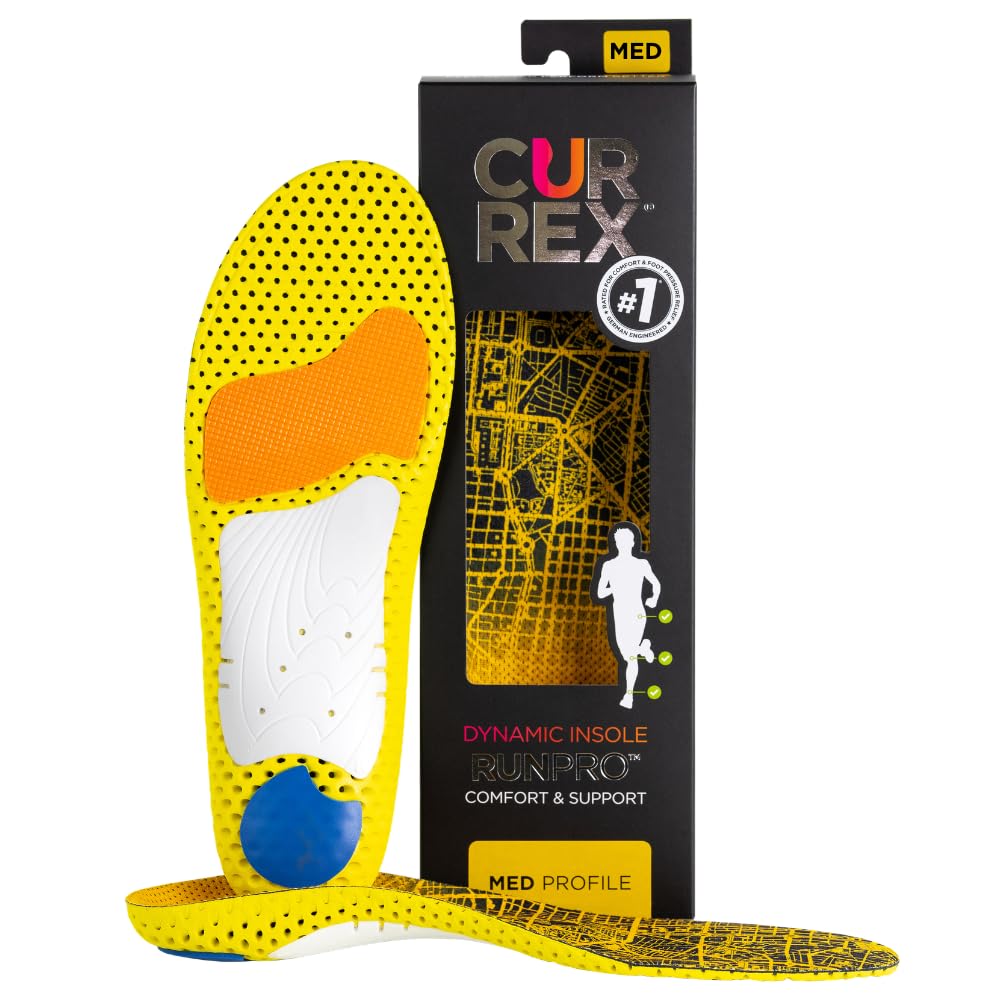
CURREX RunPro

Running-specific support

Our Score 9.0/10
Check Price

Worth Noting

  • Ordering means choosing both a size and an arch profile
Sizing
Size Large, medium arch
Heel Cup
Deep and decoupled
Top Layer
Mesh over PORON foam
Arch Profiles
Low, medium, high
Read the full review

Most insoles on this list come in one shape and hope it suits you. The RunPro asks a question first: the line is built in low, medium, and high arch profiles, and the version we cover is the medium in a size large. That matters more than any other feature here, because an arch shell sitting too high under a flat foot is exactly what makes runners decide insoles don't work for them.

The rest of the build is running-specific rather than athletic-general. A deep, decoupled heel cup centers the foot at landing, a mesh top layer sits over PORON foam to deal with sweat, and the profile stays low enough under the forefoot that you can still feel the ground at push-off. What struck us was the volume: it is slim enough that a dialed-in shoe still laces up the same way, with nothing pressing across the instep. That is the line between an insole you leave in and one you pull out after a week.

It is the pick we hand to a runner who wants one pair to do everything — daily miles, tempo, the long run. The part that takes a minute is the ordering: low, medium, and high are genuinely different shapes rather than marketing tiers, and the profile you choose is doing as much work as the foam does. Runners who have bounced off three pairs that felt wrong usually find the answer in that choice.

Bottom line: Our pick for most runners: the arch profile actually matches your foot, and the slim build leaves your shoe fitting the way it did.

#2

Sof Sole Athlete

Sof Sole Athlete

Replacing worn insoles

Our Score 8.8/10
Check Price

Worth Noting

  • Foam compresses sooner than the premium pairs
Sizing
Men's
Moisture
Top-cover moisture control
Materials
PU foam and gel
Cushioning
Heel to toe
Read the full review

A running shoe's factory insole is a flat sheet of foam with a job it quietly stops doing after a few hundred miles. Dropping the Athlete in is the least fussy fix in this group: PU foam with gel through the heel and forefoot, a moisture-controlling top cover, and enough give that the shoe feels new again without turning mushy.

We like the middle it occupies. Some insoles here are soft to the point of vagueness and the Superfeet is a rigid shell; the Athlete sits between, firm enough that your foot does not roll inward on landing and soft enough that the ball of your foot is not aching at the end of an easy ten. It is also sized to the shoe, so most runners will not need scissors, and it is the pair we hand to someone who just wants their trainers to feel better without researching arch profiles.

Volume is the catch. This is a substantial insole, and in a snug racer or a shoe you bought with no wiggle room it takes the space your toes were using. In a roomier daily trainer it disappears underfoot. If your shoes are already tight, size up in the shoe or choose something slimmer rather than forcing it.

Bottom line: Buy it if you want your running shoes to feel cushioned again without thinking about arch profiles or trimming.

#3

Superfeet High Impact

Superfeet High Impact

Firm arch support

Our Score 8.8/10
Check Price

Worth Noting

  • Premium price for a single pair
Fit
Trim to size
Sizing
Women's
Support
High-impact shell
Read the full review

The High Impact is the firm one. Put a thumb into the arch of any other pick here and it gives; this shell resists, holding a rigid cradle that keeps its shape when you land on it. That resistance is the whole recommendation. Soft foam absorbs an impact, but it cannot stop a foot from rolling inward, and for some runners that roll is the problem.

It is the pick with the strongest record on foot pain in this set, and plantar fasciitis is the case it is known for. The heel is held without pressing on the ankle bones, which is rarer than it sounds, and trimmed to the shoe it sits flat and stays put instead of creeping forward mid-run. Runners who have spent years buying cheap inserts and replacing them twice a season tend to end up here eventually.

The trade-off is feel, and it is worth being honest about. There is little padding under the ball of the foot, so a runner who wants a plush landing will find this hard and wonder what the fuss is about. It is built to control motion, not to soften the road — if softening the road is the goal, the Sof Sole and the Spenco do that job in this group.

Bottom line: We recommend it when you need a foot held rather than pampered — firm, structured, and built for arches that collapse.

#4

Dr. Scholl's Run Active

Dr. Scholl's Run Active

Women's budget pick

Our Score 8.8/10
Check Price

Worth Noting

  • Modest arch support and cushioning
Arch
Reinforced arch support
Design
Three-zone heel to toe
Sizing
Women's, trim to fit
Odor Control
Polygiene StayFresh
Read the full review

This is one of two women's-specific picks here and the only one aimed squarely at running. Dr. Scholl's builds it on a women's pattern with a three-zone heel-to-toe layout — softer at the heel, reinforced through the arch, cushioned at the forefoot — which smooths the transition from landing to push-off rather than propping the foot up in one spot.

Polygiene is the detail we did not expect to care about. Insoles live in the dampest corner of your kit, and a pair that goes sour gets binned long before the foam is finished; the treatment here targets exactly that, and it is the reason a second pair for the gym bag is easy to justify. In a hot shoe on a summer run, that counts for more than it sounds.

Where it earns its place is as the low-risk entry point. It is cut for women's shoes rather than shrunk down from a men's pattern, so it does not bunch through the midfoot in a narrow trainer, and the ride stays predictable over the shorter daily run or the treadmill session. Runners chasing a marathon or a high arch should look at the CURREX instead; this one is for getting started and staying comfortable.

Bottom line: A sensible first insole for women runners: women's-specific shaping, odor control, and a gait-friendly roll without a steep learning curve.

#5

Dr. Scholl's Sport

Dr. Scholl's Sport

All-around budget

Our Score 8.8/10
Check Price

Worth Noting

  • Not shaped specifically for running
  • Top cover wears through before the foam
Use
Multi-sport
Arch
Flexible side-to-side support
Sizing
Men's
Read the full review

The Sport is the generalist of this group. Dr. Scholl's builds it as an athletic insole for multiple sports rather than one, and that is how it behaves: gym shoes, walking shoes, hiking boots, a round of golf. Few of the running-specific picks here can move that widely, and the ones that can usually give up cushioning to do it.

It lands closer to a comfort insole than a performance one. The arch is a flexible, moderate shape with side-to-side give rather than a formed cradle, and the cushioning is a broad foam bed instead of a tuned heel-and-forefoot layout. For the runner who owns one pair of shoes and uses them for everything, that is the right compromise; for anyone chasing a personal best, it is not the tool.

It is generous through the length, so larger feet have room to work with, and it trims down easily for a smaller shoe. What we keep coming back to is the versatility: this is the pair that makes a retired set of running shoes wearable for the dog walk, which is the least glamorous and most useful thing an insole can do.

Bottom line: We keep a pair for the shoes that do everything — gym, errands, hiking — but it is a generalist, not a running specialist.

#6

Spenco Polysorb Cross Trainer

Spenco Polysorb Cross Trainer

Soft shock absorption

Our Score 8.8/10
Check Price

Worth Noting

  • Thick heel lifts the foot inside the shoe
  • Narrow through the midfoot for wide feet
Foam
Polysorb
Heel
SpenCore heel pad
Forefoot
Crash pad
Heel Cup
Deep
Read the full review

Polysorb foam is the soft end of this group. Spenco puts a SpenCore heel pad and a forefoot crash pad under a light foam body, and the result takes the edge off hard pavement instead of trying to control how your foot moves. The deep heel cup is the part you notice on a sidewalk — it keeps the foot centered without gripping it.

The arch is a soft rise rather than a hard shelf, which is why runners who cannot tolerate firm insoles get along with this one. The shape is a cross trainer rather than a running-specific last, so it settles into a gym shoe or a walking shoe as happily as a daily trainer, and the forefoot padding is where the softness pays off on longer pavement stretches.

The line we draw is between sensitive feet and unstable ones. If your feet bruise on hard ground or your heels complain after a week of concrete, this is the pair to try. If your foot rolls inward and needs holding, no amount of soft foam fixes that, and the firm Superfeet shell is the better answer.

Bottom line: Our softest-riding pick, best for sensitive feet and sore heels rather than for a foot that needs holding.

How We Tested: Six Months, 14 Pairs, a Lot of Miles

We started with a shortlist of roughly 40 insoles sold for running, then cut it down using the specs that actually change how a pair behaves in a shoe: arch height, thickness in millimeters, heel cup depth, and whether it replaces the stock liner or stacks on top of it. Anything priced above a decent pair of running shoes, or built on a shape that wouldn't fit a standard trainer, came off the list. That left 14 pairs, run in over six months.

Each pair went into at least two shoes — a neutral daily trainer and a firmer tempo shoe — and logged treadmill intervals, weekend long runs on pavement, and one rainy 10K. Because thickness eats volume, we also wore every insole in a shoe a half size small to see whether it pushed the foot up into the upper or forced the laces loose.

Arch support was judged under load rather than standing still: did the arch shell hold at push-off or roll flat, and did the heel cup keep the foot from sliding forward on downhills? Comfort and foot relief we tracked the unglamorous way, noting how the first steps out of bed felt the morning after a long run and whether an achy arch faded over the first month or simply moved somewhere else.

Durability got checked at roughly 50 and 100 miles, when we pulled each pair out to look for flattened forefoot foam, a compressed heel, and peeling top cloth. That's also where value surfaced — a cheap pair that's done at 150 miles costs more per mile than a pricier one that lasts a season. The top performers are still in rotation, and we'll update as they wear.

How to Choose Running Insoles

Start With Your Arch, Not the Label on the Box

Arch support is the most argued-about subject in this category, and the argument is almost always about match rather than quality. A support shell built for a high arch feels like a stone under a flat foot; a flat slab leaves a high arch with nothing to sit on. Neither product is bad — they are simply answering different feet.

Check yours before you shop. Wet the sole of your foot, stand on a paper bag, and look at the print: a narrow band through the middle means a high arch, a wide band means a low one. Then choose a design that offers your profile, like the CURREX line's low, medium, and high versions, or one built to hold a foot that collapses, like the Superfeet shell.

The Room in Your Shoe Sets the Limit on Thickness

Every insole borrows volume from the shoe, and running shoes are already close-fitting. A built-up insert in a snug racer pushes the top of your foot into the laces and effectively shortens the shoe. This is the most common reason a perfectly good insole ends up in a drawer.

Test it before you commit: take the original insole out, drop the new one in, and lace up. Pressure across the instep means the insert is too much for that shoe. Roomier daily trainers can absorb a thicker insole; racing flats and shoes you bought snug want something slim, which is where the CURREX's low profile earns its keep.

Decide Whether You Want Cushioning or Structure

These are different jobs, and the picks here split along them. Cushioning — the gel and foam in the Sof Sole, the Polysorb in the Spenco — absorbs impact and suits a runner whose feet ache after long pavement miles. Structure, like the Superfeet shell or the CURREX arch cradle, controls how the foot lands and suits a collapsing arch or a plantar fasciitis flare.

Getting this wrong is why people give up on insoles. A soft insert does nothing for a foot that needs holding, and a rigid one feels punitive if all you wanted was a softer landing. Name your problem first — impact or control — then shop.

Trim to the Shoe, Not to the Size on the Box

Many insoles arrive long and expect scissors. Pull the shoe's original insole out, trace it onto the new one, and cut the toe end only — shorten the heel or the arch and the support ends up in the wrong place under your foot. Cut a little, test it in the shoe, then cut again; material comes off far more easily than it goes back on.

A small gap at the toe is fine and changes nothing about how the insole works. If your shoe's original insole is glued in and will not lift out, treat that shoe as a poor candidate rather than forcing a second layer on top.

Frequently Asked Questions

Final Verdict

The CURREX RunPro is the one we point runners to first. It is the only pick here built around your arch profile rather than one universal shape, it is slim enough that the shoe still fits the way it did before, and it holds a line between the Sof Sole's softness and the Superfeet's rigid shell.

If you already know you need firm, structured support — a collapsing arch, a plantar fasciitis flare — the Superfeet is the better buy and the premium is justified. If cushioning is the whole point and you want to spend as little as possible, the Sof Sole Athlete is the pair to put in the shoe.