Recovery

Best Portable Massage Chairs of 2026

A portable massage chair pulls in two directions at once: it has to fold down light enough to carry one-handed, and it has to stay planted when a client leans their full weight into the face cradle. Get the hinge or the leg geometry wrong and you feel it right away — a rock at the front edge, a cradle that won't tilt far enough for a shorter client. What separates a chair you keep hauling to events from one that lives in the closet is rarely the padding; it's how the frame locks and whether setup still takes one person two minutes after the fiftieth time.

We've spent the past eight months with 10 of these chairs — setting them up in conference rooms, at a wellness fair, and in my own living room — and the quality gap at similar prices surprised me. Something first-timers don't know: cradle angle matters more than cradle cushion, since most neck complaints come from a pad that sits too flat. The picks below held up to real bodies, real trunks, and being handled by people in a hurry.

#1

EarthLite Vortex

Top Pick
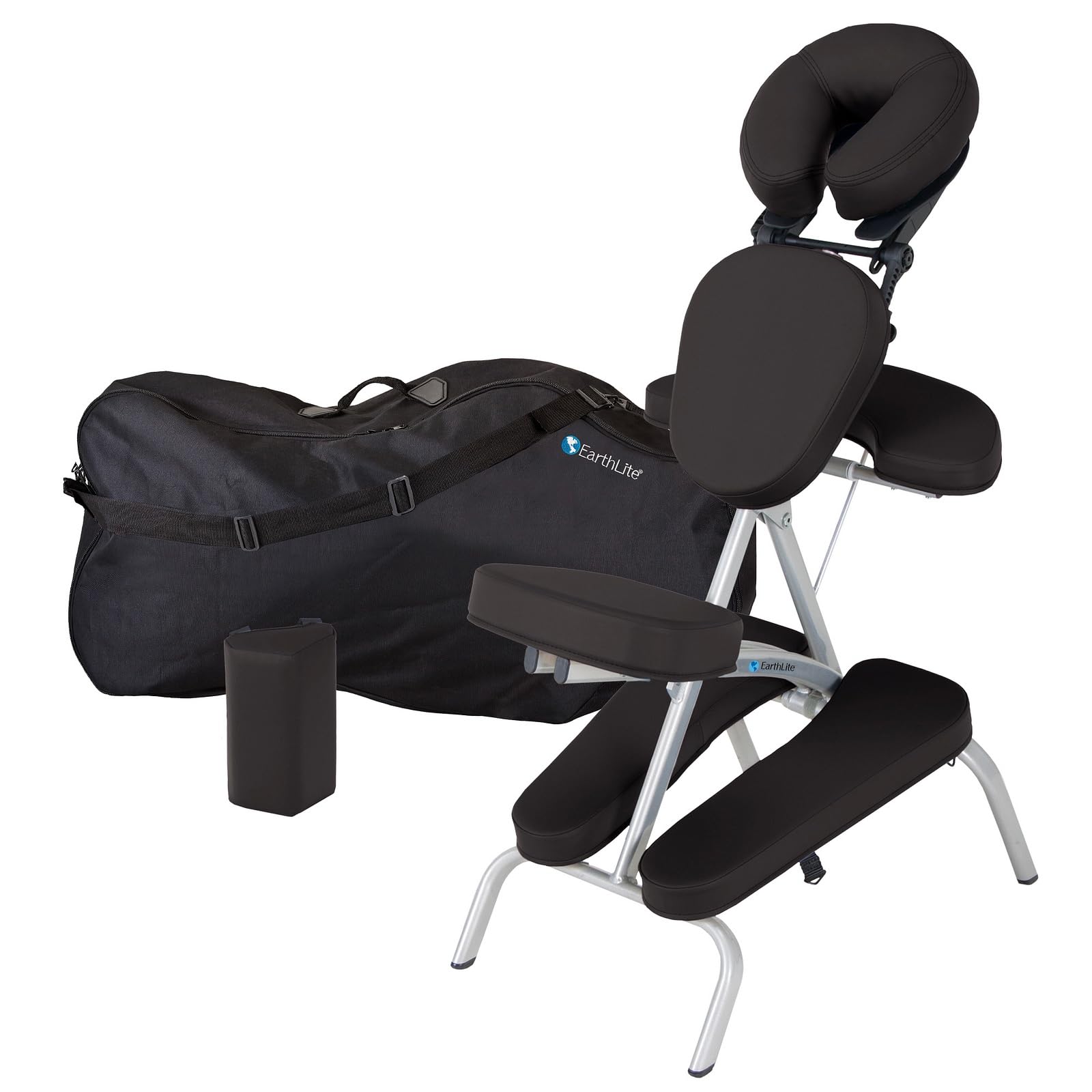
EarthLite Vortex

Mobile solo therapists

Our Score 9.2/10
Check Price

Worth Noting

  • No credible published working weight
Frame
Oval-tube aircraft aluminum
Weight
15 lb
Included
Carry case, sternum pad, face cradle, face pillow
Recline Positions
3
Read the full review

Fifteen pounds is the figure that decides this chair for us. That's the Vortex's stated weight, and it's the lightest in this group — light enough to carry in one hand with a tote of oils in the other, which is the difference between accepting a solo house call and passing it to someone with a car. The oval-tube aluminum frame clicks into a locked position and drops back flat when you're done, and it never needed a second pair of hands to do either.

Three recline positions is a feature no other chair here matches; the rest lock into a single forward angle. We came to value it for clients who can't hold a forward lean for twenty minutes without their neck complaining — tipping them back a notch keeps a session going when a flat angle would have them fidgeting. The package includes a sternum pad and strap along with the face cradle and pillow, so you're not buying support pieces separately a week later.

There's no wheeled case here, and at this weight we didn't miss one; the StrongLite needs its wheels at 24 pounds, and this one doesn't. The soft case takes the folded frame and the cradle and goes over a shoulder. The parts you handle on every setup — the cradle clamp and the hinge locks — still snapped into place with a positive click after a dozen folds, and that's the thing we watch hardest on a folding frame.

Bottom line: Our pick for most therapists: at 15 pounds it's the easiest chair here to carry alone, and the three recline positions keep clients comfortable who can't hold a forward lean.

#2

StrongLite Ergo Pro II

StrongLite Ergo Pro II

Mixed-size clientele

Our Score 9.2/10
Check Price

Worth Noting

  • Small wheels can tip the folded chair on rough ground
Weight
24 lb
Included
Carry case, face pillow, platform
Fits Clients
4' 6" to 6' 6"
Working Weight
600 lb
Read the full review

Six hundred pounds of working weight and a stated fit range of 4' 6" to 6' 6" — no other chair in this group publishes either number, let alone both. That range is the whole argument: if you never know who's sitting down next, you want the chair that has already answered the question.

We keep coming back to the seat. It's the roomiest of the four, and the height-adjustable seat and pivoting armrests let you bring the chair to the client instead of asking a stiff-shouldered office worker to shuffle into position. The heat-treated T6 aluminum double-tube frame is also the stiffest of this set, and there's a reason this is the only chair here rated for work the others aren't.

Twenty-four pounds is what that capacity costs — nine pounds more than the Vortex — and it changes how you travel: the attached wheels and ballistic nylon case turn the folded chair into something you pull rather than carry. Set the armrests and the seat locks deliberately rather than in a hurry; they hold once seated, and a rushed setup is what leaves them loose.

Bottom line: Buy this if your clients range from teenagers to linebackers: no other chair here publishes a 600-pound working weight or a 4' 6" to 6' 6" fit range.

#3

Master Massage Chair

Master Massage Chair

Therapists who travel

Our Score 9.0/10
Check Price

Worth Noting

  • Seat and chest pad adjust less than the cradle
Frame
Aircraft-grade aluminum
Weight
15.2 lb
Included
Wheeled carry case, session pouch
Face Cradle
Six-way adjustable
Read the full review

A wheeled case sounds like a small thing until you're parking four blocks from a hotel conference room. Fifteen pounds on a shoulder for four blocks is a decision you make twice; fifteen pounds rolling behind you is not. That case is why this Master Massage chair is the one we reach for on city and event work, and it's the closest thing here to our top pick on build for a little less money.

The frame is aircraft-grade aluminum under royal blue polyurethane, and the upholstery shrugs off oil and lotion with a warm cloth — useful if you move between massage and tattoo clients in the same afternoon. The six-way adjustable cradle is the better half of the package: height, tilt, and angle move independently, so a short client's face lands in the pad without a folded towel propping them up. The little session pouch for glasses and phones is the sort of detail that saves you hunting under the chair at the end of an appointment.

Adjustability is where this one has a ceiling. The cradle has plenty of travel, but the seat and chest pad don't move as far as the StrongLite's, and a big client can end up feeling packed in rather than settled. If your book skews large, that matters more than the wheels do.

Bottom line: The one we take when the job involves a walk: a 15.2-pound frame in a wheeled case, with a six-way cradle that positions clients a fixed cradle can't.

#4

JupiterForce Massage Chair

JupiterForce Massage Chair

Light-duty home use

Our Score 8.8/10
Check Price

Worth Noting

  • Cradle clamp can creep down mid-session
Frame
Powder-coated aluminum
Dimensions
23"D x 18"W x 42"H
Weight Capacity
250 lb
Height Adjustable
Yes
Read the full review

Cheapest isn't a compliment in a category where the chair holds someone's head a few inches off the floor, but it's worth knowing what the bottom of the range buys. At 250 pounds of rated capacity this is the lightest-duty chair here, and it puts a powder-coated aluminum frame, wipe-clean PU leather, and a 42-inch overall height into the same footprint as the pro chairs for a fraction of the money.

For a home studio, a tattoo setup in a spare room, or a chair that lives in the car for the occasional stall, it does the job. We like the wipe-clean surface for ink and oil, the fact that it arrives assembled apart from the headrest, and the bag, which is small enough to stand in a closet. The 250-pound rating is the number to respect here — this isn't the chair to put a 300-pound client in.

Where it shows its price is the frame. Under a heavier client the hinges flex more than they do on the EarthLite or the StrongLite, and the chair sits low with less height travel than the listing's height-adjustable line suggests — workable from a stool, awkward if you like to stand over a client. Give the hinges a few open-and-close cycles when it arrives and listen for a clean click at each joint before you trust it with anyone.

Bottom line: The cheapest way into a folding massage chair. Good for a home studio or the occasional market stall; the frame and cradle hardware won't take a full professional week.

How We Tested Portable Massage Chairs

We began with a shortlist of around 30 chairs, filtered by three specs a shopper can actually check before buying: published weight capacity, folded dimensions, and whether replacement pads, cables, or hinges were sold separately. A chair with no parts support becomes disposable the first time a lever snaps, so that cut the field fast, as did any model too heavy for one person to carry up a flight of stairs. Ten made the cut, and each one has been in rotation for eight months.

Setup and breakdown got timed with a stopwatch, solo, the first time out of the box and again after a month of repeated use — we counted how many knobs had to be turned and whether the frame locked open with one hand or needed two. Every chair was carried one-handed from a car trunk through a standard doorway and up a flight of stairs, then weighed on a luggage scale to check it against the listed spec. Stability got the harsh test: we leaned a full body weight onto the face cradle, shifted side to side, and sat forward on the knee pads on carpet, hardwood, and grass to see whether the front legs lifted.

Comfort was judged over full 20-minute sessions, with testers at 5'2" and 6'2", noting where frame rails pressed through padding at the chest and knees and whether the cradle tilted far enough to keep the neck neutral. Quality showed up over time — loose bolts, flattened foam, stitching that pulled at the seams — and value came down to whether a carry bag, spare pad, and clear instructions were included. The chairs that stayed in the trunk were the ones that set up in under three minutes and never made a client feel like they were sitting on a frame.

How to Choose a Portable Massage Chair

Carry Weight Decides More Than Any Other Number

Fifteen pounds is a shoulder bag; twenty-four pounds is a case with wheels. That's roughly the spread across these chairs, and it maps onto how you work. A therapist doing house calls and office visits wants the lightest frame that still holds a client, while someone driving between venues can trade weight for capacity and let the case roll. We put more stock in published weight than any other figure on the box, because it's the one you meet every single day.

Watch the word compact. In a listing it usually describes the folded shape in a closet or a trunk, not how the chair behaves on a flight of stairs or a two-block walk. Folded, these chairs are long — think guitar case rather than suitcase — so measure the trunk before assuming it slides in.

Working Weight Is a Load Rating, Not a Guess

A working weight figure describes a client leaning forward with their arms hanging, which is a harder job than static weight resting on a seat. The StrongLite publishes 600 pounds and fits clients from 4' 6" to 6' 6"; the JupiterForce publishes 250. Everything else here sits somewhere between or declines to say.

Treat the published number as a ceiling and leave margin for the biggest client you see regularly. If a chair lists no working weight at all and you work with heavy clients, that silence is your answer — the chairs built for it tend to say so.

The Face Cradle Is Where Cheap Chairs Fail

The cradle is the small part that ruins sessions. A clamp that doesn't lock lets the pad creep down while someone's face is in it, and they spend twenty minutes bracing their neck instead of relaxing. Look for a clamp with a positive lock and a pad that stays put on its backing, and prefer independent height and tilt adjustment if your clients vary a lot in size.

Test it before anyone sits: set the height, lock the clamp, and press down on the pad with the heel of your hand. If it moves now, it will move under a client.

Check Hinge, Seat, and Armrest Locks in Person

Wobble in these chairs almost always starts at the joints rather than the frame. Armrests that pivot, seats that slide, and hinges that fold all need a lock that seats firmly; when one doesn't, you feel a rock every time a client shifts their weight. The pro frames here use aluminum tubing and locking collars, while the budget frames put more plastic at the same joints.

Open the chair on a level floor and push down on the seat and each armrest in turn. A chair that rocks empty will rock worse with someone in it, and that's grounds for a return rather than a repair.

Upholstery and Cleanup for Spa and Tattoo Work

If the chair does double duty for massage and tattooing, the covering matters as much as the padding. Polyurethane and nylon upholstery wipe clean of oil and ink with a warm cloth, and the better ones are water- and oil-resistant rather than merely wipeable. Fabric of any kind is the wrong choice in a room where ink is open.

Padding is preference: thick foam feels plusher for a client in for an hour, thinner foam puts them closer to the frame and gives you more feedback through the chest pad. Either works, as long as the covering cleans.

Frequently Asked Questions

Final Verdict

For most people reading this, the EarthLite Vortex is the chair to buy. At 15 pounds it's the lightest here, so one therapist can carry it and open it without help, and the three recline positions mean a client who can't hold a forward lean still gets a full session.

The one requirement that changes the answer is client size. If your book includes people well past six feet or heavier than a standard chair is asked to hold, buy the StrongLite Ergo Pro II instead and accept the extra nine pounds.