Recovery

Best Massage Balls of 2026

A massage ball is supposed to hurt a little — that's how you know it's working. But there's a fine line between productive pressure and a bruise, and the wrong ball crosses it. The right one can release a knot in your calf after a run, soften the band of tension across your shoulders after a day at a desk, or take the edge off a stiff arch before you get out of bed.

Over the past three months, my team and I have tested 16 massage balls, from smooth lacrosse-style spheres to spiky textured ones, and we judged them on how much relief they actually delivered, whether they held up after daily use, and whether the price felt fair. The biggest surprise: harder isn't always better. A ball that's too firm can make you tense up instead of relax, and size matters more than most people think — a golf-ball-sized one is great for feet, but you'll want something larger for your back. What follows are the ones that earned a permanent spot on my floor.

#1

Yoga Tune Up Therapy Balls

Top Pick
Yoga Tune Up Therapy Balls

Sensitive tissue

Our Score 9.6/10
Check Price

Worth Noting

  • Natural latex, so not for latex allergies
Surface
Grippy
Diameter
2.5 inches
Material
Natural latex core
Balls Included
2
Read the full review

These are the ones we hand to people who tried a lacrosse ball and bounced off it. The shell is natural latex over a pliable core, so the ball compresses under a shoulder and then holds the shape of what it is pressing against instead of glancing off the bone. On a tight upper back the difference is immediate: real pressure, no bruise.

At 2.5 inches they are the same size as the rubber balls here, but they behave nothing like them. The grippy surface stays where you put it on a wall, which matters more than it sounds when you are working a spot you cannot see, and the give is what makes neck work possible at all. We have used them on necks, hips, and arches, and they arrive in a drawstring mesh tote that has survived being stuffed into a gym bag.

The trade-off is depth. That same give caps how much pressure reaches a big glute or a dense calf, so a solid rubber ball does more there. What we keep is the pairing rather than the substitution: these for the neck and hips, something harder for everything below.

Bottom line: We reach for these when a lacrosse ball is too blunt: pliable, grippy, and the easiest ball here to use on a neck.
#2

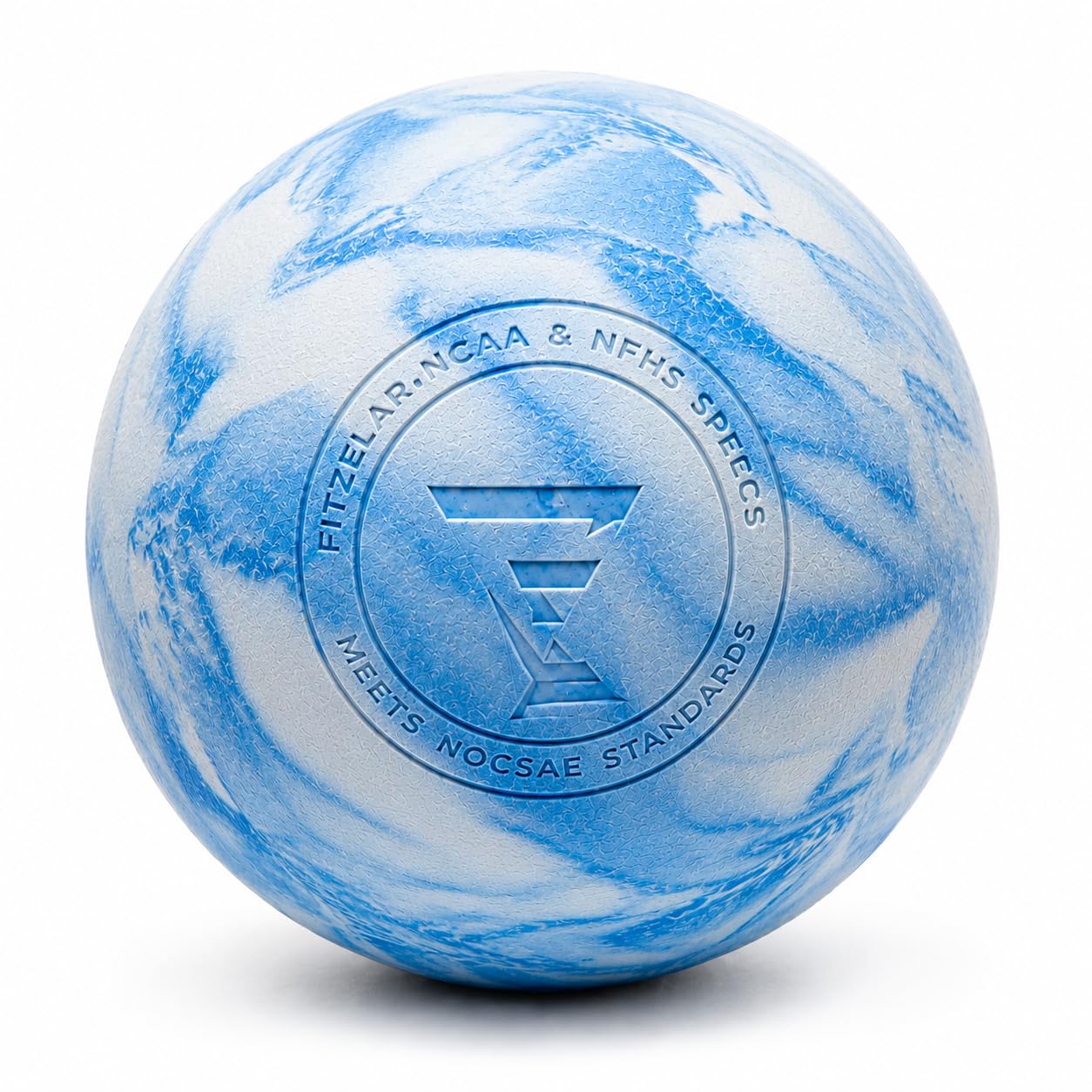
FITZELAR Massage Ball

FITZELAR Massage Ball

Single-ball buyers

Our Score 9.6/10
Check Price

Worth Noting

  • One ball only, so it moves between rooms
Diameter
2.56 inches
Hardness
45 degree
Material
Natural rubber
Read the full review

FITZELAR rates this ball at 45 degrees of hardness, which in practice sits between a golf ball and a tennis ball: hard enough to release a knot, with just enough give that a first press does not make you flinch.

That middle setting is why we hand it to someone who found a lacrosse ball too aggressive but does not want a squishy therapy ball either. It is also the only ball here that arrived with no rubber smell at all, which matters if it is going to share a bag with your clothes.

What it is not is a set. One ball, 2.56 inches across and 5.3 ounces, so it moves from room to room with you unless you buy two. And softer than a lacrosse ball is still firm on a neck. The thin drawstring bag it comes with is not much, but it keeps the rubber off the lint at the bottom of a rucksack.

Bottom line: For one ball and no decisions, this is the one: 45-degree firmness with just enough give for a neck.

#3

Kieba Massage Lacrosse Balls

Kieba Massage Lacrosse Balls

All-round use

Our Score 9.4/10
Check Price

Worth Noting

  • Small diameter leaves wide back muscles partly uncovered
Surface
Smooth
Diameter
2.5 inches
Material
Solid rubber
Balls Included
2
Read the full review

Two balls is the whole argument. One lives by the sofa, the other rides in a gym bag, and neither has to be carried upstairs when you need it. They are 2.5 inches across and 5.1 ounces each, solid rubber through and through, so there is no core to collapse when you put your weight on one — the thing you notice about a tennis ball after a month of use.

For most people this is where to start, and it is the set we reach for first when someone asks what to buy. The size covers the useful middle ground: under an arch, along a calf, under a glute, against a wall between the shoulder blades. And the firmness is the real lacrosse-ball feel, with no give at all, which is exactly why it releases a stubborn spot and exactly why it is too much on a tender neck the first time.

Use the wall before the floor for anything above the waist. Standing with the ball trapped between you and a wall lets you dial the pressure down to almost nothing, which is how to start on a neck or an upper back without regretting it the next morning. The floor version, with your whole weight on 2.5 inches of rubber, is a later step.

The smooth rubber is the one thing to know about. It picks up lint, pet hair, and dust within a day on a floor, and a furry ball does not roll cleanly, so ours live in a drawer or a bag instead. That is a small price for a surface that glides on carpet and does not drag on skin.

Bottom line: We recommend it as the default: two firm rubber balls that handle feet, glutes, and wall work for the price of one specialty ball here.

#4

TriggerPoint MB5 Foam Ball

TriggerPoint MB5 Foam Ball

Hips and glutes

Our Score 9.4/10
Check Price

Worth Noting

  • Premium price for a foam ball
Diameter
5 inches
Material
Multi-density EVA foam
Balls Included
1
Read the full review

Five inches is a different job. Where a lacrosse ball finds one knotted fibre, this finds a whole quadrant of a glute, and you can lie on it without feeling like you have been elbowed.

The foam is multi-density EVA and it compresses as you load it, so it grips tissue instead of skating over it. We used it mostly on hips, glutes, and the length of a back, where the size lets you move in slow sweeps rather than hunting for a point.

It is not a foot ball or a hand ball: against an arch it is too wide to get any purchase, and it asks for floor space, which is fine in a living room and awkward in a cubicle. What it gives back is coverage, a whole hip in one slow pass instead of a dozen small presses.

Here is the detail that settled it for us: because the ball is bigger than the knot, a t-shirt does not get pinched underneath it the way it does with a small hard ball. You can work a glute without rearranging your clothes, which in practice is the difference between using it on a weeknight and not.

Bottom line: We keep this one for hips and glutes, where five inches of compressible foam covers more ground than any small ball can.

#5

TriggerPoint MobiPoint

TriggerPoint MobiPoint

Feet and hands

Our Score 9.2/10
Check Price

Worth Noting

Surface
Raised tips
Diameter
2 inches
Material
Solid plastic
Read the full review

A smooth ball on a hardwood floor goes where it wants. The raised tips on this two-inch ball are the fix: they grab, so you can roll an arch back and forth without chasing it under the sofa. That sounds like a small thing until you have spent a minute on your hands and knees retrieving a lacrosse ball.

Two inches sits inside the curve of an arch, and the solid body does not deform however much you lean on it. It also wipes clean in a second, which is why it is the one that goes into a bag without a pouch and comes out without a coat of lint.

What you give up is give. There is no compression at all, so a bare arch gets a sharp press the first few times; a sock takes the edge off while you get used to it. It is a spot tool rather than a back tool, because the concentration that makes it good on a heel is unpleasant under a shoulder blade with your whole weight behind it. For feet and hands, it is the one we keep coming back to.

Bottom line: Our pick for feet and hands: the tipped surface grips the floor and the two-inch body sits right inside an arch.

#6

RAD Rounds 3-Pack

RAD Rounds 3-Pack

Small knots

Our Score 9.2/10
Check Price

Worth Noting

  • Costs more than a simple rubber pair
Material
Silicone
Densities
Soft, medium and firm
Ball Diameters
2.2, 1.6 and 0.75 inches
Read the full review

The reason to buy this set is the black ball, three-quarters of an inch across. Nothing else here gets under a wrist, into the meat of a forearm, along the side of the jaw, or into the gap between a shoulder blade and the spine.

The other two fill in around it. The 2.2-inch green is soft and grippy, the one you can put on a neck without a warm-up, and the 1.6-inch blue is the everyday middle. Working from soft to firm on the same area is the reason to own three densities rather than one, and the silicone glides on skin without dragging.

It is the set we recommend when the problem is precision rather than area. What it does not do is cover ground: three small balls will not sweep a back the way a five-inch one will, and the smallest is easy to lose in a bag, so ours lives in the side pocket rather than the main compartment. That is the test of whether you need it — if your trouble spots are things you can cover with a palm, you do; if they are the size of your whole back, you do not.

Bottom line: The set we recommend for jaw, wrists, and shoulder blades, where the tiny black ball reaches spots nothing else here does.

#7

Due North Foot Rubz

Due North Foot Rubz

Arch and heel

Our Score 9.2/10
Check Price

Worth Noting

  • Too small to work a calf or back
Surface
Flat spikes
Diameter
1.9 inches
Material
Dense rubber
Read the full review

This is the ball that lives under the desk. It is 1.9 inches across, dense rubber, covered in flat-topped spikes that grip a hardwood floor instead of skidding across it, which is what makes it usable while you are reading something and not looking at your feet.

The size is the point: it fits the arch and the heel, and you can work a foot seated with no setup at all. The rubber has enough give that it is not a punishment, though the spikes are firm on bare skin the first time and a sock is the easy answer. Seated at a keyboard, it is the most-used thing in this guide.

The surprise is hands. A minute rolling this under a palm after a long typing session does more than its size suggests, and it is small enough to disappear into a drawer. Owning it alongside a bigger ball is normal rather than redundant, because they do different halves of the same job.

Bottom line: The cheapest useful foot ball here: small, spiky, and happy to live under a desk.

#8

VORNNEX Spiky Ball 2-Pack

VORNNEX Spiky Ball 2-Pack

Aggressive texture

Our Score 9.0/10
Check Price

Worth Noting

  • Hard plastic spikes are harsh on bare skin
  • PVC can flatten under full body weight
Surface
Hard PVC spikes
Material
PVC
Balls Included
2
Read the full review

These are the loudest balls here. Both are covered in hard PVC spikes, and the sensation is closer to acupressure than to a smooth roll: sharp, immediate, and not something to try for the first time on a bare arch.

Used well, they work. The spikes grip, so the ball stays where you put it against a wall, and having two sizes lets you take a shoulder blade with the larger one and an arch with the smaller. On a back, with the wall doing the work, the texture finds a spot that a smooth ball glides straight over.

Hardness is where they divide people: the spike that feels productive on a shoulder can be too much on a heel, so start through a sock. The PVC also gives under a lot of weight, which makes these better for walls, hands, and feet than for lying on the floor.

Where they earn their place is the few minutes before a workout, when a quick roll on each arch wakes the feet up in a way a smooth ball does not. They also do not roll off a mat the way a smooth ball does, which is a small mercy early in the morning.

Bottom line: Buy these only if you already like aggressive texture: the spikes are intense and the PVC gives under a full body weight.

How We Tested the Best Massage Balls

To build our shortlist, we combed through customer reviews and brand specs for 16 massage balls, filtering out models with repeated complaints about seam splits or vague material claims. We made sure to include a range of sizes — from ping-pong to softball — and a mix of smooth, textured, and spiky surfaces, so we could compare how each felt on different body parts.

For three months, these balls lived on my living room floor, in my gym bag, and under my desk. I used them after runs, during work breaks, and first thing in the morning on my arches. My partner and a few coworkers also tried them on their own trouble spots — shoulders, lower backs, glutes — so we could compare notes.

We noted whether a ball felt too hard (sharp pain, flinching) or too soft (bottoming out under body weight). We tracked whether tension actually eased after a few minutes of rolling, and whether the surface stayed intact after weekly use. Spiky balls got extra attention: we checked whether the spikes dug in uncomfortably or just enough, and whether the hardness was consistent across the surface. We also weighed how easy each was to position — a smaller ball works for feet, but you need a bigger one to reach your back without slipping. At the end, we compared price against how often we reached for each one.

How to Choose Massage Balls

Firmness comes first

Pressure is force spread over area, and a ball that does not compress puts all of it into one small patch. That is how a lacrosse ball releases a glute in a minute and makes a neck miserable. We start anyone new on something pliable, a latex-core ball or a foam ball, and move to solid rubber once they know how much pressure they actually want.

The trap is buying the hardest ball on the page because deeper sounds better. Depth comes from relaxing into the pressure, not from the ball being unforgiving.

Diameter decides what you can reach

Under an inch reaches a jaw, a wrist, a forearm, the gap beside a shoulder blade. Two inches is the sweet spot for feet and hands. Two and a half covers most of the body: an arch, a calf, a glute, a mid-back spot against a wall. Five inches is for hips and glutes, where you want to sweep rather than pinpoint.

The trap is using a small ball on the floor under your full weight. That is a bruise with extra steps. Small balls belong against a wall, where you control the load; big ones can take the floor.

Smooth, textured and spiked do different jobs

A smooth rubber ball glides, which is what you want for rolling an arch or sweeping a calf, and it will slide on hardwood. Raised tips and flat spikes grip, so the ball stays where you put it on a floor or a wall; that is the whole reason the MobiPoint and the Foot Rubz work.

Spikes add intensity at the surface rather than depth, and they do not reach further into a muscle than a smooth ball of the same size. If you want deeper, go firmer or smaller, not spikier.

One ball, a pair, or a graduated set

A pair solves a boring problem: one at home, one in the bag, no carrying a ball between rooms. A graduated set lets you start soft on a neck and finish firm on a glute without buying twice, which is what the RAD Rounds set is for. A single ball is fine when you know exactly which spot you are working.

Wherever you land, think about the surface. Smooth rubber collects lint and hair, so a drawer or a bag beats leaving it on the floor.

Frequently Asked Questions

Final Verdict

Buy the Kieba pair. Two solid rubber balls for the price of one specialty ball is the best value in this guide, and 2.5 inches of real firmness covers feet, calves, glutes, and a wall-assisted back without asking you to learn a technique first.

If a lacrosse ball is too much on your neck, the Yoga Tune Up balls are the softer, grippier alternative; if the trouble is hips and glutes rather than anywhere small, the five-inch TriggerPoint MB5 does that job better than anything else here.