Recovery

Best Muscle Massage Guns of 2026

The moment usually arrives late: you're on the floor with a tennis ball wedged under your shoulder blade, or standing in the kitchen at 10 p.m. working a knot out of a calf that won't quit. A massage gun is what happens when you decide your thumbs have done enough — a handheld tool that drives a padded head into a muscle, over and over, faster and deeper than you could manage by hand. What it actually buys you is control: pressure you can dial up or back off without flinching.

The catch is that the category runs from pocket-sized units that barely tickle to near-professional tools that cost as much as a decent couch, and price alone doesn't tell you which is which. My team and I have spent the past six months using 12 of them on sore calves, stiff shoulders, and one very questionable hamstring. The spec that matters most isn't the top speed printed on the box — it's amplitude, how far the head actually travels. The guns that reach real tissue are the ones below.

#1

Opove M3 Pro 2

Top Pick
Opove M3 Pro 2

All-around recovery

Our Score 9.4/10
Check Price

Worth Noting

  • Heavier than compact picks at 2.6 lb
Amplitude
12 mm
Speed Range
5 speeds, up to 2500 RPM
Stall Force
70 lb
Battery Life
4-8 hours
Read the full review

The 12 mm amplitude and 70 lb stall force are the numbers that put the Opove M3 Pro 2 at the front of this group. We felt the difference most in the glutes and calves, where a lighter gun can start to stall unless you lean into it. The Opove keeps its rhythm with a firm hand, and the five-speed dial gives you a useful range from warm-up to serious post-leg-day work.

Battery life is rated at 4 to 8 hours, and that range matches the way we used it: short daily sessions stretched across a week, with the case keeping the heads and charger together. The motor is quiet enough for a living room, and the hidden vents are a small detail we appreciated after longer sessions because the body stayed comfortable to hold.

The body has a planted feel that suits back and hip work, and the carrying case is one of the better ones here: four heads, a charger, and a little room to spare. The whole package feels more expensive than its price tier suggests. For most people who want one gun for home recovery, this is the one we reach for first. What settled it for us was the combination of depth and calm: we could work a tight muscle for a couple of minutes without the gun bouncing or the motor demanding attention.

Bottom line: We recommend the Opove M3 Pro 2 for most people who want deep, quiet percussion and do not mind a little extra weight.
#2

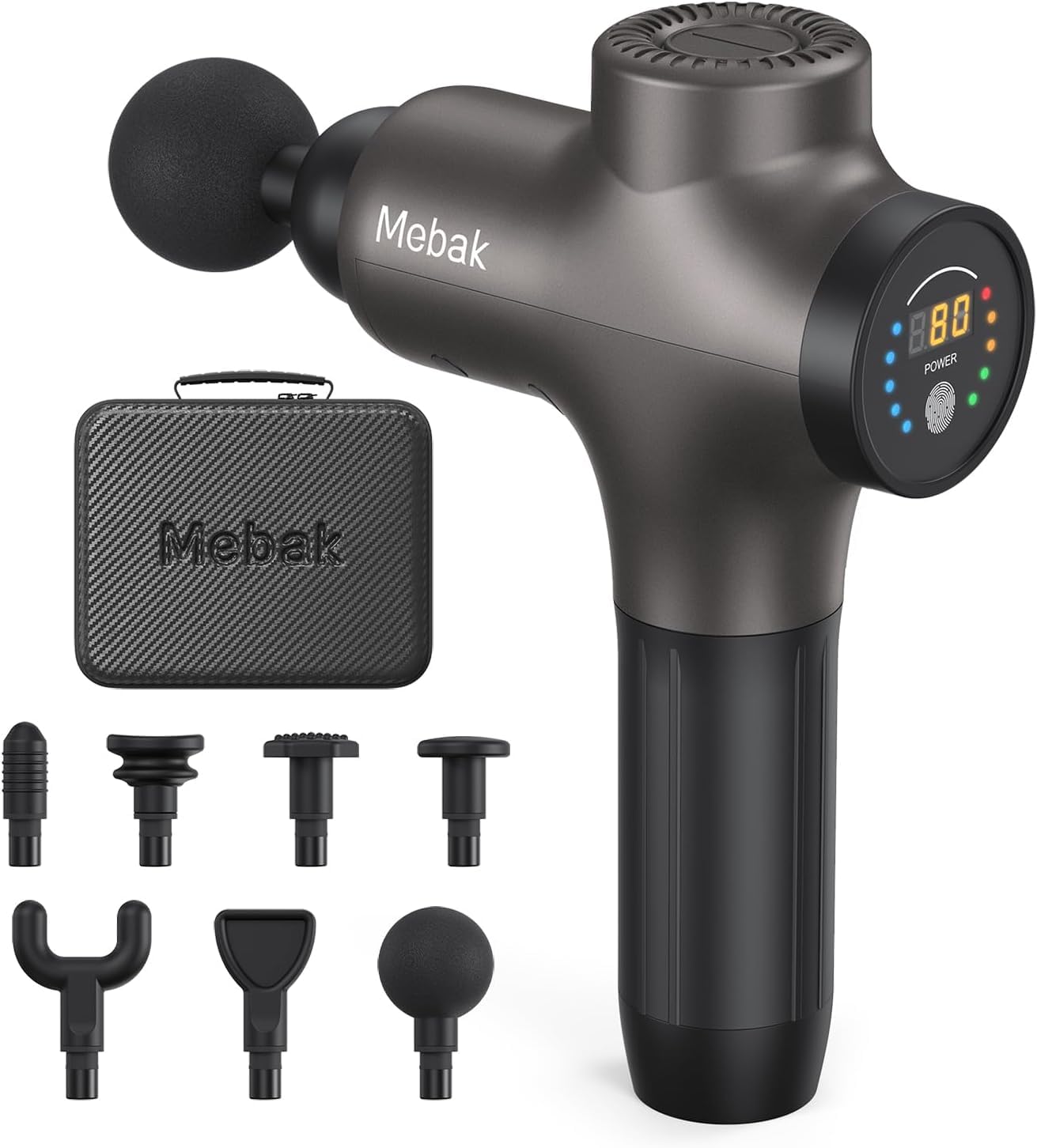
Mebak 3

Mebak 3

Deep-tissue value

Our Score 9.4/10
Check Price

Worth Noting

  • Mixed long-term durability feedback
Weight
1.68 lb
Amplitude
12 mm
Speed Range
5 speeds, 950-3000 RPM
Stall Force
53 lb
Read the full review

The Mebak 3 lines up closely with the Opove on paper: 12 mm amplitude, 53 lb stall force, five speeds from 950 to 3000 RPM, and seven heads. It costs less, which is the first reason it earns a place. The LED pressure indicator is a practical addition for anyone who is new to percussion guns and wants to know how hard they are pressing.

In use, we found the Mebak gives up a little authority on the biggest muscle groups—the Opove digs deeper before it starts to feel like work—but it is not a weak gun. The seven heads cover everything from broad back work to a narrow spot on the foot, and the lighter 1.68 lb body is easier to hold through a longer session. The controls are simple, and the case keeps the kit together.

For athletes who want deep-tissue power without paying premium prices, this is the value pick. It is also a good choice for a second gun to keep at the gym or office. The Opove still wins on pure authority, but the Mebak gets close enough that the savings are real. If your routine is mostly shoulders, calves, and quads rather than heavy glute work, the gap matters even less.

Bottom line: We recommend the Mebak 3 if you want deep-tissue power at a midrange price and can live with a shorter track record on long-term durability.

#3

Bob and Brad Q2 Pro Mini

Bob and Brad Q2 Pro Mini

Travel and portability

Our Score 9.2/10
Check Price

Worth Noting

  • Battery feedback is mixed
Weight
0.95 lb
Charging
15W USB-C, 1.5-2 hr
Heat/cold
2 presets
Dimensions
5.7 x 3.4 x 1.8 in
Read the full review

At 0.95 lb and 5.7 inches long, the Bob and Brad Q2 Pro Mini is the gun that actually goes in the gym bag. It packs two heat and cold presets, USB-C charging, and a rubberized body into a package that is smaller than most of the cases here. The one-button control keeps the operation simple when you're tired.

We found it easy to hold in one hand and angle into the upper back, and the rubberized body feels more secure than the smooth plastic on some budget minis. The heat and cold presets are a nice extra for a compact gun, though the compact body is less planted on the biggest muscle groups than the full-size picks. That is the trade-off: it is the one we pack, not the one we choose for a heavy leg session.

The case is small enough to leave in a car or desk drawer, and the 15W charging gets it back to full in about 1.5 to 2 hours with the right charger. For travelers, smaller hands, or anyone who wants a recovery tool within reach during the workday, this is the compact pick.

Bottom line: We recommend the Bob and Brad Q2 Pro Mini to travelers and smaller hands who want useful percussion without a full-size case.

#4

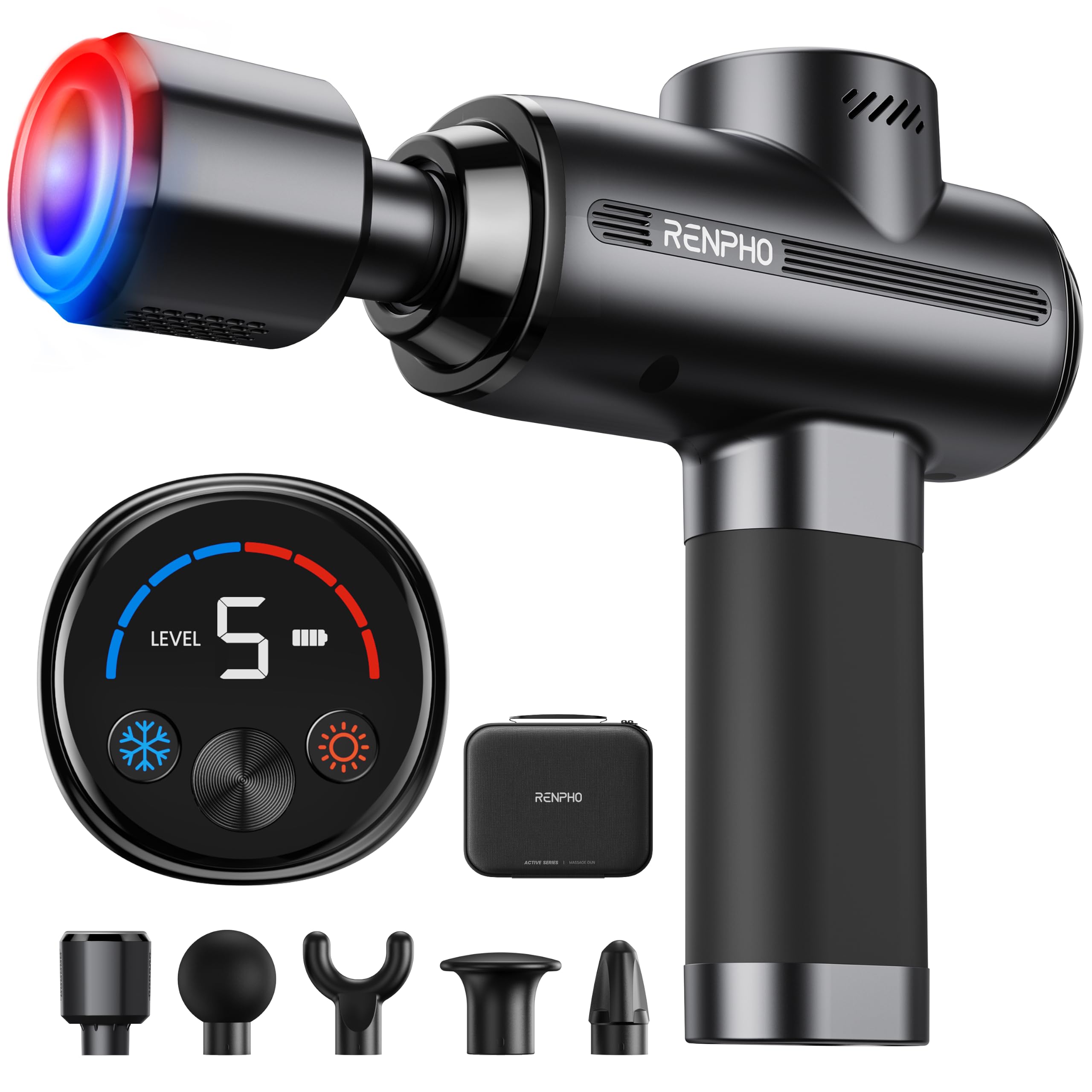
RENPHO Active Thermacool 2

RENPHO Active Thermacool 2

Heat and cold

Our Score 9.0/10
Check Price

Worth Noting

  • 10 mm amplitude trails the 12 mm guns
  • Mixed battery and durability feedback
Speed
Up to 3200 RPM
Amplitude
10 mm
Heat/cold
4 heat, 4 cold levels
Stall Force
45 lb
Read the full review

The heat and cold head is what makes the RENPHO Active Thermacool 2 more than another percussion gun. We used the warm setting before stretching and the cold setting after a hard session, and the sensation is a useful complement to the percussion rather than a gimmick. Four heat levels up to 113°F and four cold levels down to 46°F give you a real range, and the VA display makes it easy to see which mode you're in.

On the percussion side, the brushless motor runs up to 3200 RPM with a 45 lb stall force. That is enough for neck, shoulder, and calf work, and the lighter 1.79 lb body is easier to angle into tight spots. The five speeds and multiple heads cover the usual recovery routine, and the 2500 mAh battery is rated for 25% longer runtime than the previous model.

USB-C charging makes it easy to top up between sessions, and the case keeps the temperature head and the standard heads organized. The heat and cold modes are the reason to choose it, and they are easy to switch between. This is the pick for someone who wants temperature therapy in the same tool; if you only want maximum depth, the Opove is the better call.

Bottom line: We recommend the RENPHO Active Thermacool 2 for anyone who wants heat and cold therapy in the same handheld gun.

#5

LifePro Sonic

LifePro Sonic

Budget full-size

Our Score 9.0/10
Check Price

Worth Noting

  • Battery feedback is mixed
  • Bulkier than compact picks
Heads
8 heads
Speeds
6
Weight
2.2 lb
Runtime
Up to 6 hours
Read the full review

The LifePro Sonic advertises up to six hours of runtime and comes with eight heads, which is the kind of kit that makes a budget gun feel complete. Six speeds add flexibility, and the travel case holds the whole set without turning into a puzzle.

We found the Sonic easy to use one-handed, and the quiet motor is a real advantage if you share a living room. The eight heads cover broad back work, pinpoint spots, and the usual calf and shoulder routines. The six speeds are clearly marked, so you can move from a gentle warm-up to a firmer post-workout session without hunting through menus.

Where it lands: this is the full-size budget pick. It has enough power for post-workout recovery, and the six-hour claim gives it an edge over smaller guns for longer sessions. We keep it in the case as a household gun, and it is the one we hand to someone who wants a complete kit at a budget price. It is a lot of kit for the tier, and the simple controls make it easy to share.

Bottom line: We recommend the LifePro Sonic for budget-minded buyers who want a full-size gun with long runtime and plenty of heads.

How We Tested the Best Massage Guns

We started by pulling every percussive massager with a real following or a spec sheet worth reading, then narrowed to 12 units across sizes and price points — the compact ones that disappear into a gym bag and the full-size ones that live on a dresser. Anything with vague battery claims or a single head shape got cut before testing began.

For six months those 12 guns lived where people actually use them: in a duffel, on a nightstand, on the living room floor after a long day at a desk. We ran each one on calves after runs, on shoulders and traps after hours of typing, and on sore quads the morning after squats, usually five to ten minutes a session.

To get past the marketing, we leaned our body weight into each gun and watched whether the head kept punching or stuttered to a stop — that's the difference between a tool that reaches deep tissue and one that just buzzes the surface. We checked how far the head travels against a foam block, and noted how heavy the unit felt after ten minutes in hand, since a two-pound gun becomes a chore by the end of a session.

Attachments got swapped mid-session — the fork along a spine, the ball into a glute, the flat head on a big quad — and we tracked which ones we reached for and which stayed in the case. Battery life was logged honestly: every gun was run on high until it died, recharged, and run again. Durability meant real abuse, dropping them onto a garage floor and hauling them around in a packed bag for weeks. Value came last, comparing what came in the box against what the gun asked you to spend.

How to Choose Muscle Massage Guns

Depth Comes From Amplitude and Stall Force

Speed alone tells you how fast the head moves, not how much force it carries into a tight muscle. The useful numbers are amplitude—how far the head travels, usually 10 to 12 mm on a serious gun—and stall force, which is how much pressure the motor can take before it stops. A 12 mm, 50-plus-lb gun like the Opove or Mebak will feel more planted on glutes and calves than a compact model. If you mostly work shoulders and arms, a 10 mm gun can be enough; if you lift heavy or carry tension in big muscles, prioritise amplitude and stall force over a long speed list.

Weight and Reach Decide How Often You Use It

A full-size gun in the 2-to-3 lb range gives you a steadier hand for back and hip work, but it is also the one that stays in the case when you're tired. A compact under 1 lb, like the Bob and Brad Q2 Pro Mini, is easier to angle into the upper back and far more likely to travel with you. The trap is assuming compact means just as deep: smaller bodies usually trade some amplitude and stall force for that portability. Choose the size around the muscles you actually treat, not the one that looks most convenient in the listing.

Battery and Charging: Plan for the Second Year

Runtime claims are best-case figures measured on lower settings, so a gun rated for six hours may give you far less on top speed. What matters more is how you charge it and whether the battery is built to last. USB-C is convenient because you can top up from a laptop or car charger; a proprietary plug is one more cable to lose. If you use the gun daily, put the charger where you use it and avoid leaving the battery fully drained. Battery is the component most likely to end a massage gun's useful life before the motor does.

Attachments and Heat/Cold: Useful Extras, Not the Core

Four to six heads cover almost everything most people need: a ball for broad areas, a flat head for larger muscles, a bullet for pinpoint work, and a fork for the spine-adjacent muscles. A gun with ten heads is not automatically more useful; you will probably use two or three. Heat and cold are a different kind of extra. The RENPHO Active Thermacool 2 adds four heat and four cold levels, which is genuinely useful for warming up before activity or calming a muscle afterward. Buy the therapy you will use, not the longest attachment list.

Noise and Controls: The Details That Keep It in Reach

A loud gun is a gun you stop using when someone else is in the room. Below 50 dB is quiet enough for a living room; below 40 dB is close to a library. Simple controls matter too: one button and a few speeds are easier to operate on a sore shoulder than a touchscreen you have to look at. The best massage gun is the one you can pick up, switch on, and use without a setup ritual. If you share space or use it while watching TV, make noise and controls part of the decision, not an afterthought.

Frequently Asked Questions

Final Verdict

The Opove M3 Pro 2 is the one we recommend first: its 12 mm amplitude and 70 lb stall force give it the deepest, most planted feel in this group, and the long battery and quiet motor make it easy to live with. If heat and cold matter more than raw depth, choose the RENPHO Active Thermacool 2. If the gun has to travel, the Bob and Brad Q2 Pro Mini is the one to pack.