Nutrition & Supplements

Best Calcium Supplements of 2026

Calcium supplements have a reputation problem: horse pills that are hard to swallow, chewables that taste like drywall, and gummies that deliver more sugar than mineral. The right one should fit into your day without a grimace or a pint-sized glass of water—and it should be a bottle you finish. That’s the test, because consistency matters more than the label’s claim. Over the past five months, my team and I worked through 14 calcium supplements to see which ones made that daily habit easy.

I started paying attention to pill size after a chalky chewable made me gag at my kitchen counter—that’s when “easy to take” stopped being a small detail. Calcium comes in different forms, and the form affects whether you take it with food and how your stomach handles it. We looked at how much calcium each serving actually delivered, whether the label was clear and the bottle easy to open, and how each one sat after breakfast or a late dinner. The ones below earned their place by being swallowable, repeatable, and worth the cost per serving.

#1

Caltrate Minis 600 Plus D3

Top Pick
Caltrate Minis 600 Plus D3

Small daily tablets

Our Score 9.6/10
Check Price

Worth Noting

  • Two tablets per 600 mg serving
  • Costs more per serving than plain tablets
Count
150 tablets
Calcium Per Serving
600 mg
Tablets Per Serving
2 mini tablets
Vitamin D3 Per Serving
40 mcg
Read the full review

Calcium tablets have a reputation, and it's deserved: most are enormous, chalky, and a genuine hurdle before breakfast. The Caltrate Minis are the ones that got out of their own way. Two small coated tablets carry 600 mg of calcium carbonate and 40 mcg of vitamin D3, and the pair goes down more like two small aspirin than like a calcium supplement. That's why they're our top pick — the best calcium supplement is the one you're still taking in six months, and this is the bottle we kept coming back to.

The vitamin D3 dose deserves a mention. At 40 mcg per serving it's a higher D3 dose than either Citracal formula here, and D3 is what lets your body put calcium carbonate to work. Caltrate also adds zinc, copper, and manganese, which the brand ties to collagen production and more resilient bones. We treat those as a bonus rather than a reason to buy, but they don't cost you extra pills.

What you pay for is the format. A serving is two tablets, so the 150-count bottle is 75 days, and the cost per serving runs higher than the plain 600 mg tablets here. The formula also includes additives some shoppers would rather skip, which is where a bare citrate capsule like Pure Encapsulations makes more sense. Neither changes the recommendation for most people.

Nothing else in this group goes down as easily, and the quibbles are about taking two rather than about getting them down. If a calcium bottle has ever sat unfinished in a cabinet because the tablets were too big to face, this is where to start.

Bottom line: The rare calcium supplement that's genuinely easy to take: two small tablets carry 600 mg of calcium, a high D3 dose, and the minerals that go with it.

#2

Nature Made Calcium Magnesium Zinc + D3

Nature Made Calcium Magnesium Zinc + D3

Bulk budget buy

Our Score 9.6/10
Check Price

Worth Noting

  • Tablets run large
Count
300 tablets
Dosage
1 tablet up to 3 times daily
Verification
USP Verified
Added Minerals
Magnesium and zinc
Read the full review

Three hundred tablets at the lowest price tier here is the headline, and the per-tablet cost is the lowest of anything in this guide. The formula isn't bare either: alongside calcium and vitamin D3 it carries magnesium and zinc, so one bottle covers three minerals people usually shop for separately.

Dosing is flexible by design — one tablet up to three times a day, with water and a meal. That's a carbonate formula, so the meal isn't optional: carbonate leans on stomach acid to dissolve, and taking it on an empty stomach is the usual route to queasiness. Spread across meals, the same tablets sit far better.

The tablet itself runs large, and that's the main thing to accept going in. Digestion is the other variable — calcium carbonate with magnesium is a lot for a sensitive gut at once, so start with a single tablet at a meal rather than three and see how the first week goes.

What it isn't is a one-and-done. A serious daily intake means taking these at meals, several times a day, which is the trade for the price. For a household that already keeps a pill routine at breakfast and dinner, that's no burden at all.

Bottom line: The best value here: 300 tablets of calcium, magnesium, zinc, and D3, as long as you take them with meals.

#3

Nature Made Calcium 600 + D3

Nature Made Calcium 600 + D3

One-tablet routine

Our Score 9.4/10
Check Price

Worth Noting

  • Thick, dense tablet; hard for some to swallow
Count
220 tablets
Verification
USP Verified
Calcium Per Tablet
600 mg
Read the full review

A small USP Verified mark sits on the front of this bottle, and it's the closest thing to a quality guarantee in this category. The program checks that a supplement contains the ingredients and amounts on its label and that the tablet breaks down properly. Two Nature Made products here carry the seal, and it's the clearest verification among these picks.

One tablet gives 600 mg of calcium with vitamin D3, which makes this the smallest possible daily routine: a single swallow with breakfast and you're done. That's who we recommend it to — anyone who wants the calcium question settled with the least ongoing thought. The tablet is thick and scored down the middle, so it snaps in half on the days the full size is a struggle.

That thickness is the trade-off. It's a dense, heavy tablet, and if you've had trouble with calcium pills before, it's the wrong place to start — the Minis or the Citracal Petites solve that more directly.

Where it wins is the long game. A 220-count bottle runs about seven months at one a day, the 600 mg dose matches what most people need on top of food, and the cost per tablet is among the lowest here. It's the boring, correct choice.

Bottom line: Our pick for a single-tablet routine: one USP-verified tablet delivers 600 mg of calcium and vitamin D3, with no counting required.

#4

Citracal Petites

Citracal Petites

Sensitive stomachs

Our Score 9.4/10
Check Price

Worth Noting

  • 400 mg per serving means more than one
  • 'Petite' is smaller, not small
Count
375 caplets
Calcium Form
Calcium citrate
Calcium Per Serving
400 mg
Vitamin D3 Per Serving
12.5 mcg (500 IU)
Read the full review

'Petites' is doing some marketing work here. These are noticeably smaller than Citracal's Maximum caplets, but nobody would mistake one for a grain of rice. What they are is a coated calcium citrate caplet with no chalky aftertaste — and that combination, citrate plus a genuinely reduced size, is why they're our pick for anyone whose stomach has objected to calcium before.

Citrate is the reason to choose them. Unlike calcium carbonate, calcium citrate doesn't need stomach acid to dissolve, so it works with or without food, and it's the gentler of the two forms on a sensitive gut. A serving gives 400 mg of calcium and 12.5 mcg (500 IU) of vitamin D3, which is on the modest side for D.

The arithmetic is the catch. Four hundred milligrams per serving means a full day's calcium takes more than one serving, spread across meals — fine if you already take pills at breakfast and dinner, a chore if you don't. That's the trade for the gentleness, and it's why this isn't our top pick for someone who wants one tablet and out.

The coating matters more than it sounds. Coated citrate slides down cleanly and leaves nothing behind, so the sweet spot is people who take calcium between meals or on an empty stomach. Just don't order them expecting a tiny pill; expect a smaller one.

Bottom line: The citrate pick for uneasy stomachs: coated caplets you can take with or without food, though a full dose means more than one serving.

#5

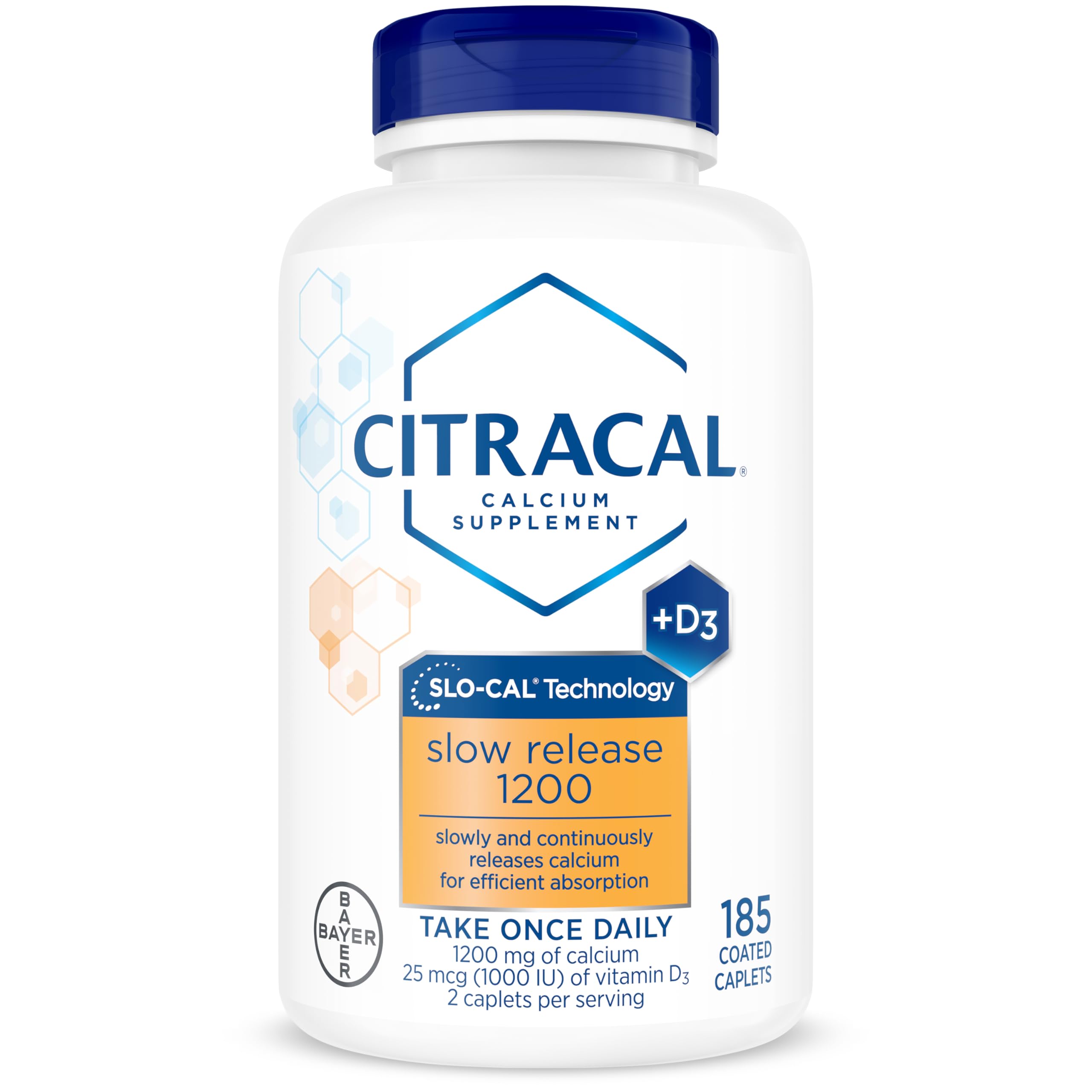
Citracal Slow Release 1200

Citracal Slow Release 1200

Once-daily dosing

Our Score 9.4/10
Check Price

Worth Noting

  • Largest caplets here, with hard edges
  • Premium price per serving
Count
185 caplets
Calcium Form
Carbonate and citrate
Calcium Per Serving
1,200 mg
Vitamin D3 Per Serving
25 mcg (1,000 IU)
Read the full review

One dose a day is the promise, and Citracal delivers it: two caplets taken together carry 1,200 mg of calcium, 25 mcg (1,000 IU) of vitamin D3, and magnesium. For anyone who has tried to remember calcium three times a day alongside everything else, that's a real simplification.

The slow-release design is what makes the big number defensible. Calcium absorbs best in doses under roughly 500 to 600 mg, so 1,200 mg arriving at once would largely be wasted; the Slo-Cal coating is meant to meter it out over the following hours instead. The formula also hedges on form, blending calcium carbonate and calcium citrate, which is a sensible way to get both a compact dose and gentler handling.

The caplets are the biggest in this guide, with hard beveled edges that make them the toughest swallow here. If you already know large tablets are a problem, this is the one to skip — the Minis and the Petites both solve a problem this one creates. If you don't mind one deliberate swallow a day, the convenience is worth a lot.

It's also the priciest per serving of these picks, and 185 caplets is about three months at one dose a day. What you're buying is the once-daily format, the magnesium, and the release mechanism — not more calcium than the cheaper bottles deliver.

Bottom line: For anyone who wants the whole day's calcium in one sitting, these two caplets deliver 1,200 mg with D3 and magnesium — size permitting.

#6

Vitafusion Calcium Gummies

Vitafusion Calcium Gummies

Pill-free routine

Our Score 9.4/10
Check Price

Worth Noting

  • Coated in sugar; a daily sugar dose
  • Texture varies from bottle to bottle
Count
100 gummies
Supply
50 days
Serving
2 gummies
Calcium Per Serving
500 mg
Read the full review

There's a version of this supplement for people who will not swallow a calcium tablet, and it's a gummy. Two of Vitafusion's fruit-and-cream gummies carry 500 mg of calcium and vitamin D3, and a 100-count bottle is a 50-day supply at that rate.

They're pleasant in a way that matters more than it sounds. The flavor is genuinely good, the texture is soft rather than chalky, and a bottle that lives on the counter actually gets used — which is the whole point of a supplement you take daily. The habit is easier to keep when the habit tastes good.

Sugar is the catch, and it isn't a small one. These are candy-adjacent and coated in sugar, and if you're watching your intake or counting carbohydrates, the trade isn't worth it. Texture also varies between bottles, sometimes softer and sometimes chewier than expected.

At 500 mg per two gummies, they're a supplement rather than a full day's calcium, so most adults will pair them with dairy or a second serving. For the person with an unused bottle of tablets in a drawer, that's still progress.

Bottom line: For anyone who won't take a pill: a genuinely good-tasting gummy with 500 mg of calcium and D3, provided the sugar doesn't bother you.

#7

Pure Encapsulations Calcium (Citrate)

Pure Encapsulations Calcium (Citrate)

Clean-label citrate

Our Score 9.4/10
Check Price

Worth Noting

  • No vitamin D3 included
  • Highest price of these picks
Count
180 capsules
Free From
Common allergens, GMOs
Calcium Form
Calcium citrate
Read the full review

What's in the bottle is short: calcium citrate, in a capsule, with no fillers, no artificial ingredients, and nothing from the common allergen list. That's the entire pitch, and for a certain shopper — the one reading every label — it's enough.

The capsule format is the underrated part. Calcium citrate capsules go down more easily than the big coated caplets, and citrate is the gentler form besides, which is why this is the one we point to when someone wants citrate without a tablet the size of a nickel. It's the easiest-swallowing citrate option here, and the gentlest.

It's the priciest bottle in this guide, and what you're paying for is the sourcing and the empty ingredient list rather than a bigger dose. If you already take vitamin D and magnesium on their own, that's a clean split; if you don't, Citracal Petites fold D3 in for less and make more sense.

For anyone who has read through the excipients on a mainstream tablet and would rather not, this removes a variable and comes in a capsule you'll actually take. That's a narrow job, and it does it well.

Bottom line: The clean-label citrate capsule for shoppers who already take vitamin D separately and would rather not swallow a chalky tablet.

#8

Nature's Bounty Calcium 1200 + D3

Nature's Bounty Calcium 1200 + D3

High-dose softgel

Our Score 9.2/10
Check Price

Worth Noting

  • No third-party verification mark on the label
Form
Softgel
Count
120 softgels
Calcium Per Serving
1,200 mg
Vitamin D3 Per Serving
1,000 IU
Read the full review

One serving carries 1,200 mg of calcium and 1,000 IU of vitamin D3, which is more calcium per dose than anything else here and roughly a full day's intake in a single go. It's a softgel rather than a tablet, and that changes the daily experience more than the numbers do.

Here's the problem with 1,200 mg at once: absorption gets less efficient above roughly 500 to 600 mg per dose, so a chunk of a single large dose passes through unused. Spread the dose across breakfast and dinner and the same bottle works considerably harder. Taken as one daily handful, it's convenient and a little wasteful.

As a softgel it goes down more easily than the big coated caplets, and the formula is free of gluten, dairy, and wheat — worth knowing if you're juggling sensitivities alongside everything else. The trade for the low price is that there's no third-party seal like the USP Verified mark on the Nature Made bottles.

For anyone already splitting calcium across the day, or who wants a softgel instead of something to chew through, this is the value answer in the group. Just don't take the whole serving at breakfast and consider the day covered.

Bottom line: A high-dose softgel at the lowest price tier: 1,200 mg of calcium and 1,000 IU of D3, best split across two meals.

How We Tested the Calcium Supplements

We built the shortlist from drugstore shelves and online listings, then narrowed by form—carbonate, citrate, chewable, gummy—along with calcium per serving, third-party testing seals, and cost per serving. Products with vague elemental calcium labels or a sugar count that swallowed the point of a supplement didn’t make the cut. That left 14 products, which we tested for five months.

For those five months, the bottles lived on my kitchen counter, in a desk drawer, and in my travel bag. I took each one as directed—some with breakfast, some with dinner, one gummy in the afternoon—and logged how easy the bottle was to open and measure, whether the pill fit comfortably on a spoon, and how it went down with a normal sip of water. Chewables and gummies got a separate taste and texture check: chalky, gritty, sticky, or actually pleasant, plus grams of sugar per serving. For digestibility, we noted who felt bloated or queasy after taking one on an empty stomach versus with food.

Effectiveness is hard to prove in a supplement, so we watched adherence—did we keep taking it without dread?—and label transparency. We compared the calcium content per serving to what the front label promised, calculated cost per 500 mg, and checked whether the bottle size made sense for a month’s supply. The ones that rose to the top were the ones we didn’t have to talk ourselves into taking.

How to Choose a Calcium Supplement

Carbonate or Citrate

Calcium carbonate packs more elemental calcium into a smaller, cheaper pill, but it needs stomach acid to dissolve, so it goes down with a meal. Calcium citrate is bulkier — you take more caplets for the same milligrams — but it absorbs with or without food and tends to sit more easily on a sensitive gut.

If your calcium lands at breakfast anyway, carbonate is the efficient choice. If you dose between meals, or your stomach has objected before, pay the extra caplets for citrate: the Citracal Petites and the Pure Encapsulations capsules both go that route.

Count Pills, Not Just Milligrams

Front-of-bottle numbers are usually per serving, and a serving is often two tablets. The Caltrate Minis give 600 mg per two tablets; the Nature Made 600 mg is one tablet. Same figure, different daily effort, so read the serving size before you assume anything.

There's a second catch. Calcium absorbs most efficiently in doses of roughly 500 to 600 mg, so 1,200 mg at once isn't twice as useful as 600 mg taken twice. Add up food and supplements toward roughly 1,000 to 1,200 mg a day, and split anything above 600 mg across two sittings.

Pill Size Decides Whether You Finish the Bottle

Size is where calcium routines go to die. The options here run from genuinely small (Caltrate Minis), to smaller-than-standard (Citracal Petites), to large caplets with hard beveled edges (Citracal Slow Release) and softgels that slide down more easily (Nature's Bounty).

If you already know big tablets are a problem, don't buy the 1,200 mg caplet and hope. Start with a mini, a petite, a softgel, or a gummy — any of them beats a bottle that stays shut.

What Comes With the Calcium

Vitamin D3 is in most formulas to help your body use the calcium, and the amounts swing widely — 500 IU per serving in the Citracal Petites, 1,600 IU in the Caltrate Minis. If you already take a standalone D supplement, watch the combined total instead of stacking two full doses without thinking about it.

Magnesium and zinc are nice-to-haves rather than requirements. Nature Made and Citracal include them; if you want calcium and nothing else, a bare citrate capsule does the job.

Seals, Dates, and What to Check on Arrival

Supplements aren't regulated the way drugs are, so a third-party mark is worth hunting for. USP Verified on the Nature Made bottles is the clearest example in this guide, and it speaks to label accuracy rather than marketing.

Then check the date. Calcium tablets get discounted when they're short-dated, and a bottle expiring in three months is a bad deal on a 150-tablet supply. Look at the printed date the day the box arrives and send it back if it doesn't leave you room to finish the bottle.

Frequently Asked Questions

Final Verdict

After working through the whole set, the Caltrate Minis are what we hand to most people. Two small coated tablets deliver a full 600 mg with a high vitamin D3 dose and supporting minerals, and the format solves the problem that actually stops people from taking calcium: the pill itself.

If you want one tablet instead of two, the Nature Made Calcium 600 + D3 is the USP-verified, no-fuss alternative. And if a calcium carbonate tablet has ever left your stomach unhappy, start with the Citracal Petites — citrate, coated, and taken with or without food.