Cardio Machines

Best Treadmills for Walking of 2026

Almost nobody who buys a treadmill runs on it. Walking is what these machines get used for — a 30-minute stretch with a podcast, a lunch break when it's raining sideways, a way to hit a step goal without leaving the house after dark. I moved my evening walks indoors two winters ago and never went back out: no weather, no dark streets, no excuses. What I didn't expect was how much the machine itself matters, and the difference between a good walking treadmill and a bad one shows up at 3 miles per hour, not 8.

Over the past six months, my team and I have walked on 10 treadmills, from compact folding models to full-size machines, putting the same 30-minute session on every one. The spec sheet rarely tells you what you'll notice most — how the deck feels underfoot at a slow pace, how loud the machine is when you're on a call. A walking treadmill should disappear into your day, not your living room, so folded footprint and setup weighed as heavily as motor size. The picks below earned their floor space.

#1

Ulfario LF-X2DF Walking Pad

Top Pick
Ulfario LF-X2DF Walking Pad

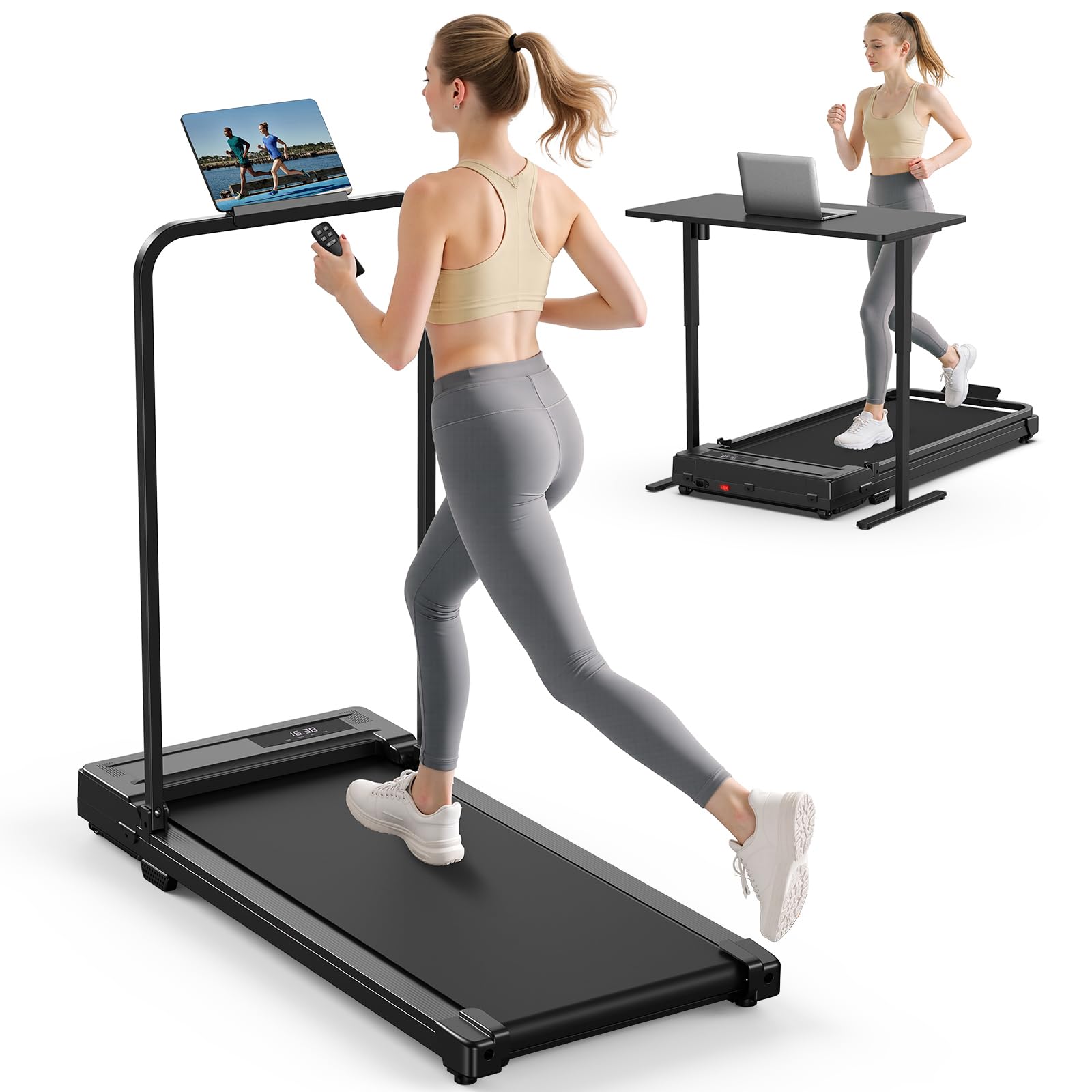
Folding handlebar

Our Score 9.6/10
Check Price

Worth Noting

  • 4 mph ceiling rules out jogging
  • 90 x 38 cm belt suits shorter strides
Deck Size
90 x 38 cm
Max Speed
4 mph
Folded Size
104 x 47 x 10.5 cm
Max User Weight
264.6 lb
Read the full review

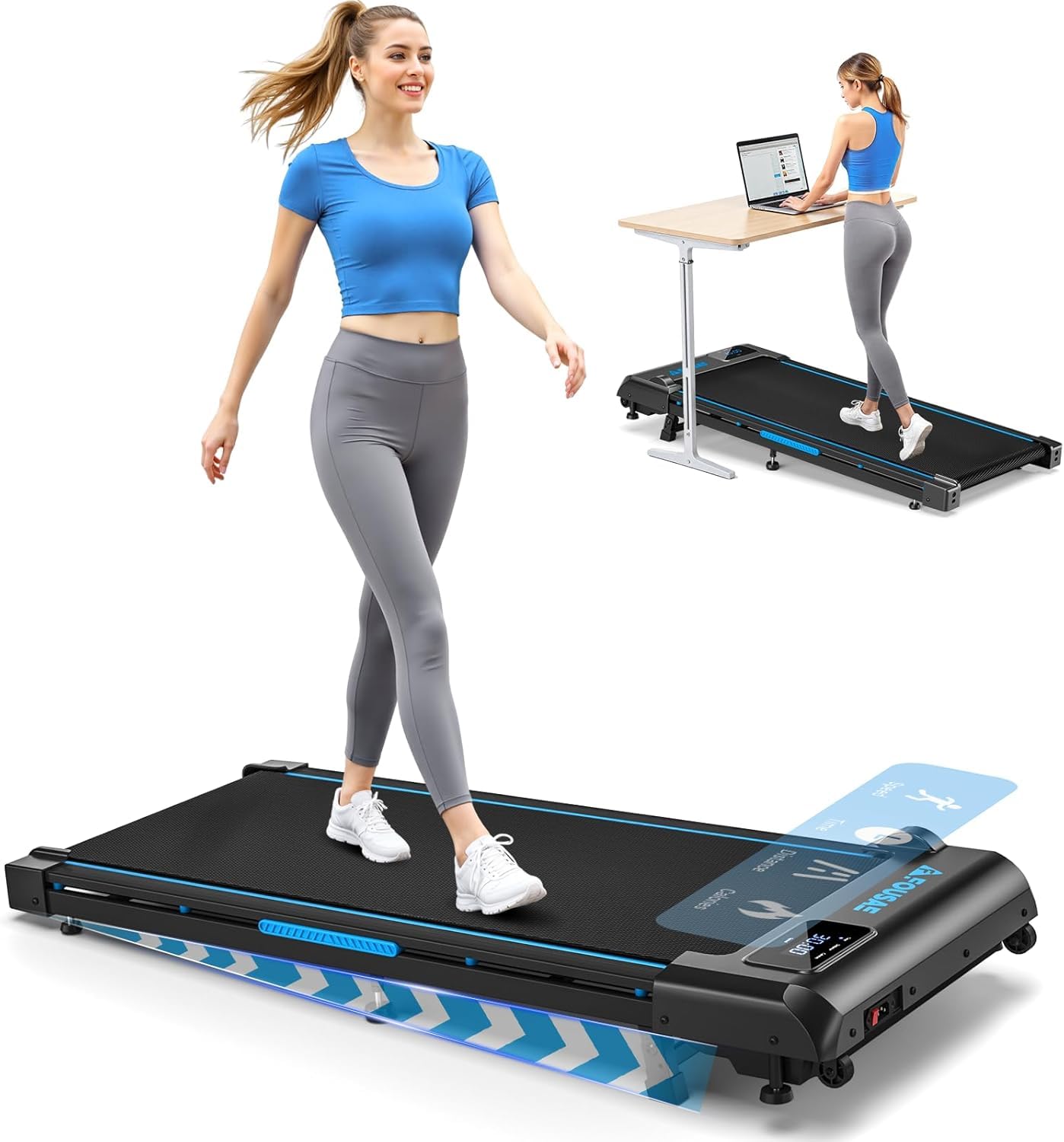
The handlebar is the interesting part. Raised, it turns a flat pad into something to hold; unbolted and lowered, it becomes a plain under-desk pad that slides beneath a standing desk. That's two machines in one frame, and at 38.5 pounds on front wheels it moves between them without much effort.

We like that flexibility more than a single-mode pad offers, because most rails force the choice: leave the bar up and you can't get close to a desk, drop it and the rail is gone for good. Here the securing bolts come out and the bar comes off, which is a weekend decision rather than a daily one, but it means the machine can follow you from desk walking to supported walking.

The rest is modest and honest: a 2 HP motor, a 120 kg capacity, and a 10.5 cm profile once the bar is down. It's among the lightest handled machines here, and that's the point — you can move it from office to living room without thinking about it.

Bottom line: We recommend it when one machine has to do both jobs: a desk pad by day, a supported walker when you want a rail to hold.
#2

Wilpkracy B01 Walking Pad

Wilpkracy B01 Walking Pad

Small spaces

Our Score 9.6/10
Check Price

Worth Noting

  • 3.7 mph ceiling rules out jogging
  • Short power cord limits placement
Incline
5% manual
Max Speed
3.7 mph
Item Weight
37.5 lb
Max User Weight
264.6 lb
Read the full review

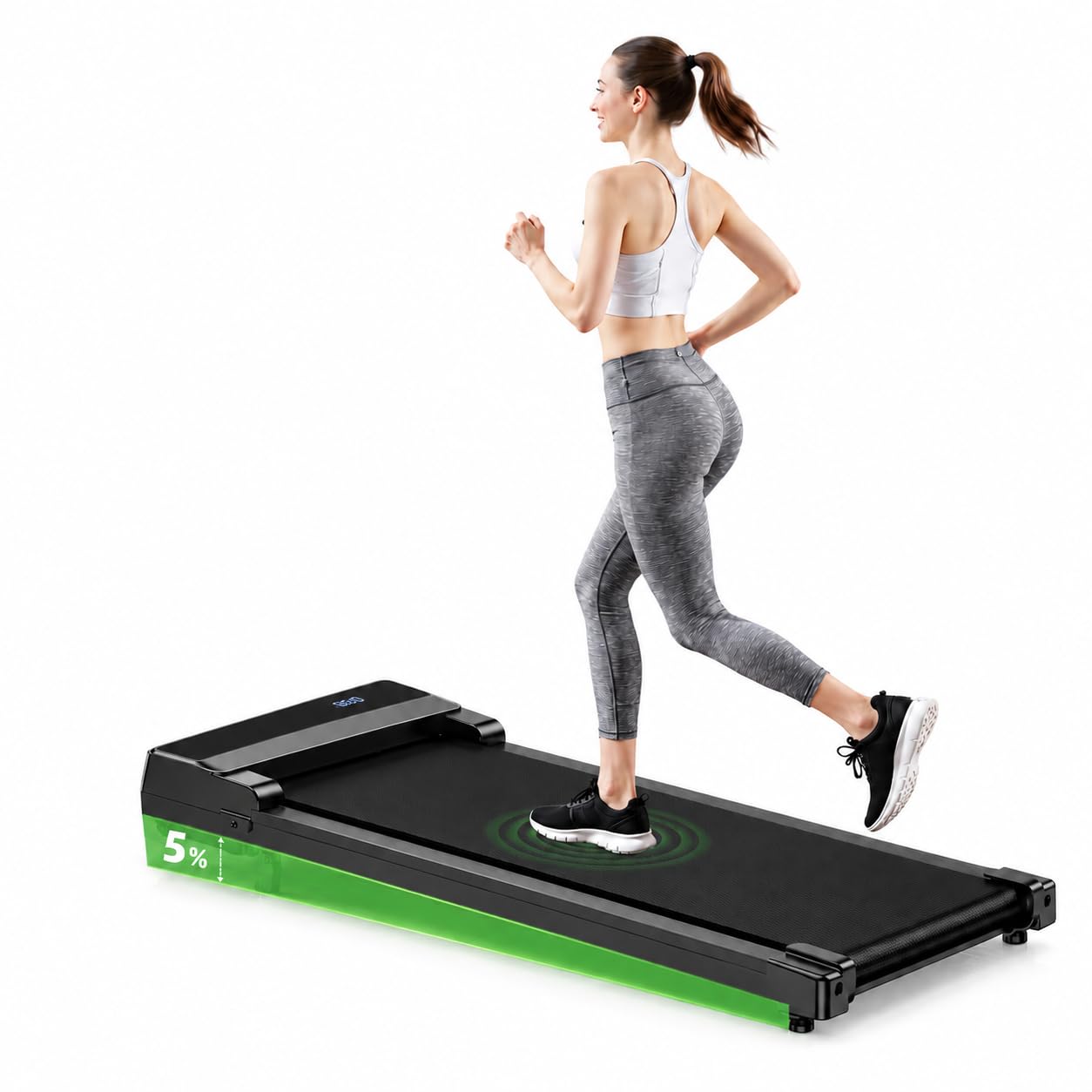
Manual incline is usually the first thing to go at the budget end, so a 5% grade here is worth noting. You set it before you start and it stays put for the session — no remote adjustment, no motor — and the deck runs under 10.5 cm tall, which is what lets it disappear under a bed.

For the money, that's a sensible package: the five-layer diamond-pattern belt is the same construction the more expensive pads use, and at 17 kg this is the lightest machine in the roundup to shift around. What you give up is pace — 3.7 mph is a good walking speed and nothing beyond it.

Plan around the cord. It's short enough that the outlet partly decides where the pad lives, which is worth checking before you clear a space for it and find out the hard way.

Bottom line: We reach for it when space is tight and the budget is tighter: a 5% grade and a slim deck, provided you'll set the incline by hand.

#3

Trailviber X01 Walking Pad

Trailviber X01 Walking Pad

Incline walking

Our Score 9.4/10
Check Price

Worth Noting

  • 4 mph top speed rules out jogging
Incline
0–12% auto, 9 levels
Warranty
3 years
Speed Range
0.7–4 mph
Max User Weight
450 lb
Read the full review

A 450-pound capacity is the number that separates this one, and it's why the frame stays quiet when you step up the incline. Nine automatic levels take you to a 12% grade without breaking stride, and the 2.5 HP motor holds a steady 0.7 to 4 mph while you're there. The incline is the reason to buy, and it's done properly.

The supporting hardware is just as serious: a double-deck structure with four silicone absorbers under the belt, a three-year warranty that's the longest in this roundup, app pairing, and a Bluetooth speaker. The speaker is the one extra we never reached for. The app is more useful if you like your step counts in one place.

The trade is portability. At 44 pounds and six inches tall it wants a permanent home and a real gap under the furniture, and lifting it twice a day gets old fast. If your pad has to move, a 36-pound machine is the better call. If it stays put, the weight is exactly what you want under a 12% grade.

Bottom line: We rate it the one to buy when incline is the point: 12 automatic levels, a 450-pound frame, and the longest warranty in this group.

#4

Fousae X Walking Pad

Fousae X Walking Pad

Brisk walking

Our Score 9.4/10
Check Price

Worth Noting

  • Tallest rail-free pad here at 4.72 in
  • No handlebar for support at speed
Motor
2.75 hp brushless
Incline
10%
Speed Range
0.6–6.2 mph
Max User Weight
350 lb
Read the full review

Two figures stand out: 6.2 mph and a 2.75 HP brushless motor. The speed ceiling is the highest here alongside the Lontek, and the brushless drive is why the noise claim sits under 40 dB where most pads quote 45.

Underneath it there's a 10% incline, 12 preset HIIT programs, three countdown modes, a double frame, and a 350-pound capacity. The programs are the kind of feature you try once and then work from the remote, but they give a flat walk a shape when the same pace gets dull.

At 38 pounds it's light enough to stand against a wall between sessions, and the 45.67-inch body is about as compact as a machine with this motor gets.

Where it lands for us is the walker who wants a real three-and-a-half to four mile an hour stride with the occasional jog, without handing a room over to a full treadmill. If your walking is all desk-side, the Vhorilix covers it for a lot less and stows thinner.

Bottom line: We like it best for walkers who want to push the pace: 6.2 mph, a 10% incline, and a brushless motor that keeps the noise down.

#5

Redliro Treadmill for Seniors

Redliro Treadmill for Seniors

Balance support

Our Score 9.2/10
Check Price

Worth Noting

  • Narrow 14.8 in deck
  • Incline stops at 2%
Incline
3 levels, up to 2%
Deck Size
39.3 x 14.8 in
Speed Range
0.5–5 mph
Max User Weight
300 lb
Read the full review

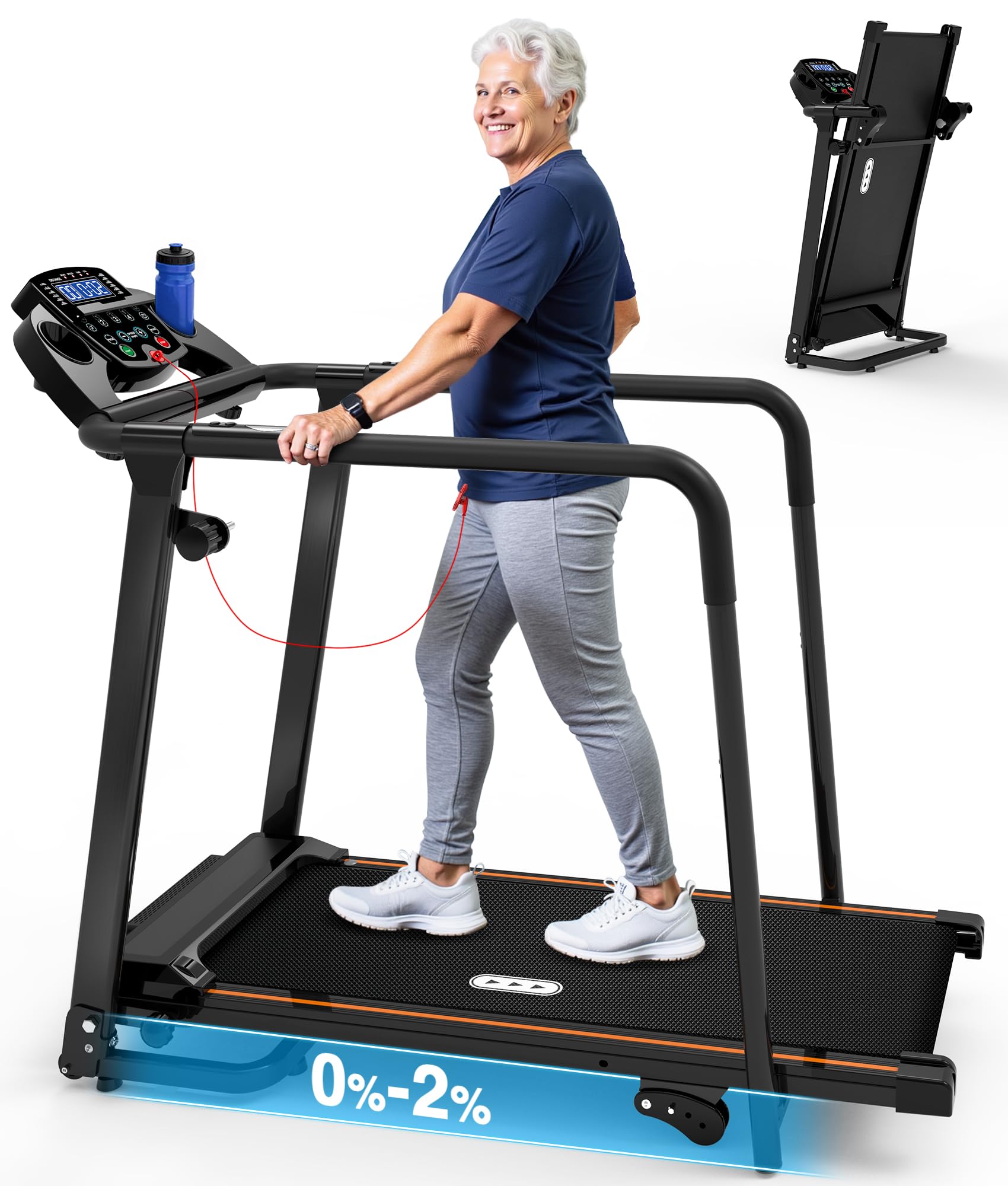
Long handrails are the whole idea. They run higher and further back than the stubby bars on the folding pads, and the speed controls and heart-rate sensors sit on them, so you can start, stop and adjust without letting go. The belt also begins at 0.5 mph and builds gradually, which matters more than any spec line when someone is getting back into walking after a layoff.

The rest of the machine is built for the same walker: 12 built-in programs, a 10-inch LCD, a one-touch mute and screen-off control for early starts, automatic belt lubrication, and a 300-pound capacity on an alloy steel frame. The deck is 39.3 inches long, which is more stride room than most pads here, so a natural pace doesn't feel hemmed in.

This is the treadmill we point to when balance is the deciding factor, and it's the only one here designed around that from the rails down. It isn't a jogging machine and doesn't pretend to be. What it does is make twenty minutes of daily walking feel secure, which is the hardest thing to buy in this category. The 58.6-pound frame is the trade — it's a fixture, not something you slide under the bed — though it folds to 8.5 inches if it has to go against a wall.

Bottom line: When balance is the worry, this is the one we point to: long rails with the controls built in, a 0.5 mph start, and a frame you can trust under a hand.

#6

Vhorilix Walking Pad

Vhorilix Walking Pad

Under-desk walking

Our Score 9.0/10
Check Price

Worth Noting

  • 4 mph ceiling rules out jogging
  • 264 lb limit suits lighter households
Dimensions
42.91 x 19.69 x 4.33 in
Item Weight
36.4 lb
Speed Range
0.6–4 mph
Max User Weight
264 lb
Read the full review

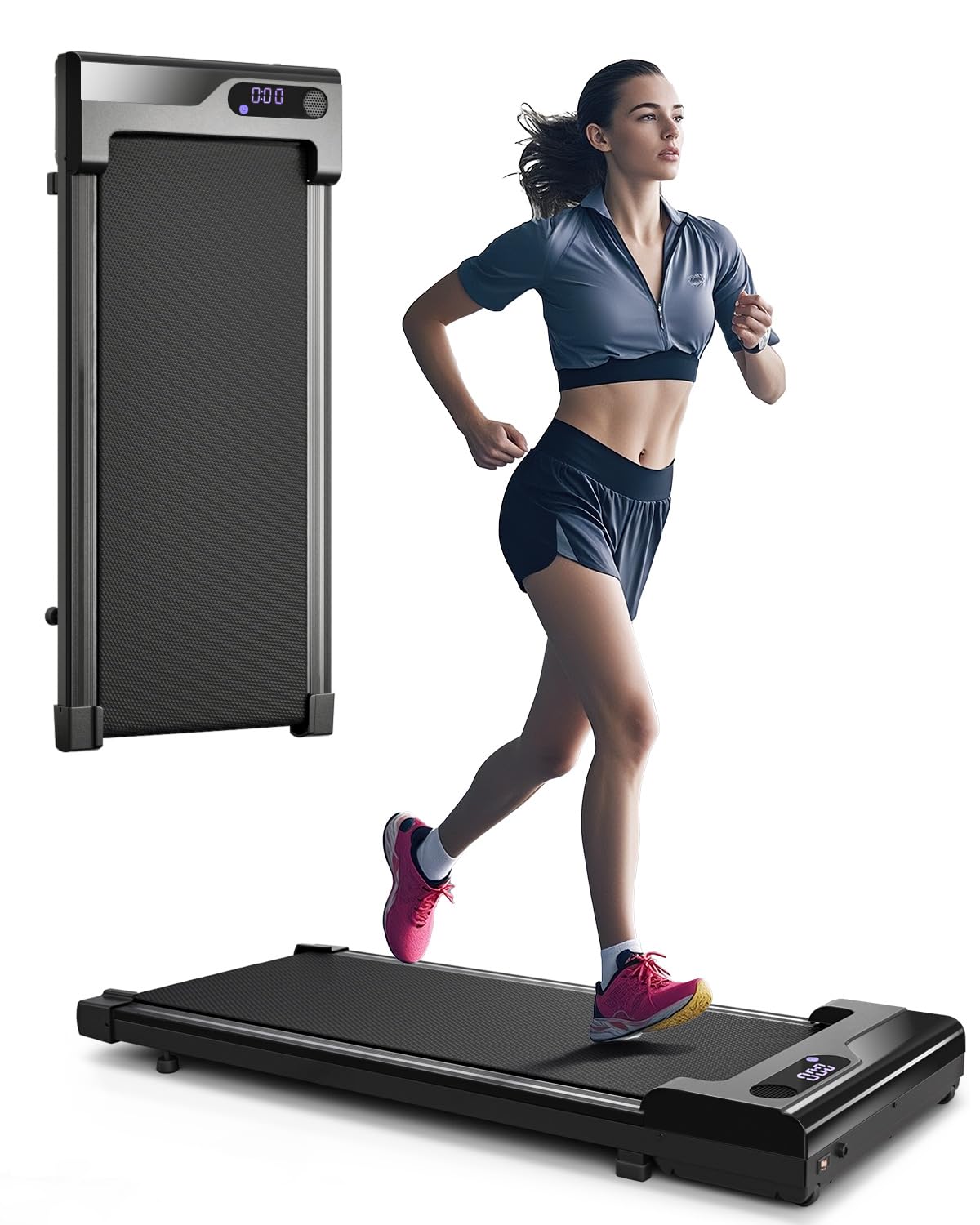
The question that decides whether a walking pad gets used is where it goes when you're not on it. At 4.33 inches tall and 36.4 pounds, this one rolls on front wheels and slides under a bed or a sofa, and it arrives assembled — no bolts, no Allen key, no second pair of hands. Put two AAA batteries in the remote and you're walking.

A 2.5 HP motor carries up to 264 pounds from 0.6 to 4 mph, and the five-layer anti-slip belt sits on silicone shock absorbers, so the deck gives slightly underfoot instead of feeling like a board on a floor. The LED display is small but readable at a glance, and there is nothing to configure before a walk.

That combination — nothing to build, nothing to trip over, and a deck that disappears — is why this is the pad we point most people to. Walking while you work, or catching twenty minutes in front of the TV, is exactly its range, and what reaches the rest of the house is mostly your own footsteps rather than the motor. That is what makes it usable during a call.

Taller walkers with a long stride will feel the shorter deck and should look at the Lontek or the Redliro instead. And if the plan is to stow it under a couch rather than a bed, measure that gap first — 4.3 inches clears most bed frames and far fewer sofas.

Bottom line: Our default recommendation for home and desk walking: it arrives assembled, rolls under a bed, and stays quiet enough to keep a call going.

#7

Lontek U20F-1 Walking Pad

Lontek U20F-1 Walking Pad

Steep incline walking

Our Score 8.6/10
Check Price

Worth Noting

  • 37.4 in deck is short for tall walkers
  • Manual incline, set before you walk
Incline
Flat, 10%, or 15%
Deck Size
37.4 x 15 in
Speed Range
0.6–6.2 mph
Max User Weight
350 lb
Read the full review

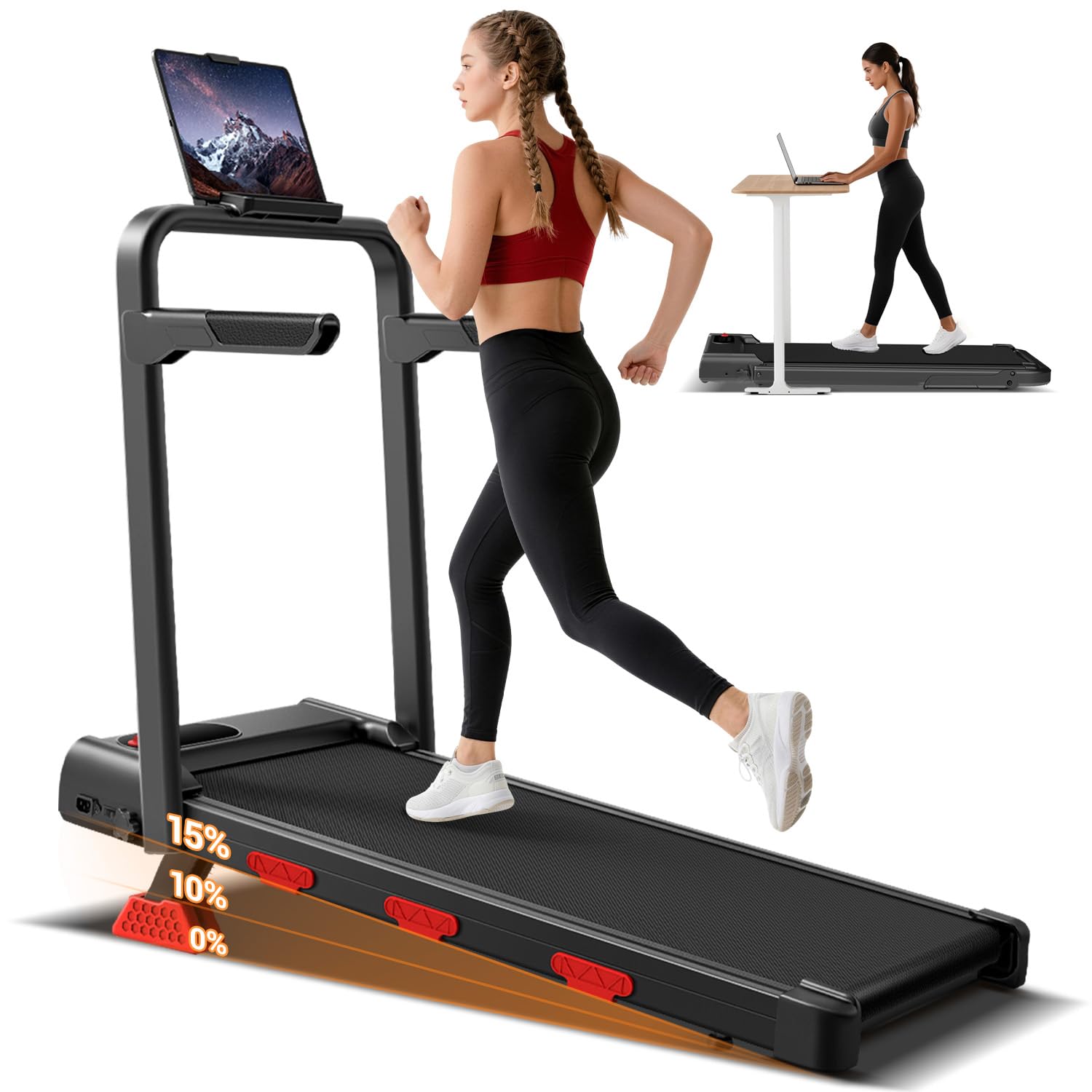
Fifteen percent is a serious grade for a pad you can slide under a bed, and it's the reason to look here. Flip-out legs give you flat, a 10% climb, or the full 15%, and the 3.0 HP brushless motor pulls 0.6 to 6.2 mph with a 350-pound capacity behind it. It's the least expensive machine in this roundup that will let you break into a jog.

The handlebar is low, and that shapes how you use it: taller walkers end up touching it rather than holding it, and the Redliro's long rails are the better answer if support is what you're after. What you're buying here is the incline and the speed, not the rail.

One practical note: the uprights come off with bolts rather than folding on a hinge, so this is a machine you set up in a spot rather than break down after every walk. Set it where it will live and the bolts stop mattering.

Bottom line: We buy the argument: 15% of incline and 6.2 mph for midrange money, provided a 37-inch deck suits your stride.

#8

Viamotion Incline Walking Pad

Viamotion Incline Walking Pad

Budget handrail

Our Score 8.2/10
Check Price

Worth Noting

  • Deck can shift underfoot
  • 3.8 mph top speed
Incline
4% manual
Max Speed
3.8 mph
Dimensions
45.53 x 21.17 x 37.4 in
Max User Weight
265 lb
Read the full review

A rail and a 4% incline for not much more than a flat pad is the pitch, and most of it lands. The handrail folds down with the deck, the display tracks time, distance, speed and calories, and the infrared remote skips Bluetooth pairing entirely — one less thing to reconnect before a walk.

Where it earns its place is slower, steadier walking with a hand nearby, without a full-size treadmill taking over the room. The rail is short, though: at around five foot seven and up, expect to rest a hand on it rather than lean, and the Redliro's long rails are the better answer if support is the point. Shorter walkers won't notice.

The 265-pound capacity and the claimed 45 dB put it in the same territory as machines that cost more, and the fold-down design means it stores against a wall or under a bed frame. Assembly is essentially nil — out of the box, plug in, walk.

For a steady daily walker in a small apartment, that's a fair trade: a rail, an incline and a folding deck for less than the machines with longer rails and steeper grades. Just don't buy it for the rail — treat it as a hand-rest and it does its job.

Bottom line: We think it earns a place for anyone who wants a hand nearby, as long as you treat the rail as a hand-rest rather than real support.

How We Tested the Best Treadmills for Walking

We built a shortlist of about 30 treadmills, from compact folding models to full-size machines, and narrowed it by reading spec sheets, warranty terms, and hundreds of customer reviews before buying 10 at retail. Every unit lived in a real home for six months, not a lab: an office corner, a living room, a basement. We walked on each one most days, usually in socks or barefoot, at 2 to 4 miles per hour, and ran the same routine — a flat 20-minute walk, a 15-minute incline session, and a few faster intervals.

Compact size got measured twice: footprint unfolded, then folded and rolled through a standard doorway. We timed folding and unfolding solo, and handed each console to someone who'd never seen the machine to see whether they could start walking without being told how. For noise, we stood a foot away on a phone call at 3 miles per hour, then again at the steepest incline. For stability, we pushed on the handrails mid-walk and watched the console for shake, and our tallest tester walked at the front of the belt to check whether the deck length forced a shortened stride.

Length and reliability were the slow tests. Over six months we noted belt tracking drift, new squeaks, loosening bolts, and error codes — the things that separate a machine that lasts from one that doesn't. Value came down to what the extra money bought: a sturdier deck, a quieter motor, a warranty that actually covers parts. The treadmills that scored best were the ones we eventually stopped thinking about.

How to Choose Treadmills for Walking

A flat pad or a machine with a rail

This is the fork that decides everything else. A rail-free pad is four to six inches of deck that lives under a desk, a bed or a sofa; it costs less, weighs less, and it's the reason people get steps in during a workday. A machine with a handlebar takes up real floor space but gives you something to hold and usually a steeper incline.

Our rule is simple: if the walk happens during something else — a meeting, a show, a scroll — buy the pad. If the walk is the activity, or someone in the house wants a hand nearby, buy the rail. The Redliro's long rails and the Vhorilix's complete lack of them are the two ends of that range.

Deck length matters more than top speed

Nearly every flat pad here stops at 4 mph, and a brisk walk sits between three and four, so the speed figure rarely decides anything. Deck length does. Under about 37 inches, the belt starts feeling cramped the moment your stride opens up, which is why taller walkers should look at the Redliro's 39.3 inches or the Trailviber's 41-inch deck.

Check the belt length, not the length of the machine. A 46-inch body can hide a 36-inch walking surface once the motor housing is counted, and the listing often quotes the outer dimensions first. If you can't find a deck figure, that's your signal to ask before ordering.

What an incline is worth, and how you change it

Grades in this set run from 2% to 15%. The mechanism matters as much as the number. Manual incline means stopping, moving legs or feet, and starting again; automatic incline changes while you walk, which is the difference between using it every session and setting it once out of curiosity.

Four to five percent is enough to notice at three miles an hour. Twelve to fifteen turns a walk into a climb and needs a frame that won't flex under you. If you'll change the grade mid-session, pay for automatic; if you'll set it and forget it, the manual machines save you money for the same workout.

Weight capacity and what it says about the frame

Capacities here run from 264 pounds to 450. That number tracks frame stiffness as much as it tracks the walker: the machines rated highest also weigh the most, and they're the ones that feel planted rather than skittish underfoot. Lighter 36-to-38-pound pads are far easier to move and more likely to shift when you pick up the pace.

If two people share the machine, or anyone in the house is heavy, buy capacity over convenience. If it's one walker and the pad has to move every day, take the lighter machine and accept that it gives a little.

Setup, storage, and folding that isn't

Most pads arrive ready to walk. Machines with rails generally want some assembly, and a full-size treadmill is a two-person job. A folding handlebar is often bolts that come out rather than a hinge that folds, so a machine advertised as folding for storage may really be a machine you disassemble once and leave set up.

Then measure the gap. Pads sit four to six inches tall, which clears most bed frames and far fewer sofas and low couches. Front wheels mean you tilt and roll rather than push, so leave yourself a clear run to wherever it parks.

Frequently Asked Questions

Final Verdict

Start with the Vhorilix. It arrives assembled, rolls under a bed, and stays quiet enough to walk through a call, which is what most people buying a walking treadmill actually need. Move up to the Trailviber if incline and a heavier walker are part of the plan: 12 automatic levels and a 450-pound frame are worth the money and the floor space.

And if balance is why you're shopping, the answer changes — the Redliro's long rails are the difference between walking with confidence and walking carefully.