Cardio Machines

Best Treadmill Desks of 2026

A treadmill desk only earns its floor space when the desk disappears from your attention. If the tray shudders every time you type, or the laptop sits so far away that you hunch, you will stop walking within a week. The setup that works is sturdy, fits your handlebars or walking pad, and lets you step on for a slow mile without rearranging your office.

I have tried balancing a laptop on a treadmill console, and I do not recommend it. Over the past six months, our team tested 12 treadmill desks and desk attachments, from simple handlebar trays to full treadmills with built-in work surfaces, judging value, quality, assembly, versatility, and how easily each rolls or folds aside. The good ones felt solid at a slow walking pace and adjusted without drama; the weak ones wobbled, pinched fingers, or put the controls out of comfortable reach. One surprise: top speed matters far less than a stable desktop and a comfortable elbow angle, since most people type best at a slow stroll. The picks below are built for that real workday pace, not the product photo.

#1

HUANUO Rolling Standing Desk

Top Pick
HUANUO Rolling Standing Desk

Walking pads

Our Score 9.4/10
Check Price

Worth Noting

  • Shallow top cramps a monitor
Wheels
Four locking casters
Capacity
200 lb
Top Size
31.5 x 15.75 in.
Height Range
28 to 46 in.
Read the full review

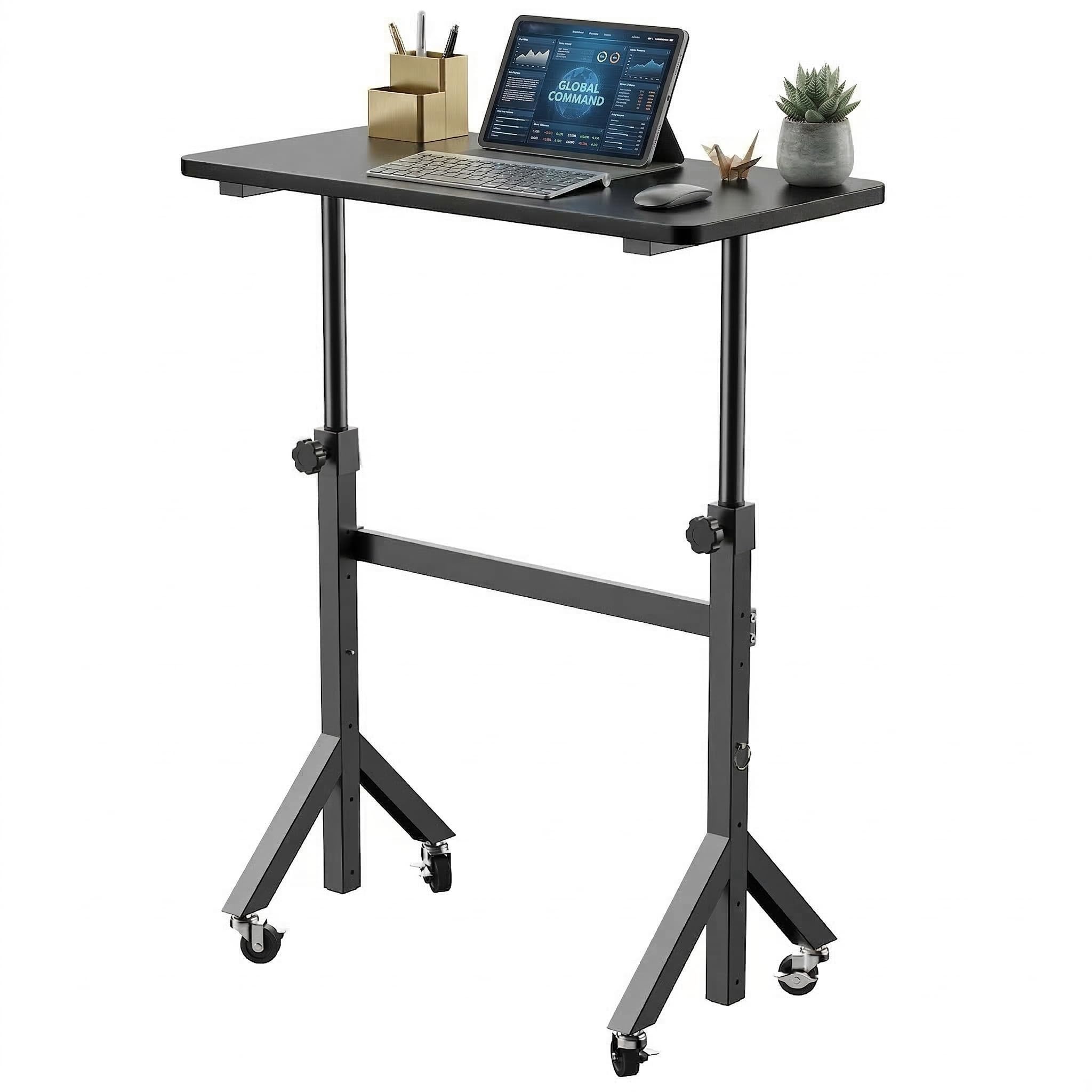
The HUANUO is a desk on casters, not a tray that straps to handrails. It rolls over a walking pad on four 360-degree casters, each with its own lock, and the top adjusts from 28 to 46 inches. The 31.5-by-15.75-inch surface is enough for a laptop and a notebook; the Y-shaped steel base is the reason it feels more planted than the usual rolling cart.

We recommend it for a walking pad because the height range covers both sitting and standing, and the locks keep it from drifting when you type. The 200-pound capacity is far more than a laptop needs, but it also means you can lean on the edge without feeling the frame flex. Assembly is straightforward, and the casters roll easily and lock down when you need them to.

It is still a freestanding desk, so it needs floor space beside or over the pad; if your room is tight, measure the footprint before you buy. For a walking pad in a home office, though, it is the most flexible piece here.

Bottom line: For a walking pad, the HUANUO is our pick: it rolls into place, adjusts from 28 to 46 inches, and locks down to type.

#2

Miden Treadmill Desk Attachment

Miden Treadmill Desk Attachment

Existing treadmills

Our Score 9.2/10
Check Price

Worth Noting

  • Flat handrails only
Setup
Two nylon straps
Weight
4.9 lb
Tray Size
35.4 x 14.2 in.
Handlebar Type
Flat handrails
Read the full review

The Miden tray is the one we reach for first when a treadmill has flat handrails. Two nylon straps cinch it down, no tools are needed, and the whole thing lifts off in seconds when you want the treadmill back. The tray is 35.4 by 14.2 inches, enough for a 16-inch laptop, a mouse, and a phone without turning into a balancing act. We especially like the raised lip and rubberized surface: they give a laptop something to push against while the belt moves.

At a walking pace, the tray stayed planted on the arms; the anti-slip top and strap tension do most of the work. A hard pull or a lean on the front edge can slide it off the handrails, so this is a tray for normal typing posture, not a makeshift standing desk to lean on. At 4.9 pounds, it is light enough to move between rooms, and the low profile leaves room for your stride.

If your treadmill has curved, padded, or unusually wide arms, the VIVO is the better shape. For flat arms, this is the tray we leave on the treadmill between sessions, because it adds a work surface without adding another piece of furniture.

Bottom line: We recommend the Miden first for a flat-handrail treadmill; it goes on without tools and stays steady at a walking pace.

#3

Qsxou Treadmill Desk Attachment

Qsxou Treadmill Desk Attachment

Drinks and devices

Our Score 8.8/10
Check Price

Worth Noting

  • No height adjustment
Weight
5.8 lb
Capacity
22 lb
Tray Size
34.65 x 25.2 in.
Device Holders
Cup, phone, tablet
Read the full review

A cup holder sounds like a minor thing until you are midway through a walking meeting and your coffee is on the floor. The Qsxou tray has one, plus a phone and tablet slot, a raised edge guard, and cooling holes under the laptop. It measures 34.65 by 25.2 inches and weighs 5.8 pounds, so it holds a laptop, a notebook, and a drink without becoming a shelf you have to clear every time.

We like this one for a full workstation, not just a laptop perch. The edge guard keeps a mouse from rolling off, the cooling holes are a practical touch for a laptop that runs warm, and the twin straps install without tools. The 22-pound capacity is modest, but it covers the laptop and gear most people bring to a walking desk.

The trade-off is grip. The top is not as secure as Miden's rubberized surface, and a laptop can creep when the belt gets going or when you bump the tray. The 25.2-inch depth also makes it a big piece to leave on the arms, so measure your handlebar span before you commit. For a dedicated walking workstation with a drink and a tablet, though, it is the most useful layout here.

Bottom line: For a walking workstation with a drink and a tablet, we like the Qsxou's cup and device holders best.

#4

THAILE Adjustable Walking Pad Desk

THAILE Adjustable Walking Pad Desk

Tight spaces

Our Score 8.8/10
Check Price

Worth Noting

  • Narrow top is tight for a monitor
Assembly
None required
Capacity
150 lb
Top Size
25 x 28 in.
Height Range
28 to 32 in.
Read the full review

The THAILE is the odd one out: a compact table that arrives assembled and does not roll, strap, or fold. The top is 25 by 28 inches, the height runs from 28 to 32 inches, and the frame is rated for 150 pounds. In a tight corner, that small footprint is the appeal; you are not giving up a whole wall to a treadmill desk.

We like it for a low walking pad or a short user who wants a dedicated surface without casters. The 150-pound capacity is generous for a table this size, and the compact top stays out of the way in a small room. It is also the easiest pick to live with in an apartment, because there is nothing to assemble and nothing to roll away.

The catch is the height ceiling. At 32 inches, it is too low for most tall users and for a standing desk over a thick treadmill deck; this is a desk for a low pad or a seated setup. For a compact, no-assembly corner, it works; for a full workstation, choose a taller rolling desk.

Bottom line: Our compact pick for a tight corner is the THAILE, but its 32-inch height ceiling rules it out for taller users.

#5

UREVO Foldable Treadmill Desk

UREVO Foldable Treadmill Desk

All-in-one setup

Our Score 8.4/10
Check Price

Worth Noting

  • Controls can be finicky
Motor
3.0 HP dual brushless
Speed
0.6 to 7.6 mph
Incline
12% automatic
Capacity
300 lb
Read the full review

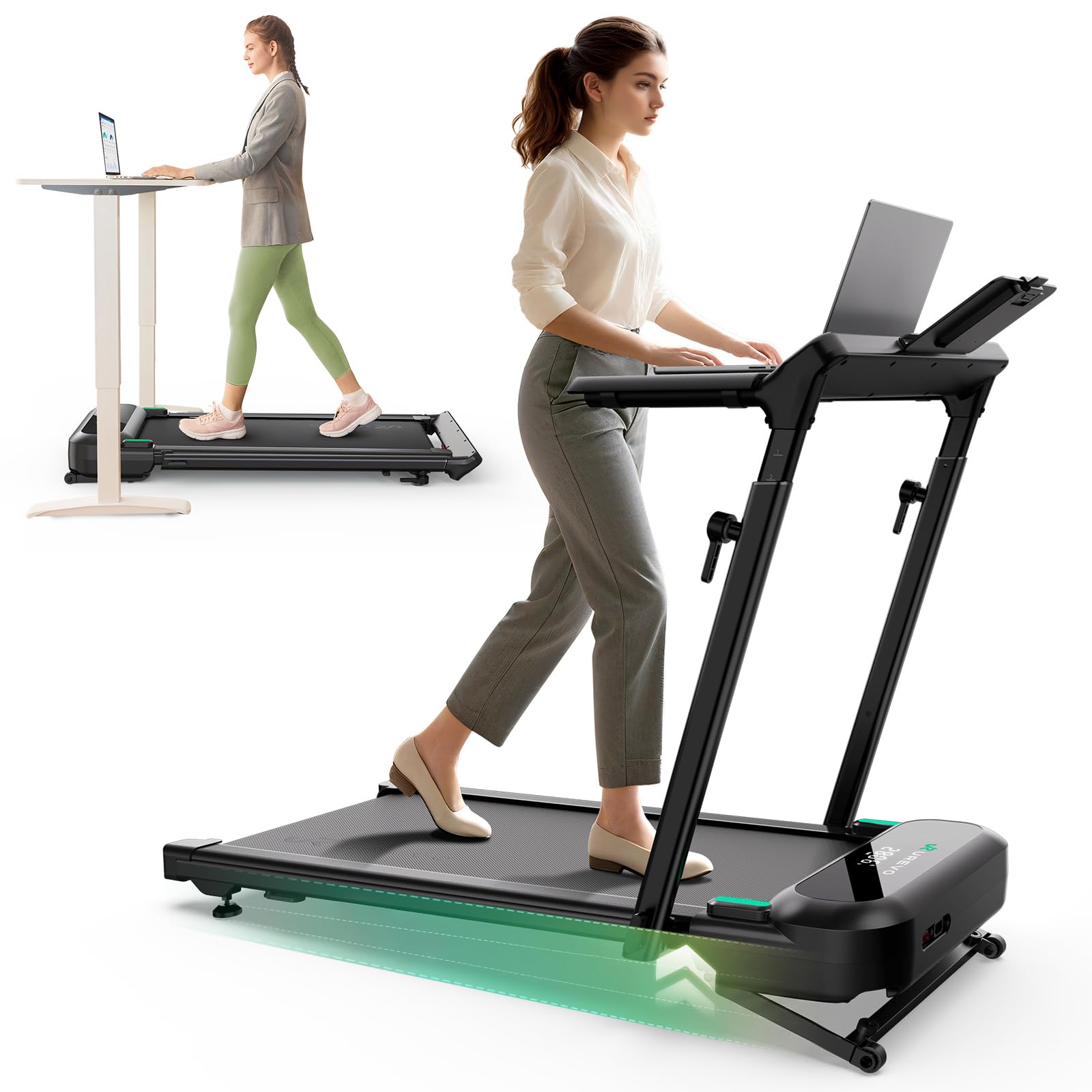
The UREVO is the only pick here that replaces the treadmill and the desk with one machine. It has a height-adjustable laptop desk over a 0.6-to-7.6-mph treadmill, plus a 12% automatic incline and a 300-pound weight capacity. The frame folds down to 52.4 by 24.6 by 6.1 inches, so it can tuck under a couch or stand against a wall.

We were impressed by the 3.0-horsepower dual brushless motor and the quiet ride; the incline is the feature that makes this more than a walking pad. The desk adjusts separately from the handlebars, which helps you find a typing height instead of accepting whatever the arms dictate. It is still a treadmill first, so the belt and deck are the parts doing the real work.

For someone starting from scratch, this is the simplest way to get a walking desk without buying two pieces. The 75-pound frame wants a permanent spot, so measure the corner before it arrives. If you already own a treadmill, a tray gets you most of the way without giving up the floor space.

Bottom line: The UREVO is our one-machine answer for someone starting from scratch, with a 7.6-mph treadmill and a height-adjustable desk.

#6

VIVO Treadmill Laptop Desk

VIVO Treadmill Laptop Desk

Wide handlebars

Our Score 8.0/10
Check Price

Worth Noting

  • Wobbles at faster walking speeds
  • Laptop strap tight on large devices
Weight
13.2 lb
Tray Size
26.9 x 11 in.
Handlebar Fit
Up to 45 in.
Height And Tilt
Adjustable, 0° to -25°
Read the full review

VIVO solves the treadmill that Miden cannot: the one with wide, curved, or shared handlebars. The mount fits arms up to 45 inches, and the tray adjusts for height with a 0- to -25-degree tilt, so you can angle a screen toward your eyes instead of hunching over it. At 13.2 pounds, it is the heaviest tray here, but that steel frame is why it feels more like a fixture than a lap tray.

We appreciate the wrist pad and mouse pad, because a bare metal tray gets old fast. The height adjustment is useful for sharing the treadmill with someone taller or shorter, and the tilt makes a laptop or tablet easier to read. Assembly takes a drill, so plan on a one-time setup rather than moving it between machines.

The 26.9-by-11-inch tray is narrower than the others, so a full-size keyboard and mouse will feel packed in. That is the main reason we do not use it as our default. For a permanent setup where the screen angle matters more than spreading out, the extra steel and the 3-year warranty earn their place.

Bottom line: We choose the VIVO when a treadmill has wide or curved arms, because its tray tilts and adjusts up to 45 inches.

How We Tested Treadmill Desks for a Real Workday

We started by researching both full treadmill desks and add-on trays, then narrowed the field by handlebar compatibility, desktop footprint, height range, assembly requirements, and the kind of floor space each setup needs. We ruled out models with vague fit measurements or controls placed where a typist would have to reach blindly. The final 12 included handlebar trays, adjustable standing desks on wheels, and complete treadmills with integrated work surfaces.

Testing ran for six months in home offices, with each unit assembled solo and timed. We noted whether the hardware made sense, how many tools were needed, and whether the desk wobbled once a laptop, mouse, phone, and cup were loaded on. We then walked at a typing pace, roughly 1.5 to 2.5 mph, while answering email, joining calls, and watching video, checking elbow height, wrist angle, and whether the controls stayed within easy reach. Wheeled and folding models were rolled across carpet and hard floor, folded and unfolded, and checked for whether they stayed put once positioned.

Fit got its own pass: we adjusted each tray or desk through its full height and width range, then tried it with different laptop sizes and handlebar spreads to see where the surface became cramped or the screen sat too close. Stability was judged at the moment of typing, not just while standing still; a desk that shimmied at a slow walk lost points no matter how good it looked. We also weighed versatility, meaning whether it could serve as a standing desk, a walking workstation, or both, and value, meaning whether the hardware, surface, and adjustment quality justified the space it took up. The setups that survived were the ones we kept using after the formal test ended.

How to Choose a Treadmill Desk

Match the Mount to Your Treadmill

Strap-on trays are the least intrusive way to add a desk. They rest on the treadmill's handrails, so they work only when those arms are flat and close enough to the tray's span. Curved, padded, or unusually wide arms need a different mount. A freestanding rolling desk avoids that problem, but it takes floor space and needs a clear path over or beside the walking pad. Measure your handrail span and the height of your walking pad before choosing. If you already own a treadmill with flat arms, a tray like the Miden is the simplest fit. If you have a walking pad with no arms, start with a rolling desk instead.

Set the Work Surface at Your Height

Treadmill desks fail at the same place a regular standing desk does: the wrong height. A tray sits at whatever height your handrails dictate, which is fine if that lands near your elbows but miserable if it forces you to hunch. A freestanding desk with a height range of roughly 28 to 46 inches covers more bodies and lets you switch between sitting and standing. Surface depth matters too. A 15- to 16-inch-deep top holds a laptop and mouse; a 25-inch-deep tray can hold more gear but eats handlebar space. Measure your standing elbow height and compare it with the desk's full range, not just its maximum.

Expect Some Movement at Walking Speed

Every treadmill desk moves a little; the question is whether it moves while you type. A tray with a raised lip, a rubberized surface, or an edge guard gives a laptop something to catch on. Locking casters keep a rolling desk from drifting, and a wide base helps on carpet. Wobble tends to show up faster as you increase speed, so test a new setup at a slow walk before you trust it with a full coffee mug. If you plan to walk fast, choose a heavier mount or a freestanding desk with a wide stance.

Plan for Space and Setup

Attachments are easy to remove, which matters if the treadmill is shared or you want it back for running. Rolling desks move out of the way but need a parking spot. All-in-one treadmills save the separate desk but weigh more and take up a permanent corner. The UREVO folds, yet its 75-pound frame is not something you move up stairs often. Think about the room you have and the number of people using the setup before you pay for more machine than you need.

Frequently Asked Questions

Final Verdict

For most people who already own a treadmill with flat handrails, the Miden is the one to buy. It straps on without tools, has enough surface for a laptop and mouse, and stays steady at a walking pace. The flat-handrail requirement is the one box to tick before ordering.

If your treadmill has curved or wide arms, the VIVO's 45-inch fit and adjustable tilt are worth the extra weight and fiddling. If you have no treadmill at all, the UREVO is the cleanest all-in-one, though its 75-pound frame wants a permanent spot.