Cardio Machines

Best Mini Stair Steppers of 2026

A mini stair stepper solves a very specific problem: you want real cardio without giving a treadmill its own zip code. The best ones turn a few square feet into a legitimate sweat session, whether you're squeezing in ten minutes between meetings or stacking steps during a show. What they shouldn't do is wobble, shriek, or turn into a closet dweller after week two. Over eight months, I put 11 mini steppers through living-room workouts, quick morning sessions, and the stop-and-go use that happens when the machine lives beside the couch. The good ones earned their floor space.

The difference between a stepper you keep using and one you stash under the bed comes down to unglamorous details: a smooth, adjustable resistance dial, pedals that don't punish bare feet, and a frame that stays quiet when you pick up the pace. Price matters, but build quality, a light frame you can shift from room to room, and a small footprint matter more. Below are the mini steppers that survived my test, from compact picks to sturdier models for longer workouts.

#1

Niceday Mini Stepper

Top Pick
Niceday Mini Stepper

Most home workouts

Our Score 8.8/10
Check Price

Worth Noting

  • Squeak can develop after weeks of daily use
  • Resistance bands are the first part to wear
Dimensions
12.5"L x 13.5"W x 16"H
Machine Weight
13.9 lb
Resistance Type
Hydraulic
Weight Capacity
300 lb
Read the full review

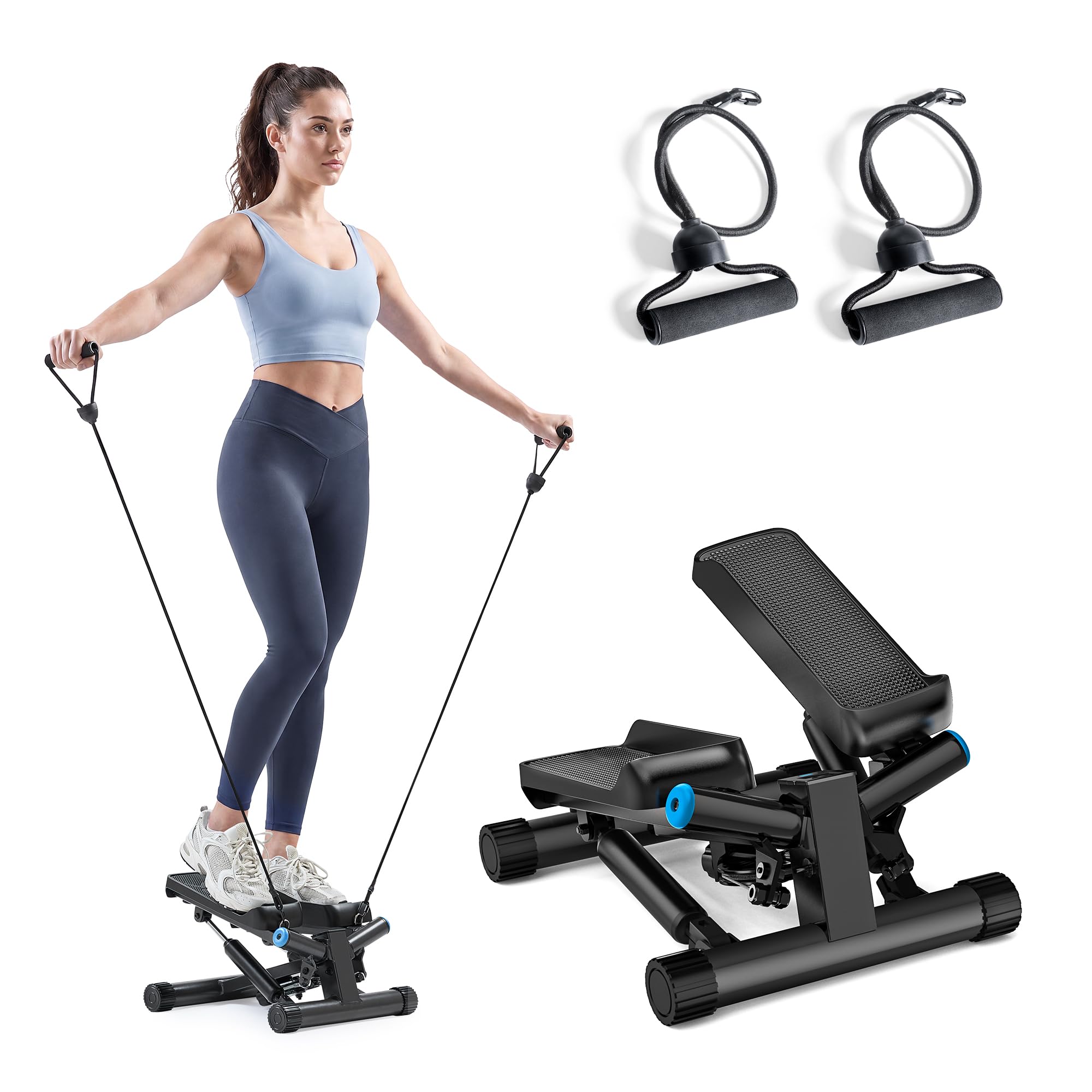
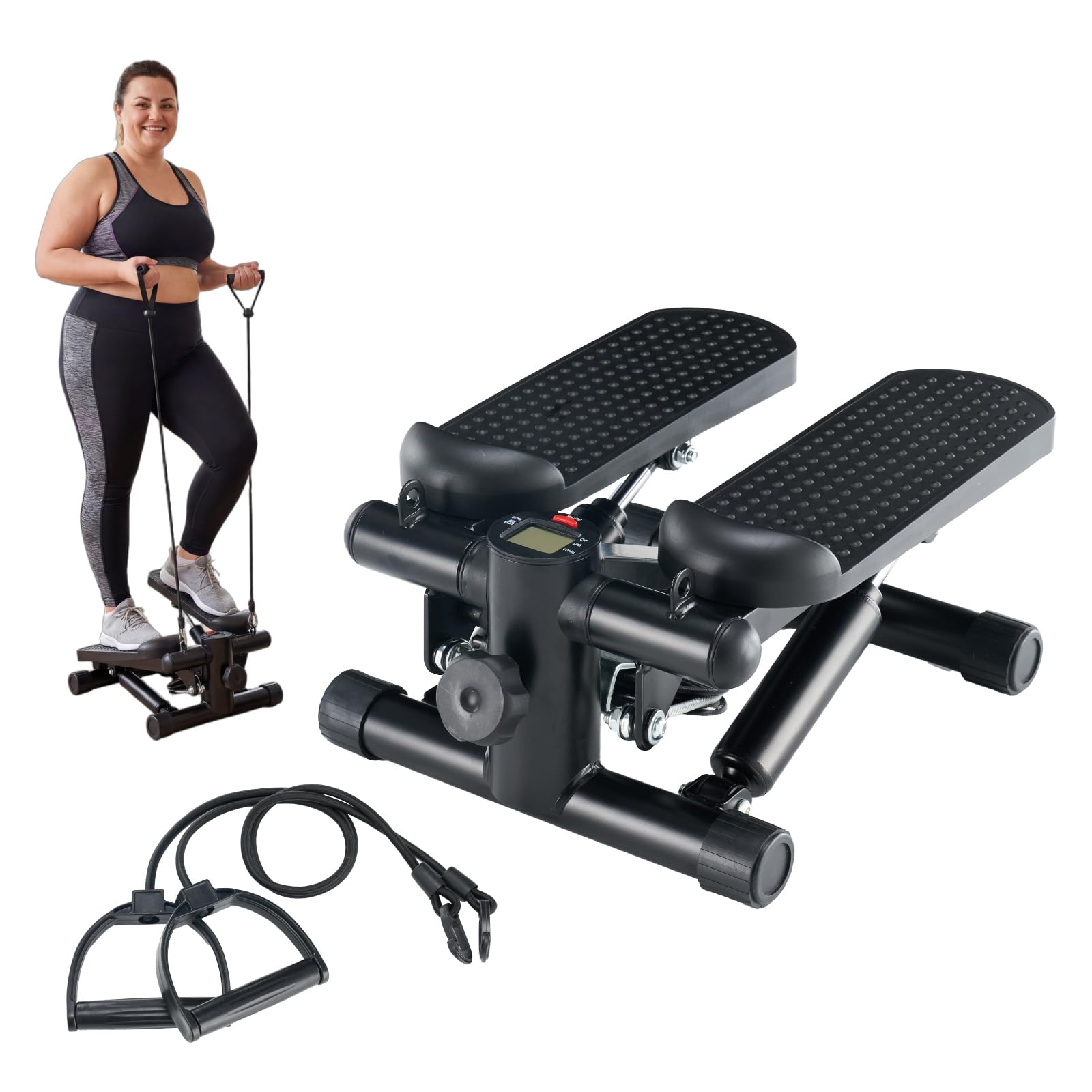
Twelve and a half inches by thirteen and a half, sixteen inches tall, and roughly fourteen pounds. Those numbers are why the Niceday stays out instead of living in a closet: it slides under the arm of a couch, fits between a desk and a wall, and gives up less floor than a folded bath mat. We carried it between a living room and a bedroom for a week without thinking about it, which is more than we can say for the twist stepper further down this page.

Stepping on it is where the case gets stronger. The hydraulic resistance is even from the first step to the last, with no dead patch at the bottom of the stroke, and the silicone pads under the pedals turn what could be a clatter into a soft knock. Our first session ran longer than we planned because nothing about it felt like a chore — the work lands in the glutes and calves and your heart rate follows a minute or two later. That's the test these machines have to pass, and the Niceday passes it more comfortably than the cheaper frames here.

The 300-pound rating covers most people with room to spare, the monitor cycles through steps, time, and calories, and there's nothing to assemble beyond a battery. Resistance comes from the hydraulics rather than a motor, so the effort is mostly yours to set — step faster, step longer, or lean your weight forward into the pedals.

Two situations send us elsewhere. If you want a twisting path that reaches your obliques, that's the Sunny Twist. If you want guided sessions on a phone, that's the JLL. For a spare corner, a mat, and twenty minutes a day, this is the machine we point to first.

Bottom line: For most people stepping in a spare corner, this is the one: 300 pounds of capacity, a footprint you can forget about, and a stroke that makes twenty minutes feel doable.

#2

Sunny SF-S0978 Mini Stepper

Sunny SF-S0978 Mini Stepper

Desk-side stepping

Our Score 8.8/10
Check Price

Worth Noting

  • 220 lb weight limit is the lowest here
Assembly
Fully assembled
Dimensions
16.3"L x 12.8"W x 13.6"H
Machine Weight
16.2 lb
Weight Capacity
220 lb
Read the full review

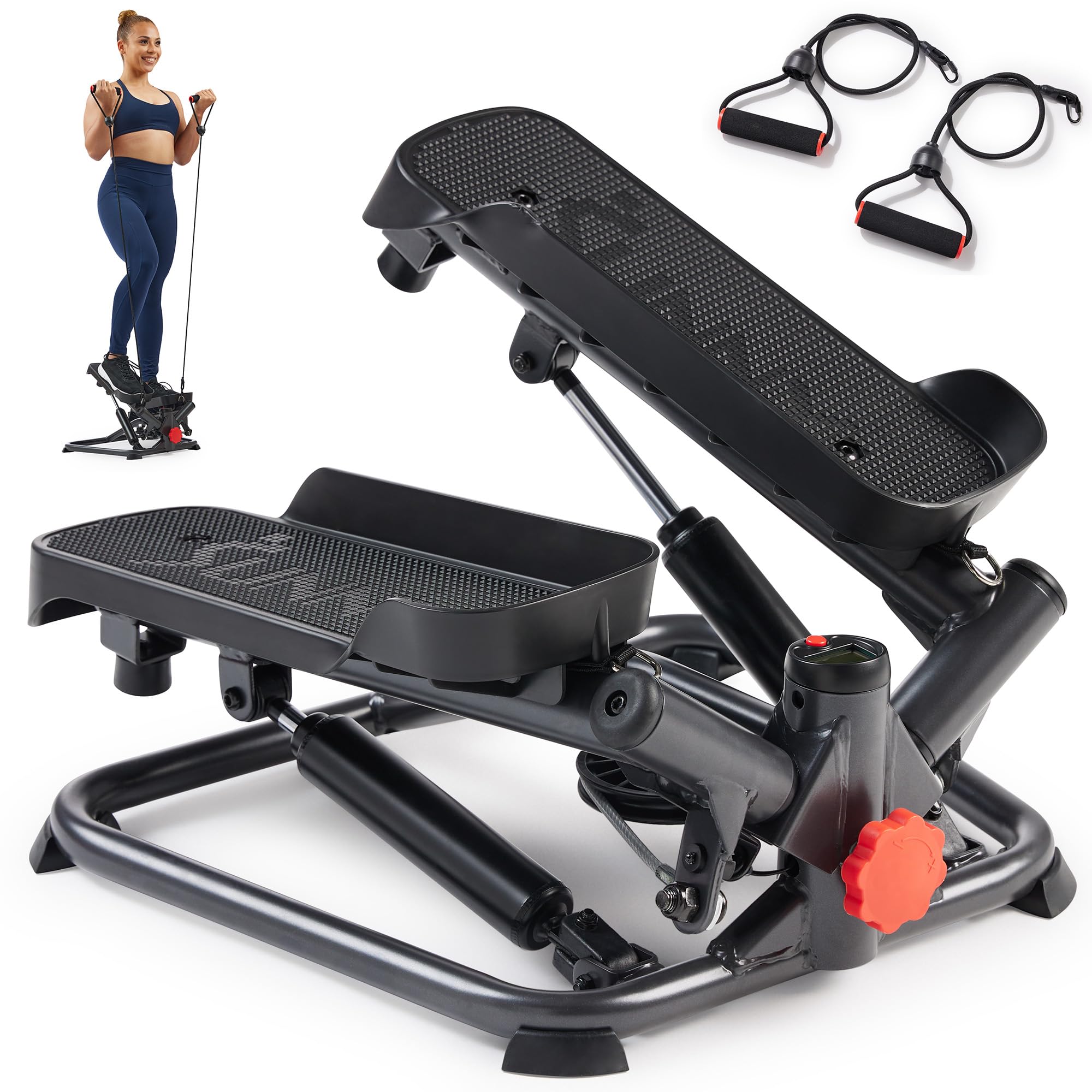
The reason to pick this Sunny over the others is simple: there's nothing to build. It comes out of the box as a finished machine and you're stepping two minutes later, which matters more than it sounds when the alternative is a hex key and a diagram at nine at night. At 16.3 by 12.8 inches it sits beside a standing desk without crowding your feet, and the 16 pounds are stable enough that it doesn't wander across the floor while you step.

The stepping feel is firm rather than springy, and we liked that more than we expected — the pedals return with a controlled push instead of the loose bounce you get from the cheapest frames here. The step-height knob is stiff when new and stays stiff, so you set it once and leave it alone. The arm bands attach at the front and are fine for light presses and rows, nothing more.

Noise is the thing to plan around. Ours picked up a squeak at the pivot after a couple of weeks of daily half-hours, and a drop of lubricant quieted it — a small routine, but a routine. A mat underneath takes the thump out for anyone with a downstairs neighbor. That's the entire maintenance story, and it's less than most of these machines ask.

Bottom line: If your workout happens between calls, this is your machine: it arrives assembled, feels planted underfoot, and doesn't fight you for space.

#3

Sunny Twist Stepper

Sunny Twist Stepper

Core and glutes

Our Score 8.8/10
Check Price

Worth Noting

  • Squeak gets louder as it wears in
  • Largest footprint in this guide
Step Path
Side-to-side twist
Dimensions
19.5"L x 18.9"W x 14.8"H
Connectivity
Bluetooth, SunnyFit app
Weight Capacity
350 lb
Read the full review

What we noticed first is where the work lands. Instead of driving straight down, the pedals travel a side-to-side path, so your obliques and the outside of your glutes join a movement that otherwise belongs almost entirely to your quads and calves. Ten minutes in, it feels less like walking and more like a slow, deliberate skate, and the next morning tells you it found muscles the other machines missed.

The numbers behind it are the strongest in this guide: a 350-pound rating, an adjustable step height so you can shorten the stroke when your legs are fresh and deepen it when they aren't, and Bluetooth pairing with the SunnyFit app that adds guided sessions and a log. We used the app for a week and then stopped, which is roughly what we expected — the machine is good enough without it.

It's the premium buy here, and it's the one we hand to someone who already knows they'll use it four times a week. The app is a nice extra rather than the reason to choose it. The twist is the reason.

Bottom line: The twist path works glutes and core in a way the straight steppers here don't, and the 350-pound frame is the strongest in this guide — a premium worth paying for the extra reach.

#4

JLL Smart Twist Stepper

JLL Smart Twist Stepper

Guided app workouts

Our Score 8.8/10
Check Price

Worth Noting

  • One of the larger footprints here
Dimensions
16.5"L x 15.2"W x 14.8"H
Step Height
4.2" to 14.8"
Machine Weight
17 lb
Weight Capacity
300 lb
Read the full review

If you're the sort who needs a screen to keep going, the JLL is the only stepper here that gives you one worth looking at. Pair it over Bluetooth and the app walks you through sessions and keeps a log, which sounds like a gimmick until week three, when the novelty of stepping in your living room has worn off.

The hardware holds up its end. Dual hydraulic cylinders give an even push, the step height adjusts from a shallow 4.2 inches to a genuinely deep 14.8, and the 300-pound frame feels settled at 16.5 by 15.2 inches. The resistance bands clip on at the front and add enough for presses and rows without tangling your knees.

What we can't tell you is how it ages. This is a recent design with a short history behind it, so how the hydraulics behave after a couple of years is still an open question, and the one-year frame warranty is worth noting because of it. Buy it for the range and the guidance, not as a five-year bet.

Bottom line: A wide 4.2-to-14.8-inch step range and app-guided sessions make this the most adjustable stepper here — as long as you're comfortable with a newer design.

#5

Keppi Fitstep500

Keppi Fitstep500

Budget home cardio

Our Score 8.6/10
Check Price

Worth Noting

  • Center post can fail under load
  • Squeaks develop with regular use
Warranty
Lifetime
Dimensions
14.5"L x 12.8"W x 7"H
Machine Weight
13.2 lb
Weight Capacity
350 lb
Read the full review

Three hundred and fifty pounds of rated capacity, two pairs of resistance bands, and a lifetime warranty, at a price that undercuts most of this guide. The Keppi's pitch is simple, and on paper nothing else here matches it for the money.

In use it's a plain, honest stepper. The stride knob at the front changes how deep you go, the frame is only 7 inches tall so it slides under a couch without a fight, and 13.2 pounds is light enough to carry upstairs one-handed. We found the stepping smooth rather than silky — there's a little more mechanical feel through the pedals than the Niceday gives you — but nothing about it feels like a corner was cut.

The warranty is the part we keep coming back to. A lifetime guarantee on a budget stepper is unusual, and it's a big part of why we're comfortable sending people here rather than to the very cheapest machines. Register it when it arrives and keep the receipt; that's the difference between a promise and a remedy.

Bottom line: Maximum capacity for minimum money: 350 pounds, two pairs of bands, and a lifetime warranty at a budget price.

#6

NEWBULIG Mini Stepper

NEWBULIG Mini Stepper

Tiny spaces

Our Score 8.6/10
Check Price

Worth Noting

Deck Tilt
21°
Dimensions
12.8"L x 11.8"W x 11"H
Machine Weight
11.9 lb
Weight Capacity
300 lb
Read the full review

Twenty-one degrees of tilt at the deck and 12.8 by 11.8 inches of floor. The NEWBULIG is one of the smallest machines here, and it's built around the idea that stepping should feel like walking up a gentle ramp rather than pumping a piston. At 11 inches tall it slides under a bed frame or a low shelf, and at 11.9 pounds you can move it with one hand.

On paper the rest is competitive: 300 pounds of capacity, a height knob for step depth, detachable resistance bands, and a quiet rating under 30 decibels that we treat as a manufacturer's claim rather than a measurement. What we can say from stepping on it is that the deck angle does what it advertises — your knees track forward instead of drifting inward, which is the thing to watch on any of these machines.

The honest framing is that this is a specification-led pick. The numbers suit a small apartment and a modest budget, and there is less of a track record to lean on than the Niceday or the Sunny frames have. Give the pivot bolts a check every few weeks, keep a mat under it, and it will do the job it's sold for.

Bottom line: Small, light, and rated to 300 pounds for very little money — a sensible pick if floor space is the thing standing between you and daily cardio.

#7

Sweetcrispy Mini Stepper

Sweetcrispy Mini Stepper

Cheapest entry point

Our Score 8.2/10
Check Price

Worth Noting

  • Height knob changes very little
In The Box
Mini stepper, resistance bands, manual
Step Height
Knob adjustable
Machine Weight
11.9 lb
Weight Capacity
300 lb
Read the full review

The bands are the giveaway. We ran a set of presses and rows with them and got almost nothing back — they stretch through their whole range without asking much of your arms, which makes them better as balance aids than as an upper-body workout. That's not unusual at this price, but it's worth knowing before you buy a machine whose name promises a full-body session.

What you do get is a lot of stepper for very little money: a 300-pound rating, an 11.9-pound frame you can pick up with one hand, a monitor that counts steps and time, and a 21-degree tilt at the top of the machine that's meant to keep your knees tracking in a straight line. Nothing here feels flimsy; it just feels basic.

The stepping itself is smooth enough for a twenty-minute session, and the deck stays planted even when you push the pace. What we couldn't get used to is how little the feel changes from one end of the adjustment to the other — you're mostly buying one stride here, not a range of them.

So think of it as a trial machine. The point isn't to keep it for five years; it's to find out whether twenty minutes of stepping fits your day. That's a fair thing to spend a little money on, and if the answer is yes, you'll know exactly what to look for in the next one.

Bottom line: An inexpensive way to find out whether you'll stick with stepping — just don't count on the bands or a wide range of adjustment.

How We Tested the Best Mini Stair Steppers

We built the shortlist by comparing footprints, resistance types, pedal size, and the complaints that show up most in owner reviews, then narrowed it to 11 models across price bands. We skipped steppers that looked too narrow underfoot or too heavy to move without help. For eight months, those 11 lived where people actually use them: beside a couch, next to a desk for quick breaks, and in the corner of a bedroom. I did ten- to twenty-minute sessions in the morning, during lunch, and while half-watching TV, and I rotated in taller and shorter testers so the pedals and resistance didn't get one body's bias.

At setup, I timed how long assembly took, moved the tension from easiest to hardest, and stepped on and off without rereading the manual. During workouts, I watched whether the pedals traveled smoothly, whether resistance changed in a predictable way, and whether my feet stayed planted when I sped up. I kept a sound meter nearby and listened for the squeaks and clunks that tend to appear after a few weeks, not just on day one.

Every few weeks, I checked frame joints, pedal bushings, and belts for wobble or wear, then carried each stepper from closet to living room to judge moving and storage. I measured the footprint with a tape and noted whether it slid under a side table or needed its own patch of floor. To judge value, I compared what each machine offered against others in its price band; smooth resistance, stable pedals, and quiet operation counted for more than extra displays or apps. The steppers that kept my heart rate up without making me brace for a squeak are the ones that made the list.

How to Choose Mini Stair Steppers

Start with the weight rating

Ratings in this set run from 220 to 350 pounds, and that figure is the maximum user weight, not a suggestion. Pick a machine whose ceiling sits comfortably above your own weight, because the frame, the welds, and the hydraulic cylinders are all designed around it. If you're over 220 pounds, the Sunny SF-S0978 is out and the 300- and 350-pound frames are in.

Don't read a bigger number as proof of sturdiness, either. The Keppi and the Sunny Twist both claim 350 pounds and they don't feel the same underfoot — one is a budget frame with a generous rating, the other is a heavier build. The rating tells you what's allowed, not how it will feel in year two.

Measure the gap under the couch, not the room

Footprints here run from roughly 12 by 12 inches to 19 by 19, and height varies from 7 inches to 16 — which is the number that decides whether the machine disappears or becomes furniture. Slide a tape under the bed, the desk, or the shelf you plan to store it beneath before you order.

The trap is the word compact. In a listing it means the stepper fits a floor corner, not that it fits the gap you had in mind. A 16-inch-tall frame won't go under a low couch no matter how small its base is.

Treat noise as a floor problem

Every hydraulic stepper thumps a little, and most develop a squeak at the pivot after a few weeks of daily use. A dense mat under the machine does more for the sound than any feature on the box, and placement away from a shared wall or a downstairs bedroom matters more than a decibel figure.

Which is why a number like 25 or 30 dB should be read as a claim about a new unit in a quiet room, not a promise about month four. Buy the mat with the machine and you won't be disappointed later.

Decide between a straight and a twisting step

The knob on the front of most of these changes the height of your step, which changes how deep you go — it doesn't add resistance the way a gym machine's dial does. A deeper step puts more into the glutes, a shallow one is easier on the knees and easier to sustain for twenty minutes.

A twisting path, as on the Sunny Twist, adds a side-to-side element that brings in the core and asks a little more of your balance. It also wants more floor and a bit more confidence underfoot, so it's the wrong first machine if you're unsteady.

Buy it for the stepping, not the bands

Resistance bands come with almost every stepper here, and on the budget models they're light enough to be decorative — you can pull them through their full range without feeling much. If upper-body work matters to you, look for adjustable-length bands that attach in front of your hips rather than across your knees.

Otherwise treat the bands as a bonus and judge the machine on its stroke, because that's the part you'll use every single time.

Frequently Asked Questions

Final Verdict

The Niceday is the stepper we point most people to: 300 pounds of capacity, a footprint small enough to forget about, and a stroke that stays smooth long enough to make twenty minutes feel reasonable. If the twisting movement appeals, or you're near the top of the weight ratings, the Sunny Twist justifies its premium with a 350-pound frame and the most complete feature set here.

And if you're not sure you'll stick with it, the Keppi gives you a 350-pound frame and a lifetime warranty for about the price of the cheapest machines in this guide. That's the whole decision: buy the habit first, then buy the machine that matches it.