Cardio Machines

Best Indoor Bike Trainers of 2026

An indoor bike trainer should make a snowy Tuesday feel like part of your training plan, not a test of patience. The wrong one turns a living room into a noisy, wobbling compromise; the right one disappears until the ride is over. That difference comes down to unglamorous details: how securely the bike mounts, how sturdy the frame feels when you stand, how smoothly resistance changes, and whether setup instructions assume you own a bike shop. A good trainer fixes all of that.

Over six months, my team and I have lived with 10 trainers, from wheel-on stands to direct-drive smart units, mounting road bikes on each. We timed setup, sprinted out of the saddle, and listened from the next room. Direct-drive trainers cost more, but they're easier to live with if you ride often. Wheel-on models can be good value when resistance stays consistent, the frame doesn't wander, and the hardware fits without a scavenger hunt. Clear instructions and a front wheel riser shouldn't feel like bonuses; the picks below account for your bike, your floor, and your neighbors.

#1

Garmin TacX Neo 2T

Top Pick
Garmin TacX Neo 2T

Realistic road feel

Our Score 9.4/10
Check Price

Worth Noting

  • You supply and fit your own cassette
Wireless
ANT+, Bluetooth
Max Power
2200 watts
Item Weight
47.4 lb
Resistance Type
Direct drive, 32 magnets
Read the full review

The Neo 2T is the trainer we point to when someone asks what a good indoor setup actually feels like. Its signature is road feel: the unit simulates surfaces through the frame, and the effect is convincing enough that long sessions stop feeling like a stationary punishment. It's also the most expensive thing on this list, and we think it earns that only for riders who will ride inside the simulation rather than just pedal against resistance.

The hardware is serious. Thirty-two neodymium magnets, a 2200-watt resistance ceiling, ANT+ and Bluetooth, and no calibration routine before a session. At 47.4 pounds it's the heaviest trainer here, which reads as a drawback right up until you sprint, when the weight is exactly why nothing moves. There's a little side-to-side movement built in for longer rides, and the box covers quick-release plus 12mm thru-axle adapters.

Where it separates from the Wahoo is the software relationship. The Neo 2T is at its best inside a training app, where road feel and the virtual flywheel do their work, and a month of Tacx Premium is included to get you started. If you want to clip in, open one app and follow a plan without thinking about the hardware, this is the one. If you want the simplest possible setup, the KICKR CORE 2 gets you there with less fiddling.

Bottom line: Worth the premium if realism is the point: road feel, a 2200-watt ceiling and no calibration, with adapters for quick-release and thru-axle frames in the box.
#2

Wahoo KICKR CORE 2

Wahoo KICKR CORE 2

Smart indoor training

Our Score 9.0/10
Check Price

Worth Noting

  • Wi-Fi pairing needs a 2.4GHz network
Max Power
1800 watts
Drivetrain
8 to 13 speed with Zwift Cog
Connectivity
Wi-Fi
Resistance Type
Direct drive, electronic
Read the full review

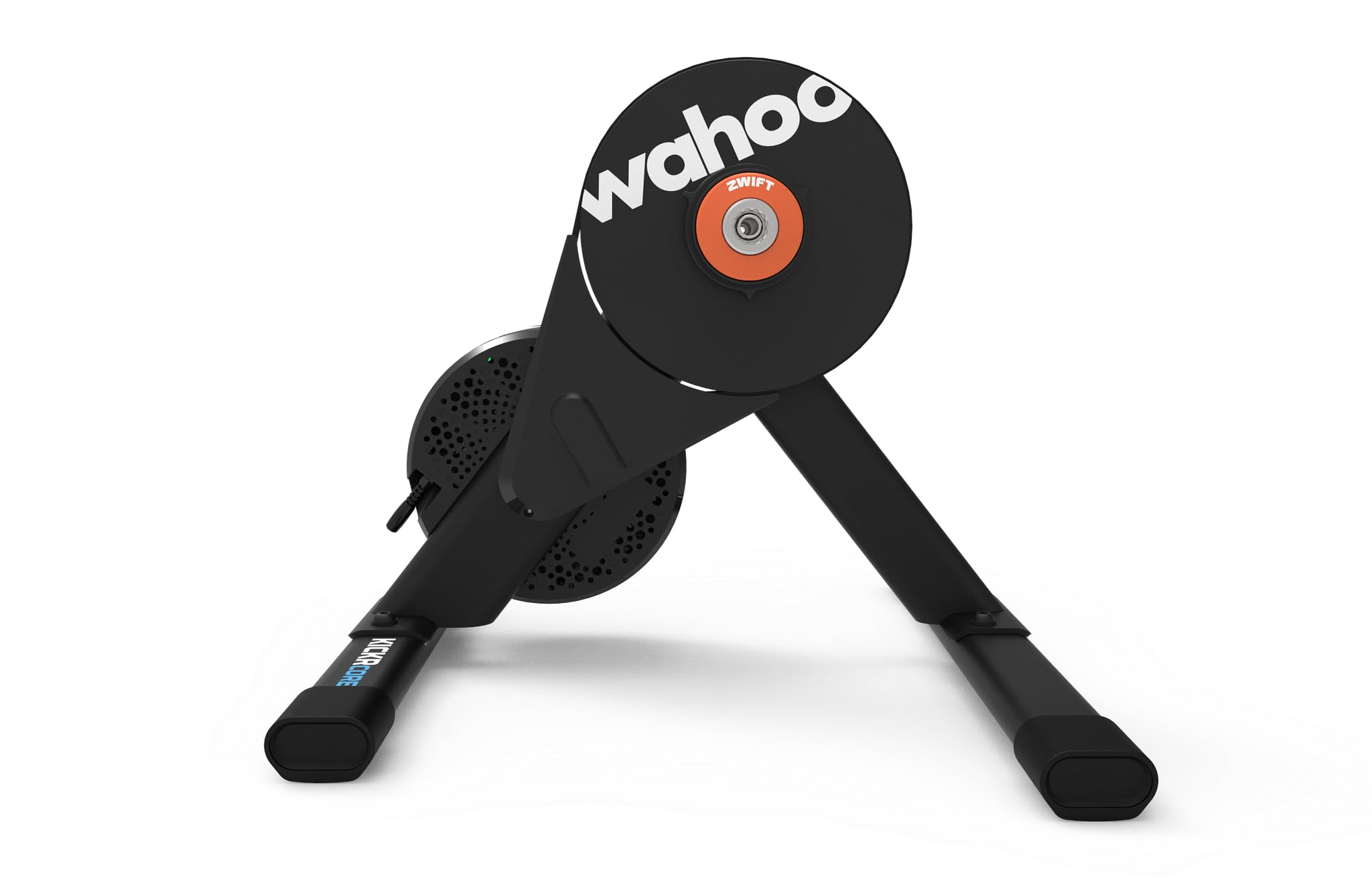
Most direct-drive trainers begin with a shopping list: match your cassette, buy the lockring tool, hope the spacing is right. The KICKR CORE 2 skips all of it. A Zwift Cog comes already fitted to the freehub and a Click shifter clamps to your handlebars, so an 8- to 13-speed bike goes on and shifts through virtual gears without a cassette of your own.

That shortcut is part of why we named it our top pick. The bigger reason is what direct drive does for the ride: the rear wheel comes off, your chain drives the unit, and the tire noise, roller slip and rubber dust that define wheel-on trainers simply aren't part of the experience. The 1800-watt ceiling is more than a recreational rider will ever use, and resistance stays smooth when the software changes it mid-interval.

Physically it's a floor-standing unit at 13.6 kg, so it lives where you set it up rather than traveling between rooms. The adapters for 12x142 and 12x148 thru-axles are in the box, which matters more every year as disc-road and gravel bikes become the norm.

What you're really paying for is the disappearance of small daily annoyances: no roller tension to set, no rear tire to burn through, no wheel slip when you stand on a climb, and no calibration ritual before a hard session. If you already own a smart trainer, none of that is new. If you've been riding a wheel-on stand and wondering why indoor training feels like a compromise, this is the answer.

Bottom line: Our pick for anyone training indoors with an app: the pre-installed Zwift Cog and Click shifter remove the cassette headache, and the direct-drive ride justifies the price.

#3

Elite Novo Force

Elite Novo Force

Wheel-on value

Our Score 9.0/10
Check Price

Worth Noting

  • Setup directions are thin
  • Thru-axle bikes need an optional kit
Storage
Folds flat
Max Power
690 watts at 40 km/h
Wheel Sizes
24 to 29 inches
Resistance Type
Magnetic, 8 levels
Read the full review

Put the Novo Force next to the direct-drive picks and the compromise is plain: your rear wheel stays on the bike and presses against a magnetic roller, so you're training through your tire. What you get back is a stand that folds, weighs about 22 pounds, fits 24- to 29-inch wheels, and costs a fraction of what the smart trainers do.

Eight resistance settings and a listed 690 watts at 40 km/h put it mid-pack among wheel-on trainers: plenty for tempo riding and structured intervals, short of what a strong sprinter wants to feel. The folding frame is the feature that earns its keep in a small apartment, since it stores against a wall between sessions. There's also a path to app data through a Misuro B+ sensor, though that's a separate purchase. Nothing about this trainer is smart out of the box.

We recommend it to the rider who wants a real trainer without spending smart-trainer money, and who rides two or three times a week rather than chasing watt targets. It's stable enough to stand and grind, the frame goes together with a couple of bolts, and the whole thing disappears into a closet when the weather turns.

Bottom line: The wheel-on trainer we point budget-minded riders to: it folds flat, holds steady, and gives you eight resistance settings for a fraction of a smart trainer.

#4

Sportneer Fluid Trainer

Sportneer Fluid Trainer

Progressive resistance

Our Score 8.8/10
Check Price

Worth Noting

  • No resistance control while riding
  • Assembly directions are hard to follow
Item Weight
24.3 lb
Wheel Sizes
26 to 29 inches, 700C
Resistance Type
Fluid
Rider Weight Limit
300 lb
Read the full review

There's no resistance lever on the bars, and that's a design decision rather than an omission. Fluid units build resistance as your speed rises, so effort comes from your gears and cadence: spin up and the trainer answers, slow down and it lets go. It's the closest a wheel-on trainer gets to the feel of the road, which is why we chose it over the stepped magnetic stands for steady riding.

The rest of the package is built to stay put. The frame is wide and low, a dual locking system clamps the rear axle, and the rider limit is 300 pounds. At 24.3 pounds it isn't something you'll move every session, but standing efforts don't walk it across the floor the way lighter stands can.

What we appreciate most is that there's nothing to fiddle with mid-session, since there's no dial to hunt for during an interval. The trade-off is real: dropping resistance for a recovery spin means shifting gears, not turning a knob, and this isn't the trainer for a rider who wants to change effort with a thumb. For base miles and longer tempo blocks, the simplicity is the point.

Bottom line: Our fluid pick: resistance that builds with your speed, a rock-steady frame and a 300-pound rider limit for longer, steadier indoor sessions.

#5

Sportneer Magnetic Bike Trainer

Sportneer Magnetic Bike Trainer

Fast bike swaps

Our Score 8.6/10
Check Price

Worth Noting

  • Top resistance is modest
Item Weight
19.3 lb
Wheel Sizes
26 to 28 inches, 700C
Resistance Type
Magnetic, 6 levels
Rider Weight Limit
300 lb
Read the full review

Bike swaps are the small daily friction of indoor training, and this stand is built to cut it. A press-down lever clamps the rear axle so mounting or removing a bike takes seconds, and the six resistance levels live on a remote that straps to your handlebars instead of a dial down by your calf.

That combination makes it the trainer we suggest for a household with two bikes, or a rider who alternates between a road bike and a hybrid. The frame is wide-based with five adjustable anti-slip feet, and it holds steady on carpet, which is where a lot of these stands start to wander.

The ceiling is the thing to understand before you buy. Level six is a modest brake rather than a wall, most of your difficulty will come from your bike's gears, and that suits winter base miles more than threshold intervals. Tighten the clamp properly every time you mount the bike; a rear wheel that shifts in the dropout is how this design goes wrong.

Bottom line: The stand we suggest to a two-bike household: the press-down lever and bar remote make it easy to live with, and the frame stays planted.

#6

Yaheetech Bike Trainer

Yaheetech Bike Trainer

Casual indoor riding

Our Score 8.6/10
Check Price

Worth Noting

  • Quick-release axles only
  • 265-pound rider limit
Item Weight
13.8 lb
Wheel Sizes
26 to 28 inches, 700C
Resistance Type
Magnetic, adjustable
Rider Weight Limit
265 lb
Read the full review

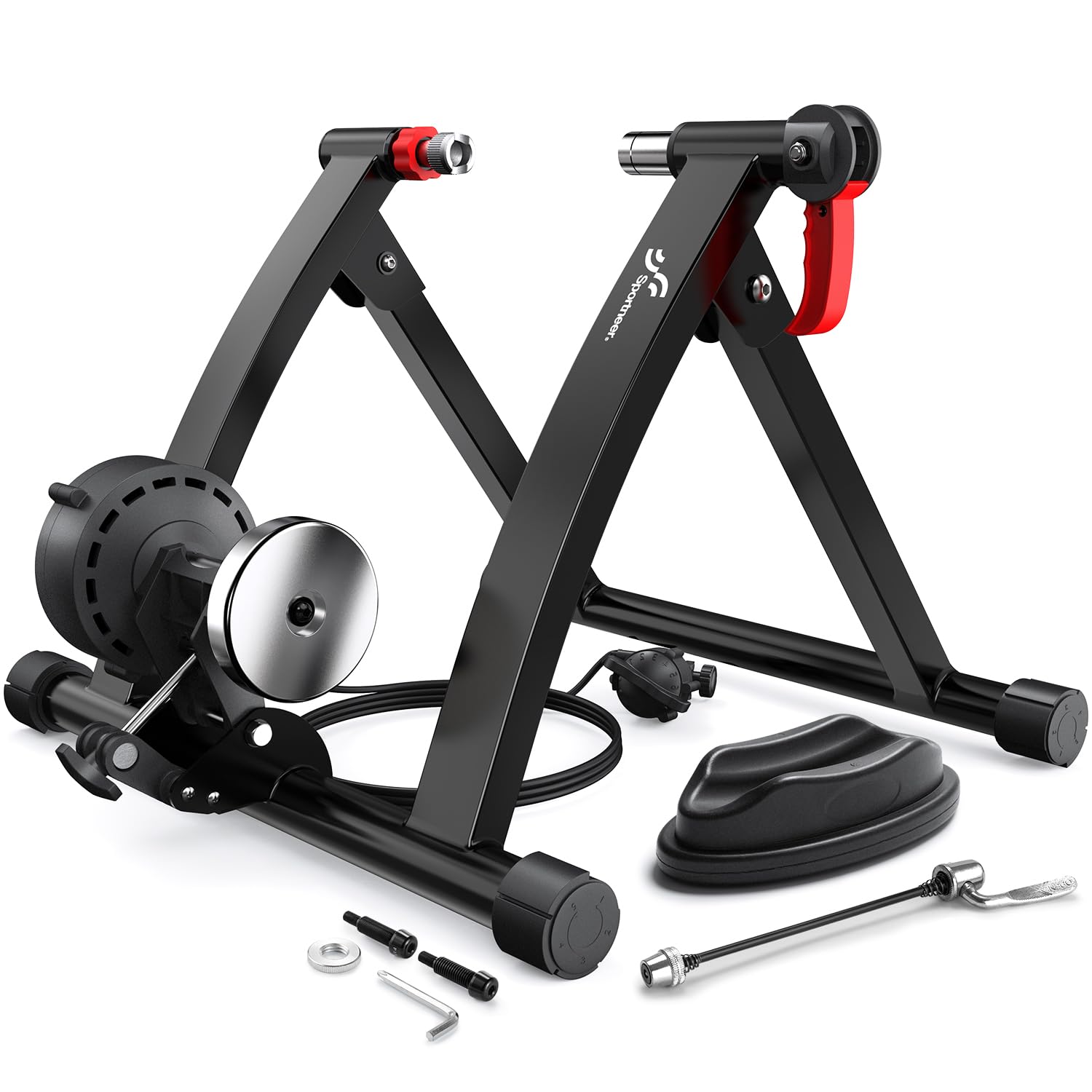
At 13.8 pounds this is the easiest trainer here to pick up and move, and the least expensive way into indoor riding. It takes 26- to 28-inch and 700C wheels, ships with a quick-release skewer, and sits on four non-slip feet that keep it from marking a floor.

Resistance is adjustable rather than stepped, so effort is set by how the roller meets the tire and by the gear you're in, not by a numbered dial on the bars. That's a simpler arrangement than the remote-controlled stands, and it's the place where a smooth rear tire changes the experience most, because tread on a roller is where the noise and vibration come from.

What it does well is the boring part. It holds a bike steady while you pedal, the feet stay put on carpet and concrete, and the light frame moves out of a living room in one hand. For a rider who wants to spin through a winter or add cardio on rainy days, we think that's enough. This is a trainer for turning pedals, not for following a power plan.

Bottom line: An inexpensive way to find out whether indoor riding sticks: light enough to move easily, simple enough to set up fast, and best for casual pedaling.

#7

BalanceFrom Bike Trainer

BalanceFrom Bike Trainer

Budget winter miles

Our Score 8.4/10
Check Price

Worth Noting

  • Assembly instructions are pictures only
Item Weight
17.6 lb
Wheel Sizes
26 to 28 inches, 700C
Resistance Type
Magnetic, 8 levels
Rider Weight Limit
330 lb
Read the full review

The pitch is the one that sells most trainers: your own bike, a rear wheel against a magnetic roller, and a bar-mounted controller with eight levels. No second stationary bike taking up a corner of the room, and a footprint about 22 inches square.

The numbers are what lift it above the cheaper stands. A 330-pound rider limit covers nearly every adult, the eight settings give a usable spread from easy spin to tempo, and the wide base with rubber feet sits low enough that it stayed put on a wood floor in our testing. It takes 26- to 28-inch and 700C wheels, which is to say almost any road, hybrid or older mountain bike.

Noise is where a wheel-on trainer lives or dies, and the tire decides most of it. A knobby mountain bike tire on a magnetic roller howls; a slick or a dedicated trainer tire runs dramatically quieter and leaves less rubber dust on the floor. If this is going in an apartment, fit a smooth tire before you judge the trainer.

It earns its place as the budget pick because it delivers what cheap trainers usually skimp on: a rider limit that fits real adults and eight distinct levels rather than a token dial. The assembly sheet is the weak link, pictures and arrows with no written steps for the tension adjustment, so plan on working it out once and then leaving it alone.

Bottom line: Eight levels and a 330-pound rider limit for very little money: our budget buy, provided you fit a smooth rear tire to keep it quiet.

How We Chose and Tested Indoor Bike Trainers

We started by researching the trainer styles riders actually cross-shop: wheel-on magnetic and fluid stands and direct-drive smart units. We filtered that pool by price, wheel and axle compatibility, resistance type, and the accessories included in the box, then narrowed it to 10 trainers.

Over six months, we used each trainer for weekday interval sessions and longer weekend rides, setting them up in a living room and a garage to hear how noise carried. We unboxed and assembled every unit solo, timing the first setup and then the daily routine of mounting a bike. We noted when instructions were vague, when a quick-release lever or front wheel riser was missing, and whether axle adapters fit road bikes without a trip to the hardware store.

For stability, we did out-of-the-saddle sprints and leaned hard from side to side, watching for frame flex, floor wobble, and any creep across the floor. We shifted through every resistance level, checking whether changes felt smooth and repeatable, and paired smart trainers with riding apps to see how quickly they responded. We also ran a decibel meter at ear level and in the next room, then compared what each trainer included against its price to judge value and build quality. The 10 units stayed in rotation for the full six months.

How to Choose an Indoor Bike Trainer

Wheel-On or Direct Drive

A wheel-on trainer clamps your rear axle and presses the tire against a roller. It's the cheaper way in, it works with almost any bike, and it puts your own saddle, bars and gearing under you. The costs are noise, tire wear and a little slip when you stand. A direct-drive trainer takes the rear wheel off and drives the unit through your chain, which is quieter, more accurate and considerably more expensive.

We think the split is simple. If you're testing whether indoor riding will stick, buy wheel-on. If you already ride three times a week and will keep doing it through the winter, the direct-drive unit is the one you'll still be using in five years.

The Axle Matters More Than the Wheel Size

Every trainer here lists wheel sizes, and that's the least useful line on the box. What decides whether a trainer works is the rear axle: quick-release, or thru-axle in 12x142 or 12x148. Several of these stands include adapters for both, and the cheapest ones are quick-release only, with a thru-axle frame needing a kit that may be sold separately or not offered at all.

Check your axle standard and your drivetrain before you order. If a listing mentions a Zwift Cog, know that it replaces your cassette with virtual shifting rather than adding to it.

Where the Noise Actually Comes From

Almost all wheel-on trainer noise is your tire, not the machine. A knobby or worn mountain bike tire on a steel roller howls; a slick or a trainer-specific tire runs far quieter and throws less rubber dust around the room. Vibration is the second source, and it travels through the floor into the room below, which is why a dense mat under the stand does more for a downstairs neighbor than any quiet claim printed on the box.

If silence is the deciding factor, skip the wheel entirely and go direct drive.

Stepped, Progressive or Electronic Resistance

Three resistance designs cover this category. Stepped magnetic units give you six or eight levels from a bar-mounted remote: simple, inexpensive, and limited at the top. Fluid units ramp resistance with speed, so your gears do the adjusting and nothing needs a dial mid-interval. Electronic direct-drive trainers let an app set resistance for you, hold a target wattage, and reach ceilings of 1800 to 2200 watts.

Match the design to the session. Steady base miles suit fluid, intervals run from a training app suit electronic, and casual spinning suits stepped.

Setup, Storage and the Swap You'll Actually Do

The stand that gets used is the one that's easy to leave out. Folding frames store against a wall, but only if you'll fold them; a trainer that lives assembled in a corner gets ridden more often. Weight tells you which is which, with light stands at 13 to 24 pounds and direct-drive units at 30 to 47 pounds staying exactly where you put them.

Think about the swap, too. A press-down axle clamp takes seconds, a bolt-on clamp takes longer, and that difference shows up on the days you almost skip.

Frequently Asked Questions

Final Verdict

The Wahoo KICKR CORE 2 is the trainer we recommend to anyone who plans to ride indoors more than a few times a month. The pre-installed Zwift Cog and Click shifter take the cassette guesswork out of setup, and direct drive removes the tire noise, roller slip and rubber dust that make wheel-on trainers feel like a compromise.

If that price is out of reach, the Elite Novo Force folds flat and pedals honestly for far less money, and riders who want the most convincing simulation should look at the TacX Neo 2T. What we wouldn't do is buy a cheap wheel-on stand and expect it to be quiet.