Cardio Machines

Best Fitness Trampolines of 2026

A rebounder is the rare piece of cardio equipment that doesn't feel like punishment. Ten minutes of bouncing in front of the TV is easier to talk yourself into than a mile on the treadmill. The catch is that a fitness trampoline is a spring-loaded platform you stand on, so a bad one announces itself fast: a frame that walks across the rug, a mat that bottoms out underfoot, legs that fold crooked and never lock again. A good one eliminates all three and makes exercise something you actually look forward to.

I've kept a rebounder in my living room since 2021, and my team has put 11 through six months of daily bouncing — morning HIIT, low-impact evening sessions, and a fair amount of kid testing. First-timers are always surprised that the bungee count on the box tells you almost nothing; what matters is whether the tension is tuned evenly across the mat and whether the frame stays planted when a jump goes sideways. The picks below got both right.

#1

JumpSport 350 PRO

Top Pick
JumpSport 350 PRO

Adjustable premium cardio

Our Score 9.4/10
Check Price

Worth Noting

  • No handlebar for balance support
  • Premium price for a home rebounder
Suspension
36 EnduroLast 4 cords
Jumping Surface
35 in
Tension Settings
Firm to extra firm
User Weight Limit
300 lb
Read the full review

Four tension settings and a set of arched legs are what lift the JumpSport 350 PRO to the top of this group. The 39-inch frame carries a 300-pound rating, and the EnduroLast cords can be set from firm to extra firm, so the same rebounder can feel calm under a cautious beginner and responsive under a harder workout. We like that the legs splay out instead of ending in four small feet; there is no narrow base to tip over when your weight drifts toward the edge.

The 35-inch mat is the number to picture, because the frame is larger than the landing area. That is enough for basic bouncing, jogging in place, and controlled intervals, though lateral moves need more care than they do on a roomier mat. The bungee suspension is also the reason this one is easy to live with in a living room: no metal springs clanging against each other, just a soft elastic ride.

Storage is realistic rather than magical. The frame stands upright on its side, which matters in a small room, and the private-use warranty covers the frame for life, the mat for four years, and the cords for four years. That coverage is a real part of the value because the suspension is the part that eventually wears.

If you want one rebounder that can move from easy sessions to harder intervals, this is the one we reach for. The 250 is the softer, simpler alternative, and the MXL is the quieter high-capacity option for a dedicated spot.

Bottom line: For a tuneable, quiet, stable rebounder without a handlebar, this is the one we recommend first.
#2

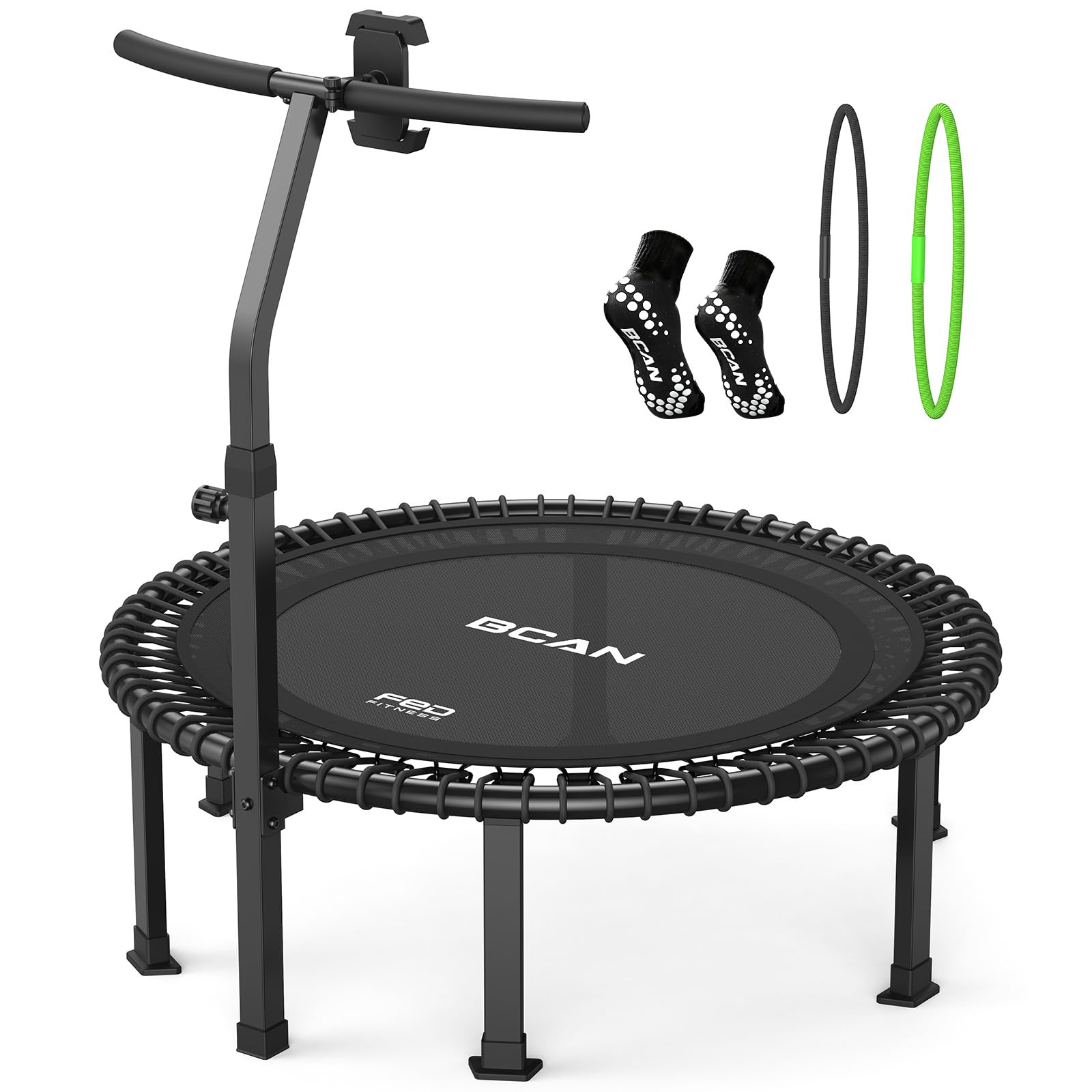
BCAN BT4

BCAN BT4

Balance and capacity

Our Score 9.4/10
Check Price

Worth Noting

  • Premium price for the capacity
Frame
One-piece 16-gauge steel
Handlebar
5-level adjustable
Tension Settings
6 levels
User Weight Limit
500 lb
Read the full review

The BT4 is the model we point to when balance, not bounce, is the deciding feature. Its five-level handlebar sits over a 40-inch mat, the frame is rated to 500 pounds, and the bar includes a phone holder that is genuinely useful for follow-along workouts. Two bungee sets let you tune the ride through six tension combinations, which is more adjustment than most rebounders here offer.

That adjustability is the reason we keep it near the top of this set. You can start with the softer setup and move to the firmer cords as your balance and fitness improve, without buying another rebounder. The one-piece 16-gauge steel frame feels planted, and the preassembled bungees cut setup down to attaching the legs and bar. The handlebar is the part that changes the ownership experience: it gives you something to hold when you are learning, and it can come off later if you no longer want it.

The cost is space and simplicity. A 40-inch one-piece frame with a handlebar takes up more floor than a bare rebounder, and it does not fold down small. We see it as a leave-it-out piece for a home gym or spare room. For that buyer, the capacity and the bar justify the footprint.

Bottom line: The best choice here when a handlebar and high weight capacity matter more than a small storage footprint.

#3

MXL FIT Bounce PRO

MXL FIT Bounce PRO

Quiet high capacity

Our Score 9.4/10
Check Price

Worth Noting

  • Stability bar sold separately
Storage
Half-fold frame
Assembly
Arrives fully assembled
Bounce System
60 bungee connectors
User Weight Limit
400 lb
Read the full review

The MXL FIT Bounce PRO arrives fully assembled, which is the first thing you notice if you have ever wrestled a bungee mat onto a frame. It is a 40-inch, 400-pound-capacity rebounder with folding legs and a half-fold frame, and its 60 bungee connectors are roughly double the count on many of the other picks here. That density is meant to smooth out the landing and spread the load across the mat.

The bounce is quiet and gentle. We appreciate that the suspension takes the noise out of a living-room workout; there is no spring clang, just a soft elastic rebound. The half-fold and spring-loaded legs make storage easier than a fixed frame, though folding the legs takes a little technique.

At the premium end of this group, the MXL makes sense for a heavier or joint-sensitive user who wants a quiet, high-capacity rebounder and values the fully assembled start. We see it as the premium quiet option for a dedicated spot in the house; if it has to disappear into a closet every day, the half-fold still takes space and effort.

Bottom line: A fully assembled, high-capacity rebounder for a buyer who values a quiet ride and a dedicated spot over quick folding.

#4

JumpSport 250

JumpSport 250

Gentle joint-friendly bounce

Our Score 9.4/10
Check Price

Worth Noting

  • No handlebar for balance
Leg Design
Patented no-tip arched legs
Suspension
2-knot EnduroLast cords
Jumping Surface
36 in
User Weight Limit
250 lb
Read the full review

The 250 is the softer, simpler JumpSport, and that is exactly why we recommend it for gentle daily movement. Its 2-knot EnduroLast cords are set at a soft tension rather than adjustable, and the 36-inch mat sits inside a 39-inch frame. The landing is forgiving, which makes it a natural fit for someone easing back into exercise or protecting sore joints.

The arched legs are the detail that sold us on this design over a typical four-foot spring rebounder. They spread the base wide and keep the frame from walking across the floor, and the whole thing stores upright on its side. Setup is mostly a matter of attaching the legs, so the first workout does not depend on a long assembly session.

The 350 adds adjustable tension and a higher weight rating for more money; the 250 gives up that flexibility in exchange for a calmer ride and a lower entry point. We like it for low-key sessions, not for someone who wants to dial up resistance as they get stronger. It is the quiet, stable, joint-friendly choice in this group.

Bottom line: The softer, simpler JumpSport for a joint-sensitive bouncer who wants a calm ride and does not need adjustable tension.

#5

BCAN SP2

BCAN SP2

Budget handlebar pick

Our Score 8.8/10
Check Price

Worth Noting

  • Legs may need periodic tightening
Handlebar
3 height settings
Frame Size
40 in
Spring Count
32 springs
User Weight Limit
330 lb
Read the full review

The SP2 is the budget-minded BCAN that still gives you a handlebar. It is a 40-inch spring rebounder with a 330-pound limit, 32 springs, and a three-height foam-padded bar. It arrives mostly assembled, so the job is attaching the legs and handle rather than lacing the mat. The frame folds to about a quarter of its size, but only after the bar and legs come off, which makes it a storage-day feature rather than a daily one.

That combination is why we keep it as the budget pick with a bar. Spring suspension gives a livelier, more traditional bounce than the bungee models here, and the adjustable handle makes it easier to share between a taller adult and a shorter teen. The 330-pound rating is generous for the price, and the 40-inch mat leaves enough room for basic bouncing without dominating a room.

The compromise is refinement. The springs and frame are not as quiet or as planted as the premium bungee rebounders, and the handlebar is a support, not a gym-grade handrail. We treat it as a starter or a second rebounder for a spare room, where its easy storage and low cost matter more than silence. If you need a bar and want the best build here, the BT4 is the step up.

Bottom line: A budget rebounder that gets the handlebar and capacity right, with a folding frame that is best treated as storage-day help.

#6

Stamina 36" Mini

Stamina 36" Mini

Small rooms

Our Score 8.8/10
Check Price

Worth Noting

  • 250-pound user limit
Monitor
LCD jumps, time, calories
Frame Size
36 in
Suspension
30 tension bands
User Weight Limit
250 lb
Read the full review

The Stamina is the smallest rebounder we recommend, and its 36-inch frame is the reason to look at it. It uses 30 tension bands rather than metal springs and includes an LCD monitor for jumps, time, and calories. The free muuv app adds guided sessions, which is more structure than most budget rebounders offer.

In a tight room, that small footprint is the feature that matters. The legs detach and the frame folds, so it can slide under a bed or stand in a closet between uses. The trade is a smaller landing area and a gentler bounce; this is a light-workout tool, not a spacious rebounder for big lateral moves.

We see the Stamina as the apartment or spare-room pick, especially for someone who wants a simple way to add short cardio sessions and likes the idea of tracking them. It is not the one for a very assertive bouncer. If you want a more substantial ride, the JumpSport 250 is the next step up in both mat size and build.

Bottom line: The compact, app-supported pick for a tight room and light cardio sessions, provided you fit well under its weight limit.

#7

ONETWOFIT 42"

ONETWOFIT 42"

Quiet budget bounce

Our Score 8.6/10
Check Price

Worth Noting

  • Handlebar can loosen over time
Legs
Six reinforced legs
Suspension
32 elastic bungee cords
Jumping Surface
42 in
User Weight Limit
330 lb
Read the full review

The ONETWOFIT takes the bungee idea and puts it at the budget end of this group. The 42-inch mat is one of the larger surfaces here, the frame is rated to 330 pounds, and six reinforced legs with rubber caps keep it from skating. Thirty-two elastic cords replace springs, so the ride is quieter than a traditional spring rebounder.

Setup is the part to plan for. The bungees are already on the frame, but pulling them into their final position takes real hand strength, and the included tool helps more than the manual does. We do not treat this as a one-person, five-minute assembly; give yourself an evening and a second pair of hands if you can.

Once it is set, the 42-inch surface is the draw. There is enough room for jogging in place, side steps, and simple dance moves without feeling perched on a small mat. The bungee ride is smooth and quiet, and the handlebar gives you a place to steady yourself when you first start.

We rate it as a strong budget alternative for someone who wants a quiet, roomy bounce but does not need a folding frame or a premium warranty. For the price, the surface area and quiet ride are why it earns a place in this group.

Bottom line: A roomy, quiet bungee rebounder at a budget price if you are ready for a more physical setup and do not need a folding frame.

#8

Kanchimi 40"

Kanchimi 40"

Large budget mat

Our Score 8.4/10
Check Price

Worth Noting

  • Spring and leg joints need checking
Handlebar
Included
Frame Size
40 in
Spring Count
32 steel springs
User Weight Limit
330 lb
Read the full review

The Kanchimi's folding claim is the first thing to get straight. The frame does fold, but only after you remove the handlebar and the legs, so it is not a quick tuck-away between sessions. What you get instead is a 40-inch spring rebounder with a 330-pound rating, 32 springs, and an included handlebar at a budget price.

The larger mat is the real draw. It gives you more room for basic bouncing and side steps than the 36-inch Stamina, and the spring suspension has the livelier, more traditional feel that some people prefer to bungee. The handlebar is a useful confidence aid for a beginner, and the closed spring design keeps the moving parts away from your feet.

The build is where the budget shows. The legs and spring clips are the parts to check before every session, and the frame is not as solid as the premium rebounders here. We see it as a leave-it-out rebounder for a spare room or garage, not a piece you want to assemble and disassemble around every workout.

We recommend it for a buyer who wants the largest mat for the least money and can leave it set up. If it has to disappear daily, pay more for a bungee folder; if it stays put, the Kanchimi gives you room to move without a premium outlay.

Bottom line: A large, low-cost spring rebounder for a spare room or garage, as long as it can stay set up between sessions.

How We Tested 11 Fitness Trampolines

We started by pulling every fitness trampoline we could find from the major retailers, then cut anything with a weight capacity under 250 pounds, a mat smaller than 32 inches across, or a frame that couldn't be retightened with a wrench. We also dropped models whose reviews kept mentioning cracked welds or legs that splayed within a few months. That left 11 rebounders, which we assembled and bounced on for six months.

Assembly was timed from box open to first bounce, done solo with only the tools that came in the box — we counted the steps and noted whether the hardware matched the diagram. Then we lived with them: 6 a.m. HIIT intervals in the living room, slower low-impact sessions after work, and backyard turns with kids who don't follow instructions.

Stability got measured in inches — how far the frame traveled across hardwood during a 20-minute session, and whether it creaked or tilted when a 200-pound tester landed off-center. For bounce, we noted whether the mat bottomed out, how quickly it returned, and whether tension felt even edge to edge. Every month we checked spring and bungee attachment points, stitching, and welds for wear.

Folding was timed and repeated, and we recorded whether the legs relocked with a solid click or needed a second person. Finally, we weighed what came in the box — cover, handle, instructions — against the price to judge value.

How to Choose Fitness Trampolines

Start With the Weight Rating, Not the Diameter

Start with the maximum user weight, not the mat diameter. A 250-pound rating is a ceiling, not a target, and it becomes more restrictive when you bounce hard or share the rebounder with someone heavier. The JumpSport 250 and Stamina are built around that 250-pound limit; the JumpSport 350 PRO raises it to 300, and the BCAN BT4 goes to 500. If you are close to the number, choose more headroom. The frame and suspension will feel steadier, and you will not spend your sessions wondering whether you are asking too much of the equipment.

Springs or Bungees: Pick Your Bounce

Springs and bungees produce different rides. Springs feel livelier and more traditional, and they can be noisier as metal moves against metal. Bungees tend to be quieter, softer at the landing, and easier to tune; the BCAN BT4 and JumpSport 350 PRO let you change tension, while the MXL uses a dense bungee set for a gentle, quiet ride. If you live above someone or exercise early, start with bungee. If you want the energetic spring feel on a budget, the BCAN SP2 is the obvious example here.

When a Handlebar Is Worth It

A handlebar is a confidence purchase. It gives you something to grab while you find your balance, and it is useful if you are returning to exercise or sharing the rebounder with someone less steady. It also adds floor footprint and another joint to check. The BCAN BT4 has a five-level bar; the BCAN SP2 has a three-height bar at the budget end. If you are confident without one, the JumpSport arched-leg designs are built to stand on their own.

Measure the Storage Routine, Not Just the Footprint

Foldable does not always mean quick. The BCAN SP2 and Kanchimi fold only after the handlebar and legs come off, so the fold is a storage-day job rather than a between-sessions move. The MXL's half-fold and spring-loaded legs are easier, but still take practice. Before you buy, decide whether the rebounder will live in one spot or disappear into a closet. If it disappears, measure the folded size and the clearance you have; if it stays out, prioritize stability over a folding mechanism.

Check the Warranty on the Suspension

Frames usually outlast mats, springs, and cords, so check what the warranty covers. The JumpSport 350 PRO covers the frame for life in private use and the cords and mat for four years; many budget rebounders offer a year. That difference matters because the suspension is the part that wears. Whatever you choose, inspect the springs or bungees and tighten the legs and handlebar regularly. A short warranty is not a dealbreaker, but factor replacement parts into the cost of ownership.

Frequently Asked Questions

Final Verdict

The JumpSport 350 PRO is the fitness trampoline we recommend first because it combines adjustable tension, a stable arched-leg frame, and a quiet cord suspension in one package. It suits a buyer who wants a serious indoor cardio tool and does not need a handlebar to feel secure.

If a handlebar is the deciding requirement, the BCAN BT4 is the better buy, with a five-level bar and a 500-pound rating. If you want the softest, simplest ride and fit under the 250-pound limit, the JumpSport 250 is the calmer choice.