Cardio Machines

Best Exercise Bikes for Seniors of 2026

The right exercise bike for an older rider has little to do with wattage and everything to do with confidence: a low step-through frame, a seat you can stay on for half an hour, and a ride quiet enough to hear the TV. I learned that watching my dad dismount a bike that sat too high and wobble before his foot found the floor. What a good bike fixes is more useful than the marketing suggests: cardio at home, at your own pace, without a gym trip or a fear of losing your balance.

My team and I rode 11 bikes over the past eight months, from folding models you stow in a closet to uprights with backrests and pulse grips, and we assembled every one ourselves. The pattern held: the bikes people quietly abandon are the ones that wobble, squeak, or leave them sore after 15 minutes, and paying more didn't automatically fix any of that. First-time buyers assume a bigger, softer seat means more comfort; shape and support matter more. The picks below are the ones still in rotation at our houses.

#1

WFLGFT Recumbent

Top Pick
WFLGFT Recumbent

Larger riders

Our Score 9.6/10
Check Price

Worth Noting

  • 87-pound frame is hard to move
  • Large footprint
Resistance
16 magnetic levels
Item Weight
87 lb
Arm Exerciser
Synchronized arm and leg handles
Weight Capacity
450 lb
Read the full review

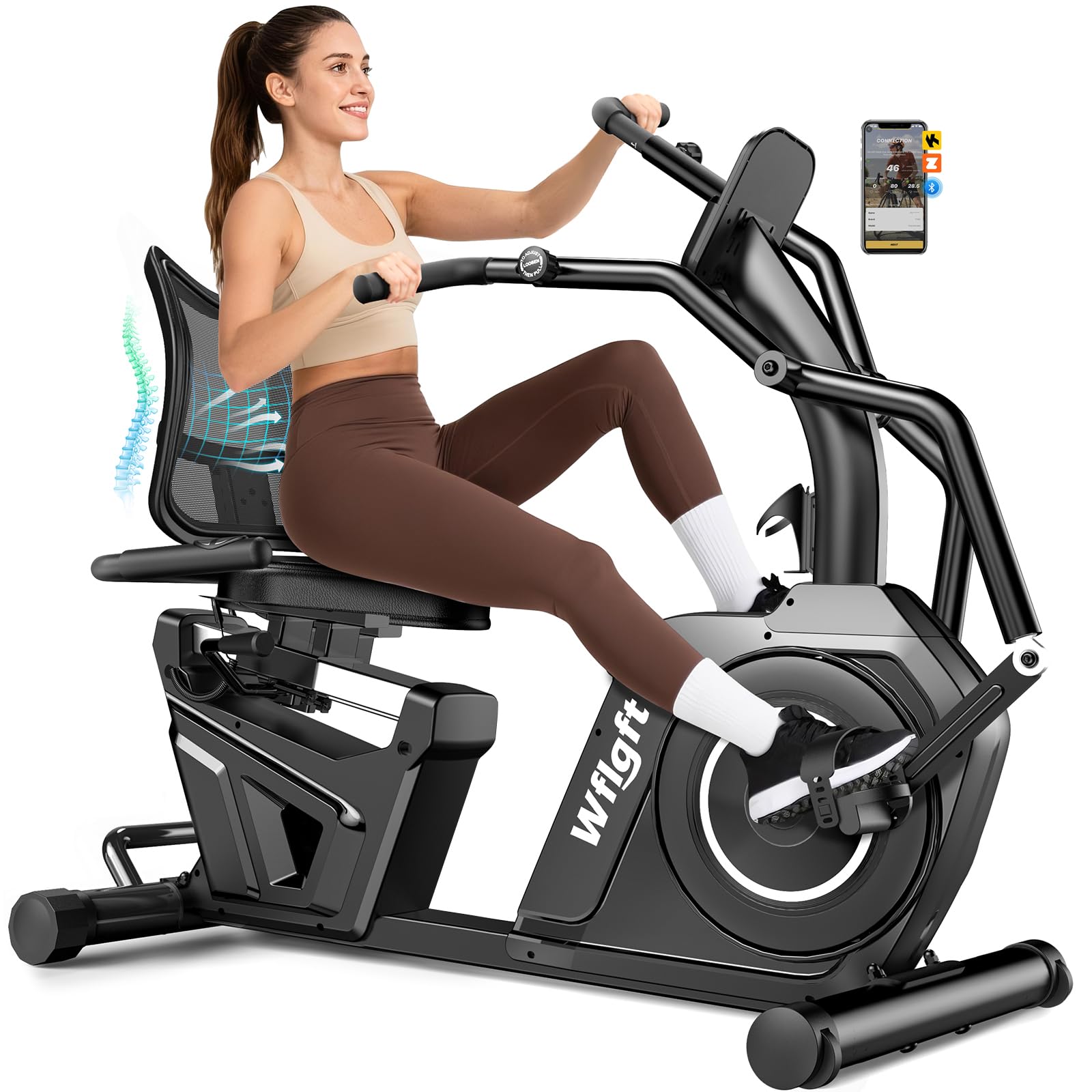
Synchronized arm and leg movement is what separates the W80601 from the other recumbents here. You push and pull with the handles while you pedal, which keeps the upper body involved without adding a second machine. We like that for someone who finds a standard bike too passive and wants a low-impact session that feels more complete.

The 450-pound frame is the other draw. It is built from reinforced 1.5T steel tubing and sits planted through the pedal stroke. The 16 magnetic levels give you a wide range from easy spinning to a real sweat, and the Bluetooth app is a bonus rather than the reason to buy. The seat and backrest are supportive enough for longer sessions.

The real question is whether you need this much bike. For a larger rider, or someone who wants arm work, the extra frame is worth it; for a pure recumbent pedal, the XVGVSV is easier to live with. This is a specialist machine, and that is exactly why it earns a place.

We also noted that the pedals and arm handles move together, so the bike asks for a little coordination at first. Give it a few sessions and the motion settles into a rhythm. For a rider who wants one machine for low-impact cardio and light upper-body work, this is the strongest heavy-duty option here.

Bottom line: This is the one for larger riders or anyone who wants arm work with their cardio, thanks to a 450-pound frame and synchronized handles.
#2

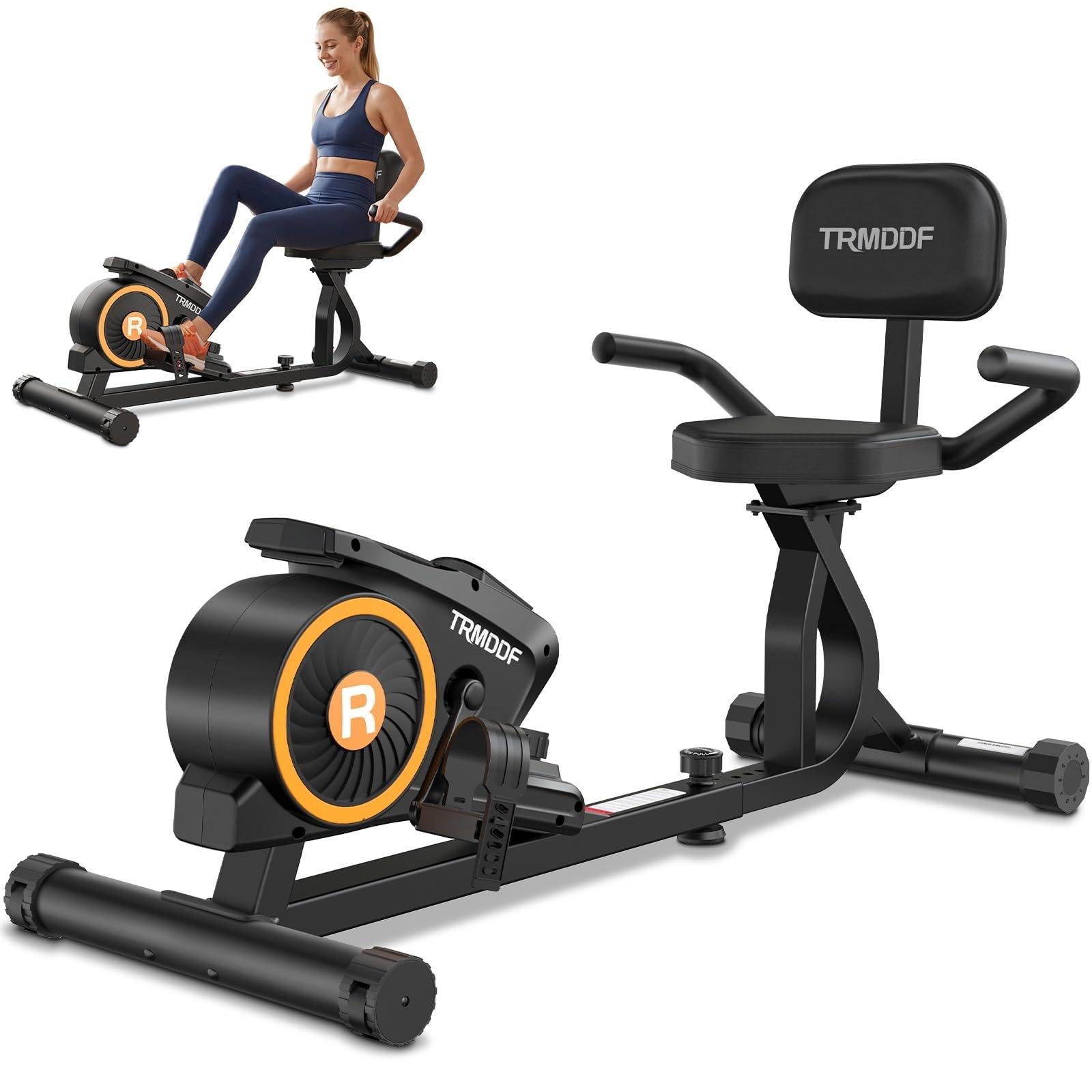
TRMDDF W356 Recumbent

TRMDDF W356 Recumbent

Budget recumbent

Our Score 9.6/10
Check Price

Worth Noting

Resistance
16 magnetic levels
Item Weight
35 lb
Pre-Assembled
90% pre-assembled
Weight Capacity
400 lb
Read the full review

The W356 looks like a budget bike on paper until you get to the 400-pound capacity. That is the same rating as our top pick, and the TRMDDF costs less. For a rider who needs a sturdy recumbent and does not want to pay for app connectivity or a premium finish, that combination is worth a look.

It is also light for a recumbent at 35 pounds, and the frame is designed to stay compact. The 16 magnetic levels and LCD cover the basics, and the bike arrives 90% pre-assembled. We like that it does not force you into a smartphone to use it.

The seat is padded and the backrest gives you the support a recumbent should. The thickened steel frame feels stable for steady riding, and the quiet magnetic system keeps it out of the way in a shared room. This is not a bike with extras piled on; it is a bike that does the main job.

For a rider who needs 400-pound support without paying for extras, this is a strong budget recumbent. We would check the seat fit first and plan on a cushion if you ride for more than 30 minutes. The W356 is not the bike we reach for when we want the most refined ride, but it is the one that makes high capacity accessible.

Bottom line: A budget recumbent that still gives you 400-pound capacity and 16 magnetic levels; consider it if the price is the deciding factor.

#3

XVGVSV W239 Recumbent

XVGVSV W239 Recumbent

Most riders

Our Score 9.2/10
Check Price

Worth Noting

  • Substantial 66-pound frame
  • Seat adjustment takes some practice
Resistance
16 magnetic levels
Item Weight
66 lb
Weight Capacity
400 lb
Seat And Backrest
Padded seat and backrest
Read the full review

The first thing we check on a senior bike is whether the rider feels held, not perched. The W239's recumbent seat and backrest are shaped for that, and the 400-pound frame gives it a planted feel that matters when you are getting on and off. It is a substantial machine, but the transport wheels let us move it aside without rearranging the room.

The 16 magnetic resistance levels move in small steps, so you can warm up gently and add tension without a sudden jump. We like that the bike does not depend on a phone or an app; the LCD shows speed, time, distance, calories, odometer, and heart rate, and the controls are easy to read. The ride is quiet enough for a shared living space.

Setup is one of the reasons this one earns the top spot. It arrives 85% pre-assembled, and the remaining work is straightforward rather than a puzzle. We also appreciate the front transport wheels and the stable base, which make it easier to live with in a room that is not a dedicated gym.

Our reservation is the seat adjustment, which takes some practice if two riders of different heights share the bike. That is a small annoyance, not a dealbreaker. What we kept coming back to was the wide backrest and the stable feel when pedaling harder; those are the things that make a daily low-impact habit easier to keep.

Bottom line: For most older riders, this is the recumbent we point to first: 400 pounds of support, a padded backrest, and 16 quiet magnetic levels at a midrange price.

#4

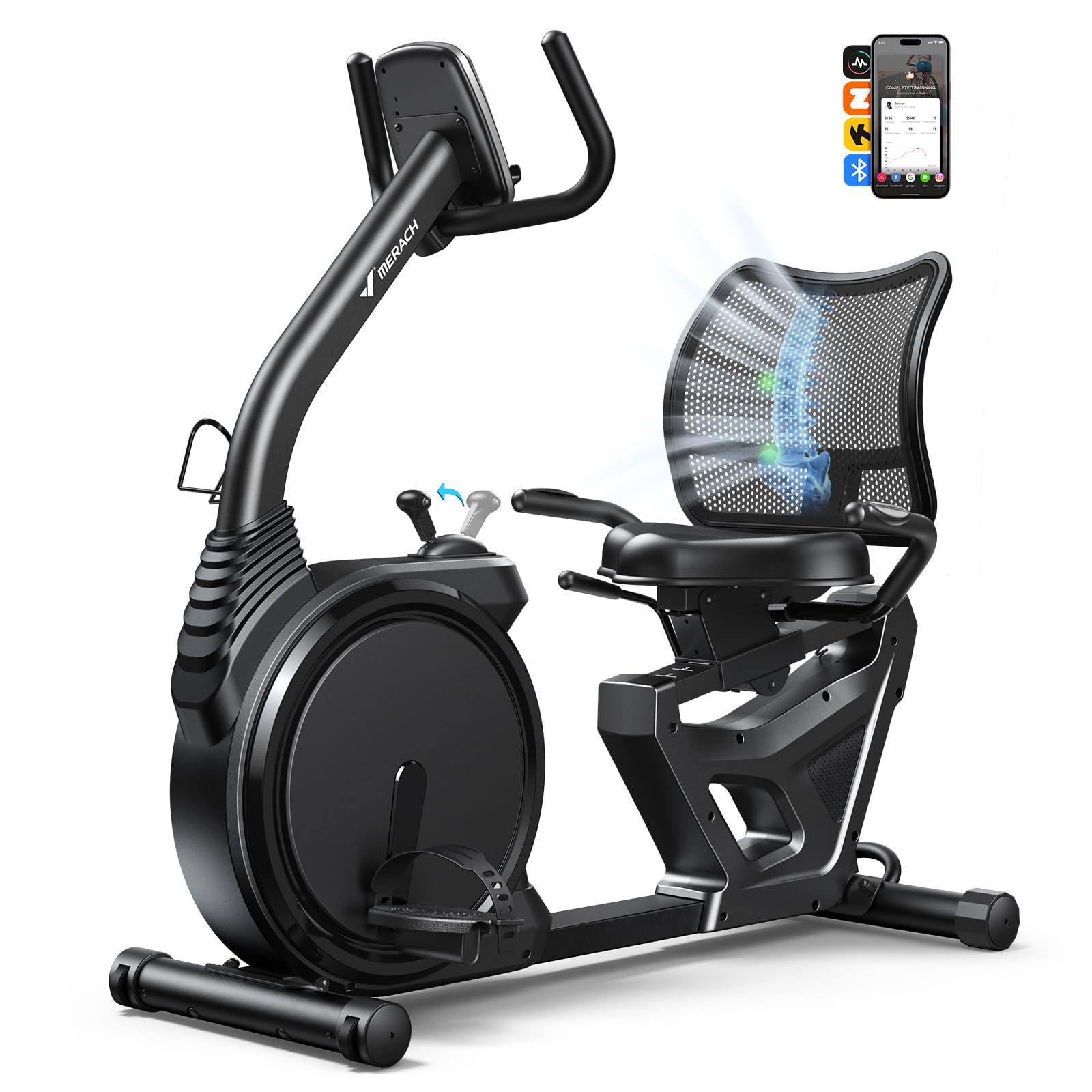
MERACH S19 Recumbent

MERACH S19 Recumbent

Premium comfort

Our Score 9.2/10
Check Price

Worth Noting

  • Only 8 resistance levels
  • May fit riders over 6 feet poorly
App
MERACH app
Resistance
8 magnetic levels
Seat Adjustment
8 seat positions
Weight Capacity
330 lb
Read the full review

The S19's car-style resistance lever is the detail we kept noticing. Instead of reaching down for a knob, you shift a lever with your hand, and the change is immediate. For a rider with arthritic hands or limited mobility, that is a real convenience, not a gimmick.

The seat is thicker than most here, with a breathable mesh back, and the eight-position seat adjustment covers a useful range. We found the ride smooth and quiet, and the 150-kilogram capacity is respectable. The dual-belt drive and 6.6-pound flywheel give it a more polished feel than the budget recumbents.

Eight resistance levels is fewer than the 16 on the XVGVSV, and the top end is not as hard. That matters if you want interval training, but for low-impact cardio and rehab-style riding, the range is fine. The MERACH app adds structure, though the bike does not depend on it.

The S19 costs more than the XVGVSV, and it gives up capacity and resistance range. What you get is a smoother lever, a plusher seat, and a more refined feel. If comfort and easy resistance changes matter more than maximum capacity, it is worth the step up.

Bottom line: If you want a quieter, smoother premium ride and like the idea of a car-style resistance lever, this is the recumbent we reach for.

#5

Sunny Health Recumbent

Sunny Health Recumbent

Easy mounting

Our Score 9.0/10
Check Price

Worth Noting

  • 300-pound capacity limits heavier riders
  • Seat runs firm on longer rides
App
Free SunnyFit app
Resistance
16 magnetic levels
Inseam Range
27.2-35.8 in
Weight Capacity
300 lb
Read the full review

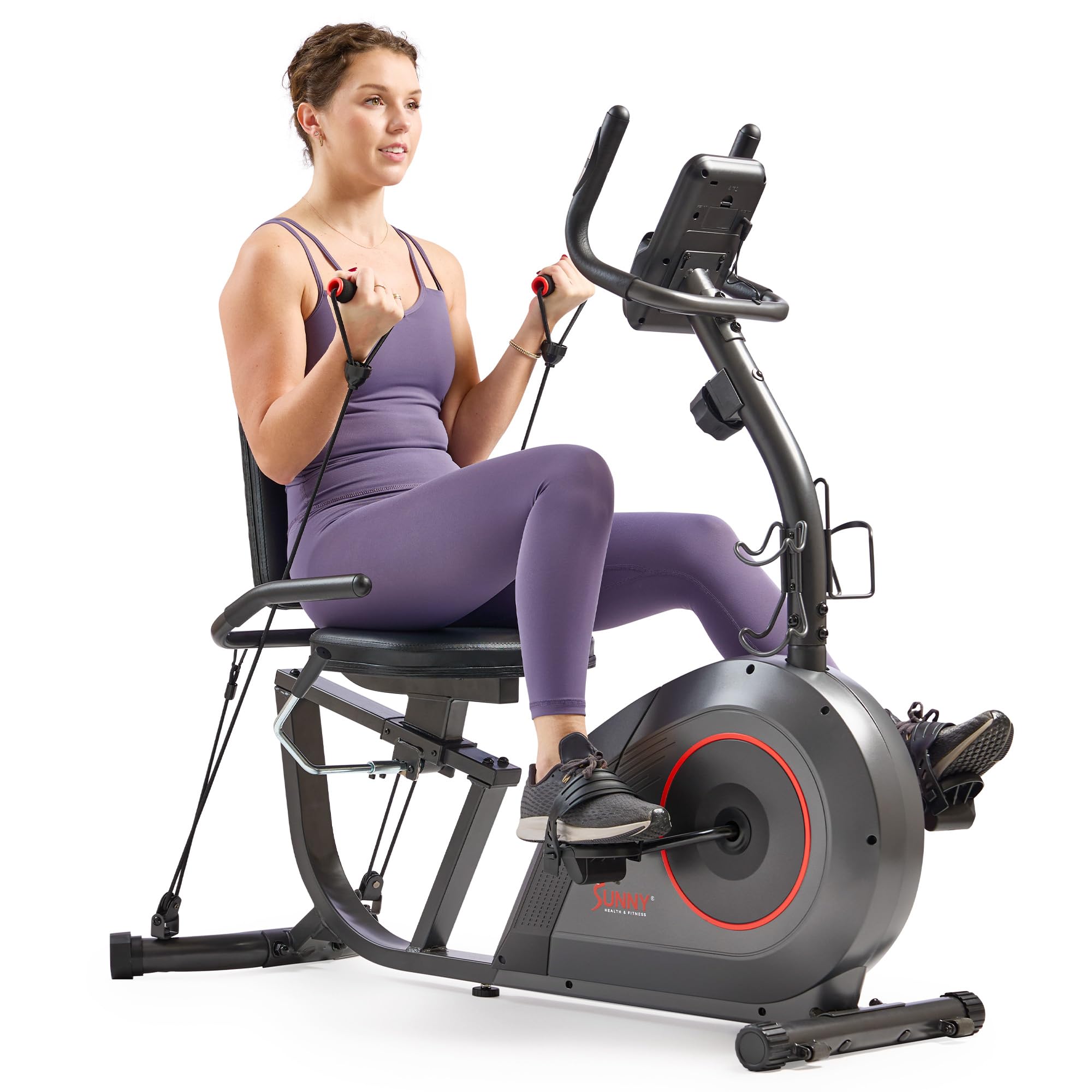
The detail that makes the SF-RB424006 easy to live with is the flip-away side handle. On a recumbent, the ride down is half the battle; a handle that moves out of the way gives you something to steady yourself with and then clears the path for your leg. We noticed that immediately because it is the kind of thing that matters more than another resistance level.

The seat is wide and cushioned, with a padded backrest, and the 27.2-to-35.8-inch inseam range covers a lot of shorter and average-height riders. We like the seat shape for longer sessions, though the backrest is where the support really shows. If you want a bike to feel less like a gym machine and more like a chair you pedal, this is the one to try.

SunnyFit is free and adds 1,000-plus trainer-led workouts and scenic rides. We are not going to pretend every rider wants an app, but the option is nice when walking is limited and you need structure. The 16 magnetic levels are smooth and quiet, and the two 20-pound resistance bands add light upper-body work without a second machine.

Our main pause is the 300-pound capacity, which puts it behind the heavy-duty picks here. For many older riders that is plenty, and the wide seat and easy mount are worth more than a higher number. We found the app pairing simple enough to use without a manual, which is not always the case.

Bottom line: Choose this if getting on and off is the priority: the flip-away handle and wide seat make mounting easier, and the SunnyFit app adds guided workouts.

#6

Goimu 5-in-1 Foldable

Goimu 5-in-1 Foldable

Small spaces

Our Score 8.8/10
Check Price

Worth Noting

  • Seat shape may pressure some riders
Resistance
16 magnetic levels
Item Weight
50.6 lb
Foldable Design
5-in-1 folding X-frame
Weight Capacity
330 lb
Read the full review

The GOIMU's folding X-frame is the feature that earns it a place, but not because folding is a novelty. In a small apartment, the difference between a bike you can leave out and one you have to step around is the difference between using it and not. It folds down and rolls, and at 50.6 pounds it is manageable for one person.

We were pleasantly surprised by how much support the backrest adds. The seat is wide, and the 16 magnetic resistance levels give you more range than the 8-level folding bikes we tested. The arm bands are a nice extra for light upper-body work, though we would not treat them as a replacement for a full strength routine.

The folding mechanism is the trade-off. This is not as planted as a full recumbent, and if you pedal hard you may feel that difference. But that is the price of a bike that disappears into a closet, and for steady low-impact riding the frame is stable enough.

We ended up leaving it unfolded most days, but knowing it could disappear for guests made the living room feel less like a gym. If you have the floor space and want the most stable ride, choose a full recumbent instead. If storage is the deciding constraint, this is the foldable we keep in the conversation.

Bottom line: A smart pick when the bike has to disappear between sessions: it folds compactly, keeps a backrest, and supports 330 pounds.

#7

YOSUDA Recumbent lrc-01

YOSUDA Recumbent lrc-01

Compact rooms

Our Score 8.8/10
Check Price

Worth Noting

  • Seat padding is basic
  • Taller riders may run out of legroom
Dimensions
45 x 20 x 39 in
Resistance
16 magnetic levels
Item Weight
58.4 lb
Weight Capacity
350 lb
Read the full review

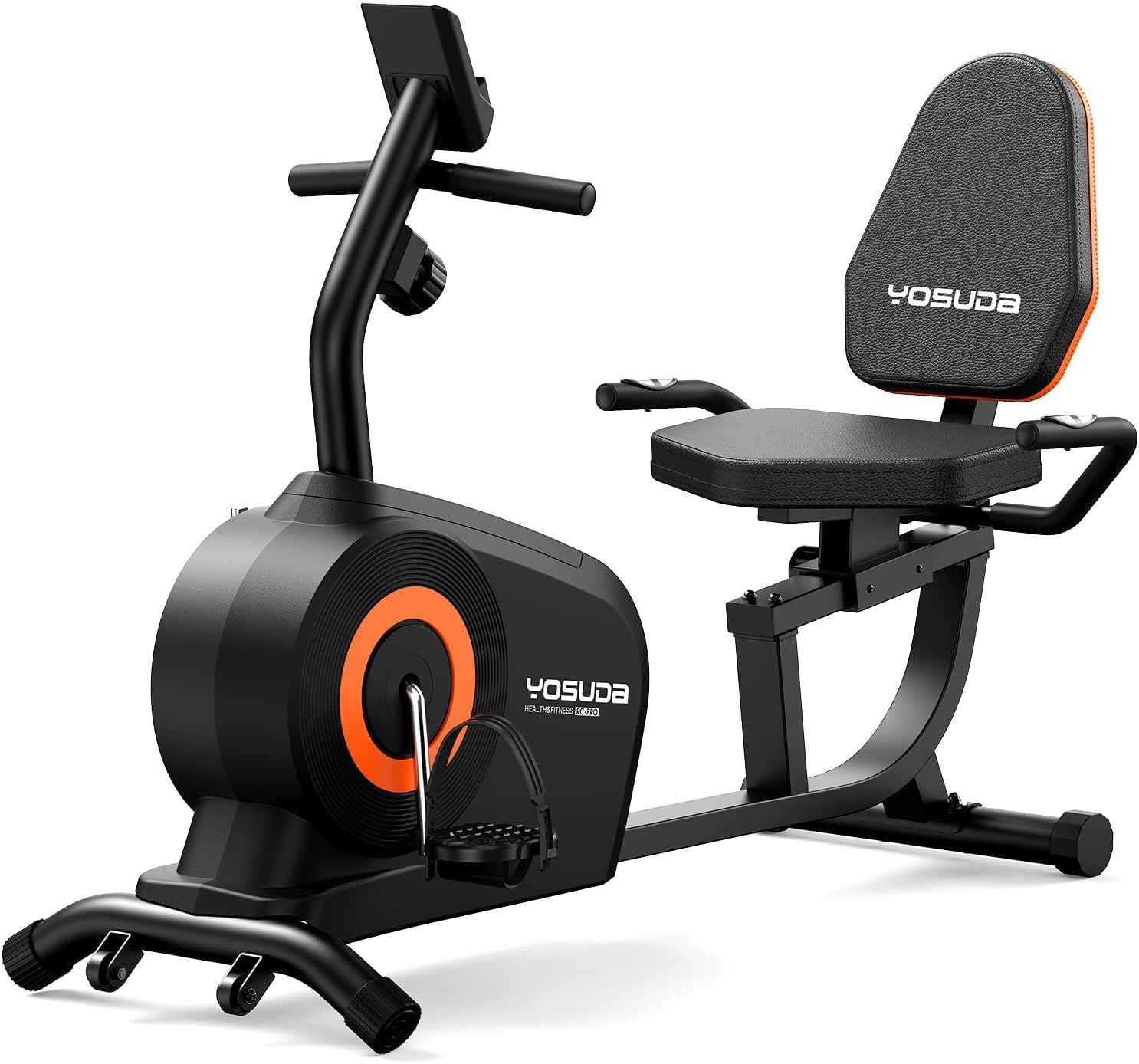
A recumbent does not have to dominate a room. The YOSUDA lrc-01 is 45 inches long and 20 inches wide, which is small enough to sit in a corner or at the end of a sofa without making the space feel like a gym. At about 58 pounds, it is light enough to move when you need the floor back.

The trade-off for that footprint is a shorter frame. Riders around average height fit well, and the seat adjusts infinitely with a pull knob; taller riders should check the leg extension before buying. The 350-pound capacity is solid for the size, and the 16 magnetic levels are smooth and quiet.

We liked the simple LCD and pulse grips, but the seat is the weak point. It is functional rather than plush, and a gel cover or a different seat will be the first upgrade for some riders. That is a small fix, not a reason to skip the bike, especially at this size.

If you want a recumbent for a small room and do not need a 400-pound frame, this is a sensible pick. The backrest gives you support that a folding X-bike cannot match, and the ride is quiet enough for a bedroom or shared living space. We found the pull-knob seat adjustment easier to live with than the spin-and-lock systems on some folding bikes.

Bottom line: For a recumbent that fits a tight corner without giving up back support, this 350-pound bike is our compact choice.

How We Tested 11 Exercise Bikes and Kept Riding Them

We started with spec sheets and a stack of customer reviews, narrowing a long list to bikes with a low step-through frame or adjustable standover height, a seat that moves up, down, and fore-aft, and a weight capacity that left some margin. Anything that required a subscription to use the console was cut, and so was anything whose reviews repeatedly mentioned a wobbly frame or a seat that wore out within months. From there we bought 11 bikes across the price range and assembled every one ourselves, stopwatch running, counting how many tools were needed and how legible the instructions were. Two of them took under 30 minutes solo; two took an afternoon and a second person.

Each bike then lived in a tester's living room or spare bedroom for the full eight months, ridden 20 to 30 minutes at a time, usually in the morning with the TV on at normal volume so we could judge noise honestly, plus a decibel app for the ones that seemed loud. We pedaled hard, stood up on the pedals, and leaned on the handlebars to see whether the frame rocked or the stabilizers lifted. For sturdiness we also checked welds and plastic housings by hand and noted anything that creaked by week three.

Seat size got its own log. We measured every saddle, then rode 30 minutes in street clothes, since most people won't change into padded shorts at home, and recorded where soreness showed up. Functionality came down to small things: could we reach the resistance knob without leaning forward, read the console without glasses, use the pulse grips without losing the screen. We weighed all of it against price at the end, and the bikes that scored best were rarely the most feature-packed.

How to Choose an Exercise Bike for Seniors

Start With the Mount

For most older riders, the mounting position decides whether the bike gets used. A recumbent with a low step-through and a wide seat lets you sit down before you lift your legs over the frame; a folding X-bike can be stable once you are on, but the step-over is higher. We prefer to pay more for a bike that feels easy to get on and off than for an extra screen or app. Look for a side handle or a seat you can slide into, and avoid any upright bike that forces you to swing a leg over a high bar.

Prioritize the Seat and Backrest

Padding is not the same as support. A wide seat with a shaped backrest keeps you from sliding forward and takes pressure off the lower back, while a thick seat that is too soft can put pressure on the wrong spots. We look for a backrest, an adjustable seat height, and a seat angle that fits the rider. If the seat is close but not quite right, a gel cover is a cheap first fix; if the backrest hits you in the wrong place, choose another bike.

Match Resistance and Capacity to the Rider

Magnetic resistance should start easy and change smoothly; 16 levels give you more room to progress than 8, but 8 is enough for gentle, short sessions. The weight rating is a safety limit, not a target. Choose a bike rated above the rider's weight with some margin, especially if the bike will be shared. A 300-pound frame is fine for many riders; a 400- or 450-pound model adds stability for larger riders.

Measure the Footprint Before You Buy

A recumbent can take up as much floor as a small armchair, so tape the footprint plus two feet of clearance in front and beside it. If the bike will live in a shared room, a folding frame or transport wheels matters more than a longer frame. Folding bikes are easiest to store, but they often give up some planted feel. We skip a bike that has to be folded after every ride unless the storage gain is real.

Decide How Much Setup and Noise You Will Tolerate

Most bikes arrive partly assembled, but the last steps still need tools and patience. If you live alone, check whether the brand offers assembly help or a clear video before you order. Magnetic resistance is usually quiet enough for a bedroom or living room; friction bikes can be louder and need more adjustment. An app is optional. Buy it for guided workouts if you will use them, not because the bike feels incomplete without it.

Frequently Asked Questions

Final Verdict

For most older riders, the XVGVSV W239 is the recumbent we recommend first. It gives you a 400-pound frame, a padded backrest, 16 quiet magnetic levels, and manageable assembly at a midrange price, which is the balance most shoppers need.

If getting on and off is the bigger concern, the Sunny Health & Fitness SF-RB424006's flip-away handle and wide seat make it the easier mount. If you need a 450-pound frame and arm exercise, choose the WFLGFT W80601.