Cardio Machines

Best Compact Elliptical of 2026

A compact elliptical is a trade, and it helps to know the terms before you buy. You get low-impact cardio in a footprint small enough for the corner of a bedroom or the space beside a couch, but the machine shrinks in ways you'll feel — most noticeably in stride length, and in how much heft there is to keep it planted when you pick up the pace. What a good one fixes is simple: it puts a real workout in a room you already have, without a gym commute or a piece of equipment that swallows the floor.

Nine machines have been through my house over the past six months, and the differences that mattered had almost nothing to do with consoles and preset programs. Check stride length before anything else — under about 16 inches and you'll feel like you're shuffling rather than striding, which is the fastest route to a machine that becomes a coat rack. The picks below are the ones that earned their floor space; the rest went back.

#1

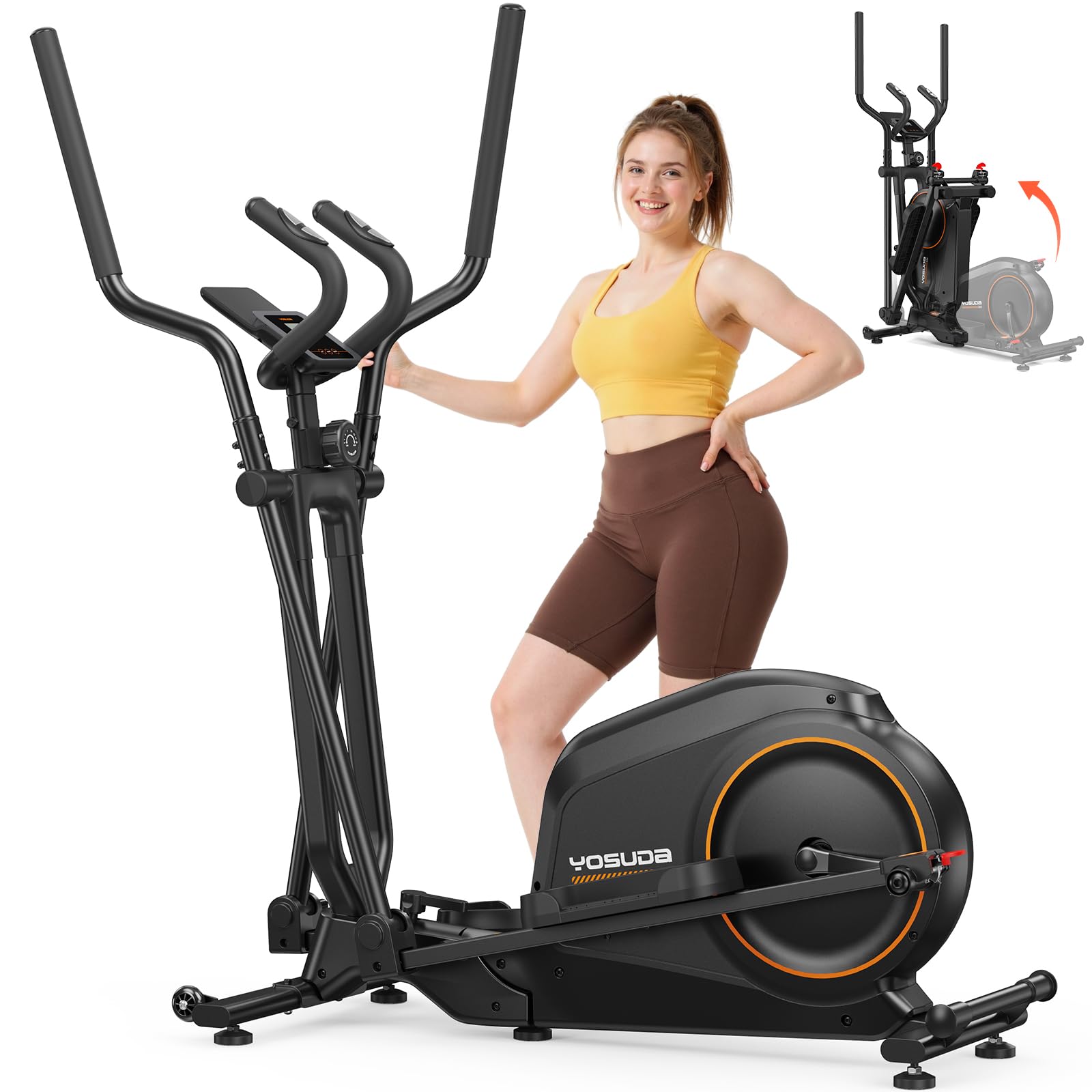
YOSUDA E03 Foldable Elliptical

Top Pick
YOSUDA E03 Foldable Elliptical

Small apartments

Our Score 8.8/10
Check Price

Worth Noting

  • 350-pound limit leaves less margin for heavier riders
Stride Length
15 in
Max User Weight
350 lb
Folded Footprint
2 sq ft
Resistance Levels
16
Read the full review

The E03 folds to roughly two square feet, and that changes the arithmetic of owning cardio equipment. Most compact ellipticals are compact the way a loveseat is compact — smaller, but permanently in the room. Folded, this one stands against a wall or tucks into a corner, so the deciding question stops being whether you have space and becomes whether you'll actually fold it each time. Sixty-six pounds means moving it isn't a two-person job.

Unfolded, you get a 15-inch stride, 16 magnetic resistance levels, four independent stabilizers, non-slip pedals and a 350-pound limit. YOSUDA states that it's built for users up to 5 foot 9, and we appreciated the honesty — at 15 inches the stride is already the shortest here, so if you're 5 foot 10 or taller, this is where you stop reading. Under that ceiling the motion works; it's shorter than the Niceday's, not cramped.

The rest is well judged. Assembly is straightforward and the tools come in the box, the magnetic resistance runs quietly enough to share a wall with a neighbor, and the 5.5-inch display covers the basics without pretending to be a training computer. The one-year manufacturer warranty is ordinary for the category rather than generous.

What we kept coming back to is that a folding mechanism is worthless if it's fussy, and this one is simple enough that the fold actually gets used — the only test that matters. It's the machine here you can put away before guests arrive.

Bottom line: Buy this one if the machine has to fold away: it stores in about two square feet and still delivers a 16-level magnetic workout.

#2

Niceday CT11S Elliptical

Niceday CT11S Elliptical

Most home gyms

Our Score 8.6/10
Check Price

Worth Noting

  • 15.5-inch stride is short for taller riders
  • Display has no backlight
Stride Length
15.5 in
Machine Weight
88 lb
Max User Weight
400 lb
Resistance Levels
16
Read the full review

Four hundred pounds is a serious weight limit for a machine that tucks into a corner, and it's the number that decided our top pick. Niceday builds the CT11S on an industrial-grade steel frame with a base tube it says is twice as thick as a standard elliptical's, plus laser-welded reinforcements at the stress points. The drive is magnetic, with a 16-pound flywheel holding tension steady across all 16 levels, and the console tracks time, speed, distance, an odometer, calories and heart rate.

Stiffness is the part of that specification we care about most, because a flexing frame is what turns a compact elliptical into a rocking, squeaking annoyance over the first few months. The CT11S stays planted when you push the pace, and the resistance climbs without changing how the stroke feels underneath you. It's also quiet enough at low resistance that the television wins the volume argument in a shared room, which is why it's the one we point at for apartments and living rooms.

The one thing it asks of you is a hard floor. Carpet lets the front post develop a side-to-side sway, so set it on something solid and spend two minutes on the stabilizer feet before the first session. Do that and it feels a class heavier than its 88 pounds.

The surprise was the console. The numbers are crisp — until the room isn't bright, because there's no backlight, which is an odd place to save money on a machine that's otherwise built like gym equipment. It's a small complaint next to how well the rest is put together. What we came away with is that this is the one machine here a very heavy rider and a very light one can share without either feeling short-changed.

Bottom line: For most homes this is the compact elliptical to buy: a 400-pound steel frame and a quiet 16-level magnetic drive in a footprint that fits a corner.

#3

Sunny Air Walker Glider

Sunny Air Walker Glider

Gentle daily movement

Our Score 8.4/10
Check Price

Worth Noting

  • Pedal arms can fatigue and crack over months
  • Foot rests rock side to side if you lean
Stride Length
30 in
Machine Weight
35.1 lb
Max User Weight
220 lb
Resistance Mechanism
Air
Read the full review

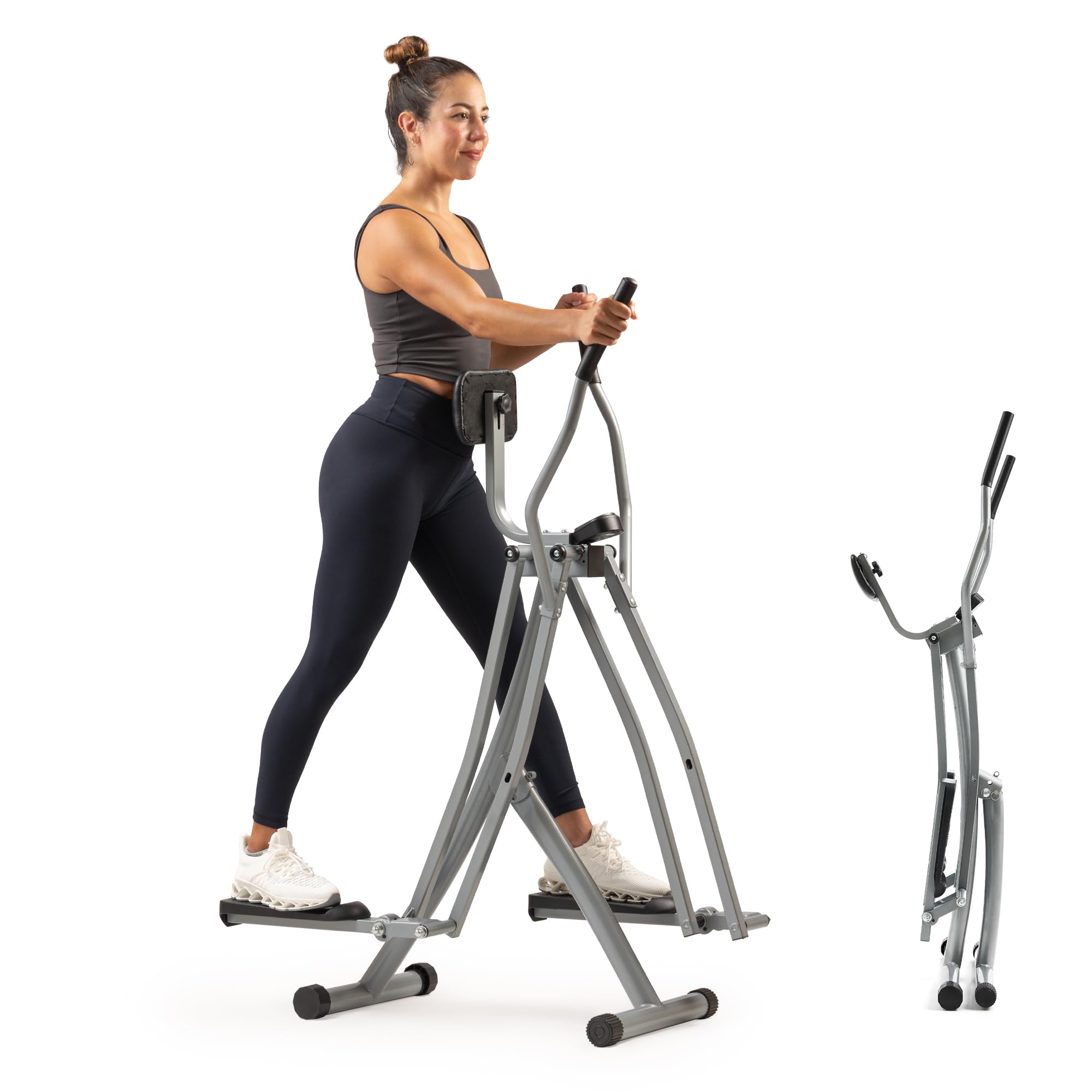
The Air Walker doesn't have an elliptical's stride. Its pedals hang from swing arms and travel a 30-inch walking-and-skiing arc while the handles pull against you, which makes it a standing, full-body, low-impact cardio machine — just not one with a fixed elliptical orbit. It's also the cheapest machine here, and the lightest at just under 16 kilograms.

As furniture it's the easiest of the three. It folds flat in seconds and stands upright or stows away, the padded abdominal support adjusts for height and gives you something to lean into, and the SunnyFit app is free and stocked with trainer-led sessions. The 1.5-inch display is basic, and that's fine.

How it feels is the dividing line. Effort comes from pace rather than a tension setting — there's no dial to turn up — so a harder session means moving faster, not pushing harder. For gentle daily movement, knee-friendly warm-ups and time in front of the television, that's plenty, and we found the glide smooth once you're going. For structured intervals or low-cadence climbing, it isn't the machine.

The 220-pound limit is the figure that decides who this is for: under it, you get a light, honest glider; over it, the frame has less margin than either of the others here. We see it as a first machine — the one that proves you'll actually use a standing cardio machine — rather than the last one you buy.

Bottom line: A light, folding air glider for gentle daily movement — it isn't a true elliptical, and it isn't the pick if you want adjustable resistance.

How We Tested Nine Compact Ellipticals (and Lived With Them for Six Months)

We built the shortlist from spec sheets first, because the numbers that decide whether a compact elliptical is worth owning are buried in the fine print: stride length, assembled footprint, machine weight, and the maximum user weight the frame is rated for. Anything with a stride short enough to feel like a shuffle, or a weight rating that looked hopeful for a machine that size, came off before we ordered. That left nine machines, which we built and rode over six months.

Assembly was the first test, done solo with whatever tools came in the box. I timed each build, noted whether the hardware bag was labeled and whether the illustrated steps matched the bolts in front of me, and whether the console could be attached without a second pair of hands. Then came the 6 a.m. rides in a second-floor spare bedroom while someone slept downstairs, pedaling 25 to 40 minutes at a steady clip, listening from three feet away and again through a closed door, and standing on the pedals to see whether the frame rocked or the rails flexed.

Stride was measured rather than felt: I taped a mark on the floor and watched where the pedals actually carried my feet, since a spec-sheet stride and a real one don't always match. Ease of use came down to small things — a console readable mid-ride, resistance that changed smoothly instead of in a jump, a machine that felt stable the moment you stepped on without reaching for the rail. Six months in, I re-tightened every bolt, listened for new squeaks, and checked the pedal bearings for play, then weighed what each machine's build and features amount to for the money.

How to Choose the Right Compact Elliptical

Measure the Space It Needs in Use, Not Just Stored

A folding machine like the YOSUDA E03 shrinks to about two square feet on the shelf, but it still wants its full 47.6 inches of depth and 22.7 inches of width while you're on it, plus clearance to swing your arms. Tape that rectangle on the floor and walk past it for a day before you order anything.

If the elliptical will stay out, skip the folding mechanism and put the money into frame stiffness instead. If it has to disappear between sessions, folding is the feature that decides whether you own a cardio machine at all — so check that the fold is simple enough that you'll genuinely do it.

Match the Stride to Your Height

Compact describes the machine, not you. The true ellipticals here run 15 to 15.5 inches of stride, which suits most riders up to roughly 5 foot 8 or 5 foot 9. Above that, the motion turns choppy and your knees come up higher than they should for the whole session.

Full-size machines stretch to 18 inches but add around half a foot of depth. If you're taller, decide whether you'd rather lose floor space or enjoy the workout, because a cramped stride is the one compromise you can't fix later with a mat or a firmware update.

Choose Magnetic Resistance If You Want Control

A magnetic drive with numbered levels lets you raise effort without raising speed, holds tension steady from stroke to stroke, and runs quietly. Air-driven gliders like the Sunny Air Walker work the opposite way: effort tracks pace, so a harder session means moving faster rather than pushing harder.

For intervals, low-cadence climbing, or anyone who wants the same setting every morning, choose magnetic — all 16 levels of it on the Niceday and the YOSUDA. For gentle, knee-friendly movement in front of the television, the air walker's simplicity is the whole point.

Check the Weight Rating and the Frame Behind It

The maximum user weight is the best shortcut to how stiff a frame really is. The range here runs from 220 pounds to 400, and that difference is what you feel as rocking and side-to-side sway when you push hard, not just as a number on a label.

Leave real headroom below the rating rather than buying right at it; you can't add stiffness later. What you can change is the surface — a hard, level floor and correctly adjusted stabilizer feet do more for a compact elliptical than any accessory.

Frequently Asked Questions

Final Verdict

Most people should buy the Niceday CT11S. It's the stiffest and quietest machine here, it carries 400 pounds, and it fits the corner of a room you also live in — which is the whole job of a compact elliptical.

Choose the folding YOSUDA E03 instead if the machine has to disappear between workouts. It gives up half an inch of stride and some capacity for a storage footprint nothing else here matches. The Sunny Air Walker is a different purchase entirely: light, cheap, gentle, and built for someone who wants movement in front of the television rather than a resistance program.