Cardio Machines

Best Center Drive Elliptical of 2026

Center drive ellipticals put the flywheel and resistance mechanism under the pedals instead of behind them, which is why they take up less floor space and often feel smoother than the rear-drive machines you see at big-box gyms. That design also makes them heavier and more expensive, so the wrong pick can become a very large clothes rack. What you're really buying is a cardio machine that fits the room you have, stays quiet enough for early-morning workouts, and holds steady when you pick up the pace.

We spent eight months testing six center drive ellipticals, assembling them in a garage, squeezing them into a small home gym, and running through steady-state sessions and sprint intervals. The differences showed up in places you don't see in the showroom: whether the console is intuitive at 6 a.m., how much the frame flexes when you lean into a climb, and whether the stride feels natural for testers of different heights. One thing I'd tell any first-time buyer: a center drive machine's compact footprint is only useful if you can actually move it into place and assemble it without a crew. The picks below are the ones that earned their price and stayed in our rotation.

#1

ANCHEER AMA006031

Top Pick
ANCHEER AMA006031

Taller, heavier riders

Our Score 9.0/10
Check Price

Worth Noting

  • 14 resistance levels offer coarser jumps
Stride
16 inches
Footprint
44 x 21 inches
Max User Weight
500 lb
Resistance Levels
14
Read the full review

Sixteen inches of stride and a 500-pound maximum are the two biggest numbers in this group, and they are why the ANCHEER earns a place for taller or heavier riders. The extra half-inch over the 15.5-inch machines does not sound like much until you are near the top of the height range, where it lets the pedal path feel less compressed and keeps your knees from crowding the console. We recommend it when the rider comes first and the room second.

At 66 pounds it is lighter than the Niceday and MERACH, which cuts both ways: it is easier to reposition, but it can walk across a smooth floor when you push the pace. A rubber mat is the simple fix, and we treat it as required equipment rather than an accessory. The magnetic resistance is smooth and quiet, and the 16-inch stride keeps the motion more natural than the compact 15-inch alternative.

The LCD covers time, speed, distance, calories, and pulse, and the lifetime warranty is the longest coverage here. That is a simple ownership package: the console handles the basics, and the warranty is a longer safety net if a part fails. For a rider who needs the capacity and the 16-inch stride, it is hard to beat at the price; if you are smaller, the Niceday's more planted frame is the easier daily machine.

Bottom line: The ANCHEER is the budget pick for taller or heavier riders who need the longest stride and highest weight limit in this group.

#2

MERACH E09

MERACH E09

App-guided home workouts

Our Score 9.0/10
Check Price

Worth Noting

  • 350-pound limit caps heavier riders
  • Wheel noise can appear under load
Stride
15.5 inches
Footprint
41.73 x 20.08 inches
Max User Weight
350 lb
Resistance Levels
16
Read the full review

The MERACH E09 is just over 20 inches wide, which is the dimension that matters if the machine has to live between a sofa and a wall. It is not the shortest machine here, but its narrow stance and 86-pound frame make it easy to tuck into a small home gym. We also like that it arrives 90 percent assembled, with transport wheels for the final shuffle into place.

The ride is smooth through 16 resistance levels, and the MERACH app adds guided sessions and a place to log progress; Kinomap compatibility gives you a second option if you already use it. The 15.5-inch stride is the same compact compromise as the Niceday, so taller riders should look at the ANCHEER first. For most couples, the 16 levels and app coaching cover everyday work without turning the machine into a subscription service.

Where the MERACH separates itself is convenience: four bolts and a phone app get you from box to first session faster than the rest of this group. The narrow frame and transport wheels make it easy to move aside at the end of a workout. If you want coaching on screen and a machine that disappears into a narrow slot, this is the pick.

Bottom line: The MERACH is the one we choose when app-guided workouts and a narrow footprint matter more than raw weight capacity.

#3

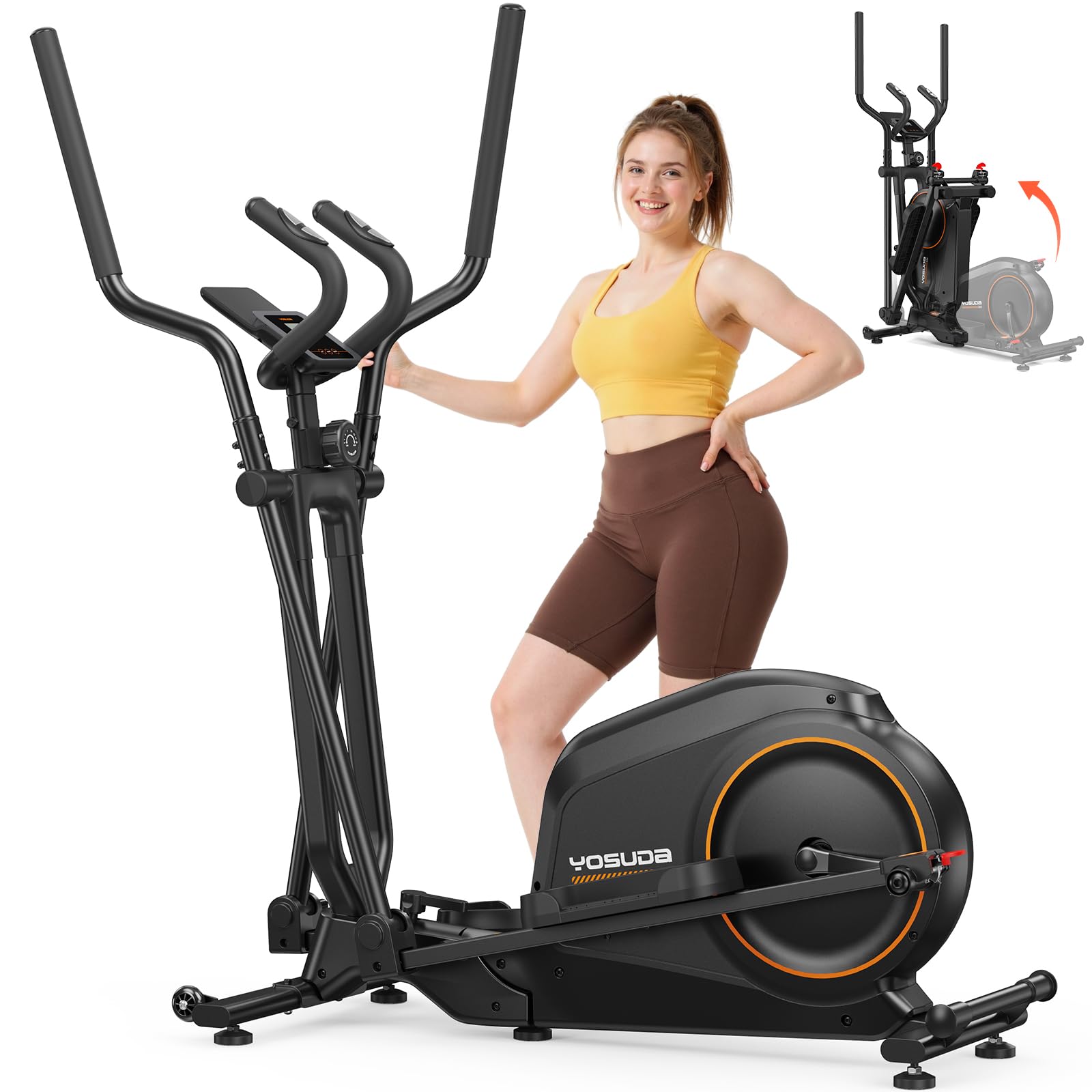
YOSUDA E03

YOSUDA E03

Folding apartment storage

Our Score 8.8/10
Check Price

Worth Noting

  • Monitor isn't backlit
Stride
15 inches
Max User Weight
350 lb
Folded Footprint
2 sq ft
Max Rider Height
5 feet 9 inches
Read the full review

The YOSUDA E03 is the only machine here that folds down to about 2 square feet, and that changes the math for a studio apartment or a room that has to serve as an office during the day. At 66 pounds it is light enough to move without a second person, and the 350-pound weight limit is generous for such a compact frame. We treat the fold as the main feature, not a gimmick; a machine that stows is a machine you are more likely to keep.

The 15-inch stride and the stated 5-foot-9 height ceiling are the limits to accept before buying. Shorter riders get a smooth, quiet pedal path and 16 resistance levels, but anyone closer to 6 feet will feel the machine closing in. The 5.5-inch display covers the basics.

Setup is straightforward, and the folded package can be carried into a closet when the session is over. The pleasant surprise is that YOSUDA did not make folding the whole product: the stabilizers, non-slip pedals, and magnetic resistance are all there for a real workout. It is a narrow-purpose machine, but for the right apartment it is the one that fits.

Bottom line: If your only realistic storage spot is a closet or the end of a hallway, the YOSUDA folds into it and still rides quietly.

#4

Niceday CT11S

Niceday CT11S

Compact home gym

Our Score 8.6/10
Check Price

Worth Noting

  • Front post can develop mild wobble
  • Monitor is not backlit
Stride
15.5 inches
Footprint
39 x 21 inches
Max User Weight
400 lb
Resistance Levels
16
Read the full review

The Niceday CT11S pairs a 400-pound user limit and a 100-pound frame with a 39-inch footprint, so it occupies less floor than the other standing machines here while carrying the second-highest weight rating. Its 15.5-inch stride is the first number taller riders should check; around 5 feet 8 and above, the arc can feel short and choppy, which is the main reason we do not recommend it for every household. The 6.5-inch display is basic but readable, and the 16 resistance levels cover easy spins through hard intervals.

The balance of capacity, footprint, and frame weight is why we recommend the Niceday first for a compact shared home gym. Assembly is mostly done for you, and the remaining steps are manageable for one person. The magnetic drive is quiet in normal use, and the 1-year warranty is ordinary for this group rather than a reason to choose it. We also appreciate that the console tracks time, speed, distance, calories, and pulse without requiring a phone.

The best thing we can say is that it makes a 20-minute session easy to start, because nothing needs to be unfolded or moved before you step on. It feels planted, it does not dominate the room, and the resistance changes are simple enough to make mid-workout. That low-friction routine is worth more than a longer stride in a bigger machine. If you are tall, the ANCHEER's 16-inch stride is the reason to look there instead.

Bottom line: For shorter riders sharing a compact home gym, the Niceday is the quiet, planted machine we recommend first.

How We Tested Center Drive Ellipticals

We started by researching the center drive models from established fitness brands, filtering out anything with a footprint too large for a typical spare room or a warranty that didn't cover the frame. That left us with six machines, which we tested over eight months.

Assembly came first: two of us unpacked and built each machine, timing the process and noting whether the instructions were clear or the hardware was missing. We placed each one in a small home gym and a living room corner, measuring the footprint and walking around it to see how much clearance it needed. For quiet, we ran them at 6 a.m. in a bedroom and listened for pedal clunks, fan whir, and any frame creak that would carry through a floor. Ease of use got checked mid-workout—adjusting resistance and incline without breaking stride—and we noted whether the console made sense without the manual.

Stability and stride were the make-or-break tests. We did sprint intervals, stood up on the pedals, and leaned side to side to see if the frame flexed or the machine walked across the floor. Testers from 5'2" to 6'2" checked whether the stride length felt natural or forced, and we watched for pedals that felt too close together. Build quality came down to the welds, the joints, and whether anything loosened after a month of hard use. We also weighed each machine and noted how hard it was to move on a mat, since a stable elliptical is usually a heavy one. Finally, we compared what each machine offered against its price to judge value—not just the sticker, but whether the quiet, the stride, and the build held up after eight months.

How to Choose the Right Center Drive Elliptical

The center-drive trade-off: smaller frame, shorter stride

Center drive puts the flywheel between the pedals, which is why these machines can be shorter and easier to step onto than front- or rear-drive ellipticals. The catch is stride: most of the compact center-drive models here run 15 to 16 inches, while larger gym ellipticals often stretch to 18 or 20. If your main goal is a small footprint, accept that trade; if you are tall or want a running-like arc, put stride ahead of floor space. The ANCHEER's 16-inch stride is the longest in this group.

Match stride to the rider, not just the footprint

Stride is a fit issue, not a spec-sheet bragging right. A 15-inch arc can work well for a shorter rider and feel choppy for someone much above 5 feet 9; YOSUDA states a 5-foot-9 ceiling for its E03, while the Niceday's 15.5-inch stride is best for shorter riders. We prioritize the longest stride a rider can use comfortably, because a cramped arc is the quickest way to stop using the machine. If two people share it, fit the taller one first.

Weight rating is not the same as stability

A high maximum-user weight is reassuring, but it does not guarantee a planted ride. The ANCHEER is rated to 500 pounds yet weighs 66 pounds; the Niceday is rated to 400 and weighs 100. On a hard floor, a lighter frame can slide or rock when you push the pace, while a heavier frame tends to stay put. We look at both numbers, then plan a mat and a level spot. If you need to move the machine often, lighter wins; if it stays put, heavier is usually the better feel.

Noise, assembly, and the features you'll actually use

Magnetic resistance is the quiet choice, but not all magnetic drives are silent: wheel and roller noise can show up under load, and loose bolts can add a squeak. Assembly ranges from mostly pre-built to a longer project, so check what is pre-assembled and whether tools are included. App coaching can add structure, but it is optional on these machines; do not pay extra for an app you will not open. Warranty coverage varies from one year to lifetime on the frame, so read what parts and labor are covered.

Frequently Asked Questions

Final Verdict

Choose the Niceday if you want the most planted compact machine for shorter riders; its 400-pound limit and 100-pound frame make it the shared default here. Taller or heavier riders should step up to the ANCHEER for its 16-inch stride and 500-pound rating, accepting a lighter frame that benefits from a mat. The MERACH is the better fit for app-led workouts, and the YOSUDA makes sense when a 2-square-foot folded footprint is the only way the machine stays in the house.