Accessories

Best Wrist Wraps of 2026

A wrist wrap has one job: make you forget about your wrists under a heavy bar. The wrong pair makes itself known immediately—too stiff and it fights your setup, too soft and it gives nothing back when you press overhead, and a sloppy fit can turn a routine wrap job into a mid-set distraction. The right pair gives firm, even wrist support, stays comfortable through a full session, and keeps its grip after months of strapping and unstrapping.

Over the past three months, my team and I put 16 pairs through squats, bench presses, overhead work, and conditioning circuits, paying attention to how each one felt from the first wrap to the last rep of a session. We also checked the unglamorous stuff: whether the closure stayed anchored after repeated pulls, if stitching frayed at the edges, and if the stiffness matched the lift instead of fighting it. The picks below are the wraps that balanced support, comfort, and durability without making us think about them mid-set.

#1

Rogue Fitness Wrist Wraps

Top Pick
Rogue Fitness Wrist Wraps

Olympic lifts

Our Score 9.6/10
Check Price

Worth Noting

  • Too little material for heavy pressing
Length
12 in
Weight
3.52 oz
Material
Cotton, polyester, elastic
Sizes Available
12, 18, and 24 in
Read the full review

Twelve inches is the short end of the range, and it's the wrong choice for most lifters and the right one for a specific job. Short wraps give you two passes instead of three or four, so there's less material to build tension with and the wrist keeps some movement. That is exactly what an Olympic lifter needs when a snatch or a clean gets caught in a deep position and the wrist has to travel.

For that job this is the best wrap here, and the one that would live in a weightlifting bag. The blend — 50% cotton, 40% elastic, 10% polyester — is why: the cotton keeps it from feeling like plastic against the skin while the elastic does the work, and at 3.52 ounces it nearly disappears in a bag. Rogue sells the identical wrap in 18 and 24 inches, so stiffness is a choice rather than something the design forces on you.

Two things to know before ordering. The elastic stretches with use, so a snug first fit is the right first fit; it won't tighten up later. And the sizing is real — this is not an 18-inch wrap folded smaller, so read the length before you click.

Bottom line: For Olympic lifting we reach for these: 12 inches of flexible wrap that lets the wrist move under a catch, and not much use on a heavy bench.

#2

Gymreapers Weightlifting Wrist Wraps

Gymreapers Weightlifting Wrist Wraps

Overall strength training

Our Score 9.4/10
Check Price

Worth Noting

  • Stitching at the hook-and-loop is the wear point
Length
18 in
Closure
Hook and loop with thumb loop
Approval
IPF approved
Material
Polyester and elastic
Read the full review

IPF approval is a line most wraps can't cross, and this pair crosses it — which is the first reason we hand it to most lifters. It's a true 18-inch wrap in a polyester-elastic weave with reinforced thumb loops, the length that gives you three passes around the wrist and the tension range a heavy bench actually needs. On a working set it stops the wrist rolling back instead of just reminding you it's there.

The thumb loops are the detail we appreciate most. They're wide enough not to bite into the webbing between thumb and index finger while you tension the wrap, and that matters when you're setting up alone under a loaded bar with no hand free. Tightening is a two-second job: wrap, press the tab, go. The surprise is a glue-like smell straight out of the bag, which faded within a couple of days and never came back.

Firm rather than board-stiff is the right description. There's a short break-in, a session or two, before the elastic settles into the shape of your wrist, and after that it holds tension without a re-wrap between sets. We stop short of calling it a competition-only wrap: it's civilised enough for a general strength program, which is exactly why it's the pair we reach for first.

Bottom line: Our pick for most lifters: IPF-approved, 18 inches of firm elastic, and the most consistent support on heavy pressing in this group.

#3

Fitgriff Wrist Wraps

Fitgriff Wrist Wraps

Everyday gym sessions

Our Score 9.4/10
Check Price

Worth Noting

  • Less rigid than a stiff wrap on max attempts
Weight
4.59 oz
Markings
Left and right
Material
Cotton
Dimensions
17.72 x 3.15 x 0.04 inches
Read the full review

Next to our top pick, these feel like a thick sock rather than a cast. Same 18-inch job in practice — the listed dimensions are 17.72 by 3.15 inches — but the face is cotton and the whole wrap is softer and more pliable straight out of the bag, with no break-in at all. The left and right markers are printed clearly enough to read in a dim gym, which saves the fumble when you're setting up.

That softness buys comfort. We wore them through pressing sessions and through higher-rep bodyweight work, and they were the pair we forgot we had on. Cotton against the skin is friendlier than an elastic face, and the industrial hook-and-loop grabs hard enough that the tab doesn't creep once it's pressed down. Tightening is forgiving too — you can adjust mid-session without unwinding the whole wrap.

The value pick of the mid-priced pairs here. It costs less than our top pick and less than both stiff wraps, and it asks nothing of you in return: no break-in, no technique, no fuss. If you're not chasing a platform total and you want a wrap that stays pleasant for a whole session, this is the one we point you to.

Bottom line: Buy this if you want support without a break-in: softer than our top pick, marked left and right, and comfortable for a full session.

#4

TECEUM Weightlifting Wrist Wraps

TECEUM Weightlifting Wrist Wraps

First-time buyers

Our Score 9.4/10
Check Price

Worth Noting

  • Gives more under heavy loads than an elastic wrap
Pack
1 pair
Length
18 in
Material
Cotton
Read the full review

The cheaper end of this guide doesn't announce itself. Eighteen inches of cotton-elastic with a thumb loop and a print running down the face, no approval badges and no warranty card in the box. What it does have is the basic geometry right: full length, a loop that holds its position, and a closure that stays where you tension it.

We wore these for overhead pressing and for loaded carries, and the cotton face is the reason they stayed on for both. There's give in the weave, so the wrap settles against the wrist instead of pinching, and the thumb loop is soft enough that you can leave it on the thumb through a whole set. Nothing about them feels premium, and nothing about them feels disposable either.

That combination makes them the pair we suggest for a first buy and a sensible spare for a gym bag. The support is real for pressing and carrying, the fit is forgiving on a wrist that hasn't been measured, and if you decide you want a stiffer wrap later you'll know exactly what you're buying. It's the cheapest way to learn what you actually prefer.

Bottom line: A good first pair: comfortable cotton, supportive enough for overhead work, and inexpensive enough that finding out what you like costs little.

#5

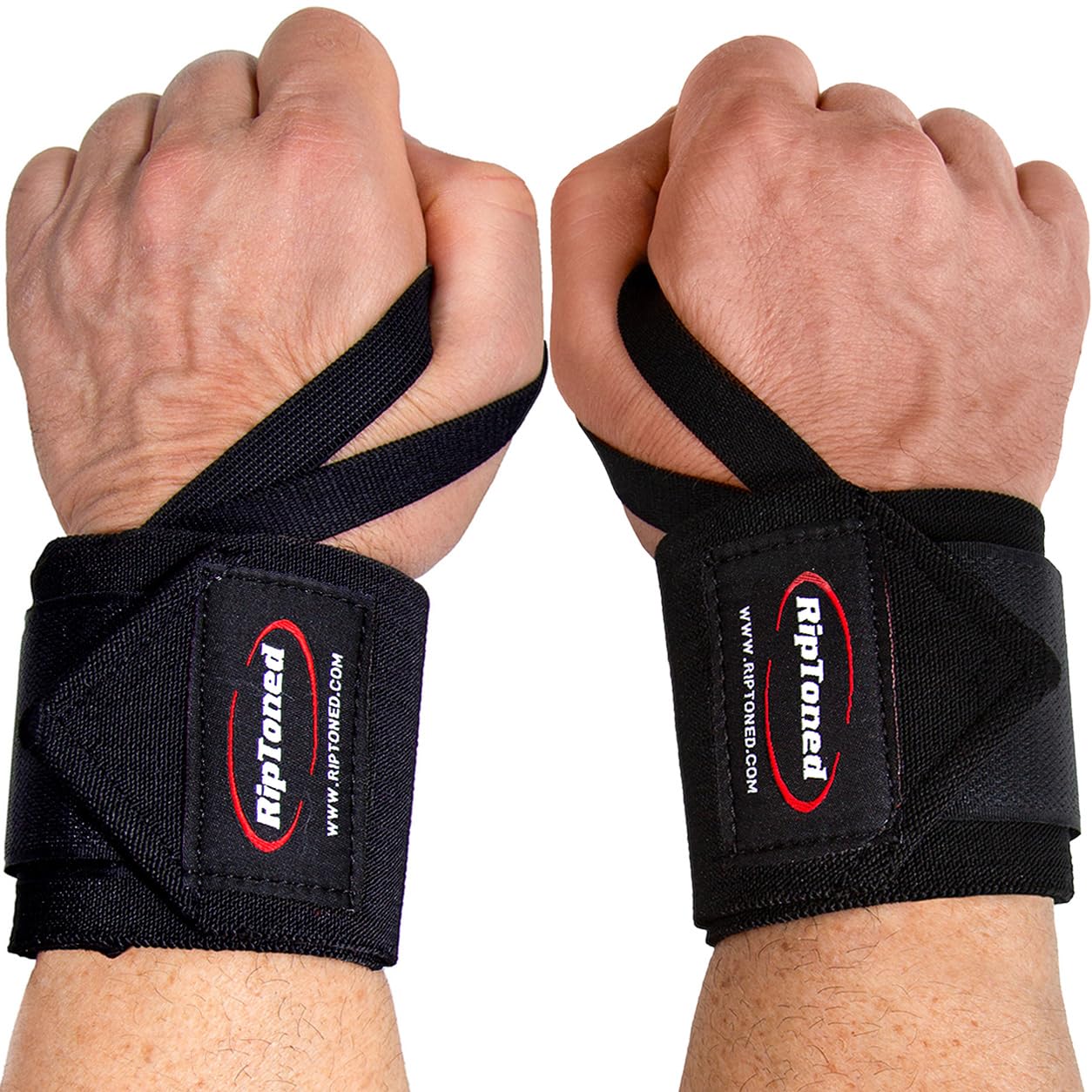
Rip Toned Stiff Wrist Wraps

Rip Toned Stiff Wrist Wraps

Heavy bench pressing

Our Score 9.2/10
Check Price

Worth Noting

  • Too stiff for high-rep accessory work
Care
Machine washable
Warranty
Lifetime replacement
Wrist Fit
5.5 to 9 in
Dimensions
18 x 3 x 0.05 inches
Read the full review

Stiff is the honest word. Out of the bag these feel closer to a strip of conveyor belt than to fabric, and the first wrap of a session is a negotiation — you tension them, they push back. The break-in is deliberate, one to two weeks of training before they mold to your wrist, and after that stretch of sessions we agree with the idea: the conformed wrap is a different thing from the one in the package.

For heavy pressing, that stiffness is the whole point, and this is the pair we reach for on a max-effort bench day. USPA and USAPL approval covers the platforms most lifters compete on, the hook-and-loop holds its tension once you've set it, and the fit range runs from 5.5 to 9 inches, so it isn't a specialist wrist size. The lifetime replacement warranty is the part that got our attention: it covers the hook-and-loop, the stitching, and the material, which is precisely where wraps fail.

Two conveniences worth knowing: they're machine washable, and each pair ships with a small pouch so they don't shed lint through the rest of your bag. If you have a meet coming, order a month out rather than the week before — a stiff wrap that hasn't molded to you is a distraction on the platform, and these need the time.

Bottom line: We recommend the stiff version to anyone who presses near a max and wants a lifetime warranty on the part that usually fails.

#6

VINSGUIR Wrist Wraps

VINSGUIR Wrist Wraps

Slim wrists

Our Score 9.2/10
Check Price

Worth Noting

  • Hand wash only
Length
21 in
Approval
USPA certified
Material
Polyester
Warranty
1 year
Read the full review

Twenty-one inches is three more than the standard wrap, and those three inches change where the pressure lands. Instead of three tight passes you get four slightly overlapping ones, and the tension spreads further up the forearm rather than concentrating in one hard band. That makes this the pair we hand to lifters with slim wrists, and to anyone who has found an 18-inch wrap bunching under a heavy press.

It's the least expensive wrap in this guide, which usually means a corner somewhere. The face is a touch wider than the others, noticeable on a very small frame and irrelevant on an average wrist, and the polyester is smoother to wrap than a cotton face, so you get an even, flat wrap once you've set it. USPA certification, double-stitched edges, and a one-year warranty are unusual at this end of the group.

In a mixed session it behaves like a firm everyday wrap rather than a competition one — supportive enough for pressing volume and overhead work, comfortable enough that you won't strip it off between sets. For a lifter who wants to find out what a wrap does before committing to a stiff pair, this answers the question cheaply.

Bottom line: The pair we hand lifters with slim wrists: 21 inches spreads tension instead of bunching it, and it costs the least of the wraps here.

#7

DMoose Fitness Wrist Wraps

DMoose Fitness Wrist Wraps

Approved budget lifting

Our Score 9.2/10
Check Price

Worth Noting

  • Less rigid lockout than a stiff elastic wrap
Length
18 in
Closure
Hook and loop
Approval
USPA and IPL
Material
Cotton and elastane
Read the full review

USPA and IPL both approve this wrap, which is more competition cover than most lifters will ever need and worth something to the ones who do compete. It's an 18-inch wrap in a cotton-elastane blend, with reinforced stitching and a heavy-duty hook-and-loop closure.

The blend is the interesting part. Elastane is what gives a wrap its stretch and recovery, and cotton is what keeps it from turning into a sweaty band halfway through a session. That combination is why this one stays comfortable for a whole workout rather than just a top set, and it's the reason it reads as a general-strength wrap rather than a competition-only one.

Fit follows the usual 18-inch pattern: three passes on most wrists, with the thumb loop holding position while you tension with your free hand. The closure is built for range, tight for a press and backed off for volume work, and it holds both without the tab creeping. On a very small wrist, length is still the thing to settle before you order.

Where it lands for us is the middle of this guide. Two real approvals, a breathable material, and a softer ride than the stiff wraps above, at a price below our top pick. For a lifter who wants an approved wrap without spending two weeks breaking one in, that's a straightforward answer.

Bottom line: A sensible middle option for us: two competition approvals, a breathable blend, and less rigidity than the stiff wraps here.

How We Tested Wrist Wraps

We built the shortlist by reading specs and owner feedback, comparing widths, lengths, and closure styles, and filtering out wraps that lacked a clear size range or felt like one-size-fits-all compromises. From that pool, we tested 16 pairs over three months, rotating them through squat days, bench and overhead sessions, and faster conditioning circuits so each wrap saw both heavy, low-rep work and sweaty, high-rep use.

On the first wear, we wrapped each pair solo and noted how easy it was to get a snug fit, whether the material pressed evenly across the wrist or pinched at the edges, and how much stiffness it added during warm-up sets versus working sets. During training, we paid attention to whether the support felt firm without cutting circulation and whether the wrap stayed put through repeated sets—no rolling, no loosening, no constant re-adjusting.

After sessions, we inspected stitching at the thumb loop and edges, looked for frayed threads, and repeatedly opened and closed the hook-and-loop to see whether it still grabbed after sweat and chalk. We logged how each pair held up at the one-month mark and again at three months, then compared notes on which ones still felt comfortable and secure. The best wraps did their job quietly; the weaker ones made themselves known through slipping closures, stiff edges, or stitching that started to go.

How to Choose Wrist Wraps

Length Decides How Much Wrap You Get

Twelve inches gives you two passes, 18 gives you three, and 21 gives you four. Each extra pass spreads the pressure further up the forearm and builds more tension, which is why 18 inches is the default for pressing and 12 is the Olympic-lifting size: a catch needs the wrist to travel. The trap is assuming longer means more support. Tension is something you apply, not something a wrap has, and a loosely wrapped 21-inch pair gives you less than a tight 12. Buy for the lift, then learn the tension.

Stiff Wraps Break In, and That Isn't a Fault

A stiff wrap feels wrong for the first week. It resists, it doesn't follow the shape of your wrist, and it can feel like a mistake. That is designed in: the Rip Toned pair is built to mold across one to two weeks of training, and judging it after a single session tells you nothing. If you have a meet on the calendar, buy a stiff pair a month out rather than the week of. A soft cotton wrap like the Fitgriff or TECEUM pairs skips the process and gives up some lockout in return.

The Closure Is What Fails First

Look at the stitch line where the tab meets the elastic, not at the velcro pile. A strong hook-and-loop closure pulls hard on whatever holds it, and that seam is where wraps come apart — the same failure turns up across this group. Reinforced stitching and a warranty that covers the closure are worth more than another half-inch of length. Stiffness you can feel in the shop; stitching you can only judge by the promise behind it.

Fit, Thumb Loops, and Competition Approval

Most 18-inch wraps fit wrists from roughly 5.5 to 9 inches. A slim wrist takes more passes out of the same length, which is what makes a 21-inch wrap worth having, while a heavy forearm can leave an 18-inch wrap feeling short on coverage. The thumb loop exists to hold the wrap while you tension it with your free hand, and a wide one won't dig into the webbing between thumb and finger. Approval only matters if you compete: IPF for IPF meets, USPA, USAPL, or IPL for those federations. Outside competition, buy on fit and stiffness and ignore the badge.

Frequently Asked Questions

Final Verdict

Most lifters should buy the Gymreapers pair. IPF approval means it's legal wherever you compete, the 18-inch length gives you the passes a heavy press needs, and its support held up on the heaviest sets we handled. If you press near a maximum and want a stiffer wrap with a lifetime warranty covering the closure, the Rip Toned stiff version is the better tool.

And if your training is snatches and cleans rather than bench, buy the Rogue 12-inch — and don't expect it to lock out a press.