Accessories

Best Weight Sleds of 2026

A weight sled is about as simple as fitness equipment gets: load it with plates, grab a handle or strap into a harness, and push or drag. That simplicity is why the differences between models matter. A sled that wobbles under load or tips on a turn turns every session into a negotiation, while a solid one disappears under the work. I've used sleds in muddy backyards and cramped garage gyms, and the right one earns its footprint by making hard training feel straightforward.

Over the past six months, my team and I have assembled, loaded, and dragged nine weight sleds across turf, concrete, and gravel. We care about the things you'd care about: whether the welds hold after repeated drops, whether assembly takes ten minutes or an afternoon, whether the price matches the hardware, and whether the sled is stable enough to push hard without chasing it across the yard. A good sled is a long-term piece of training equipment. The picks below are the ones that held up.

#1

TYRSEN Weight Sled

Top Pick
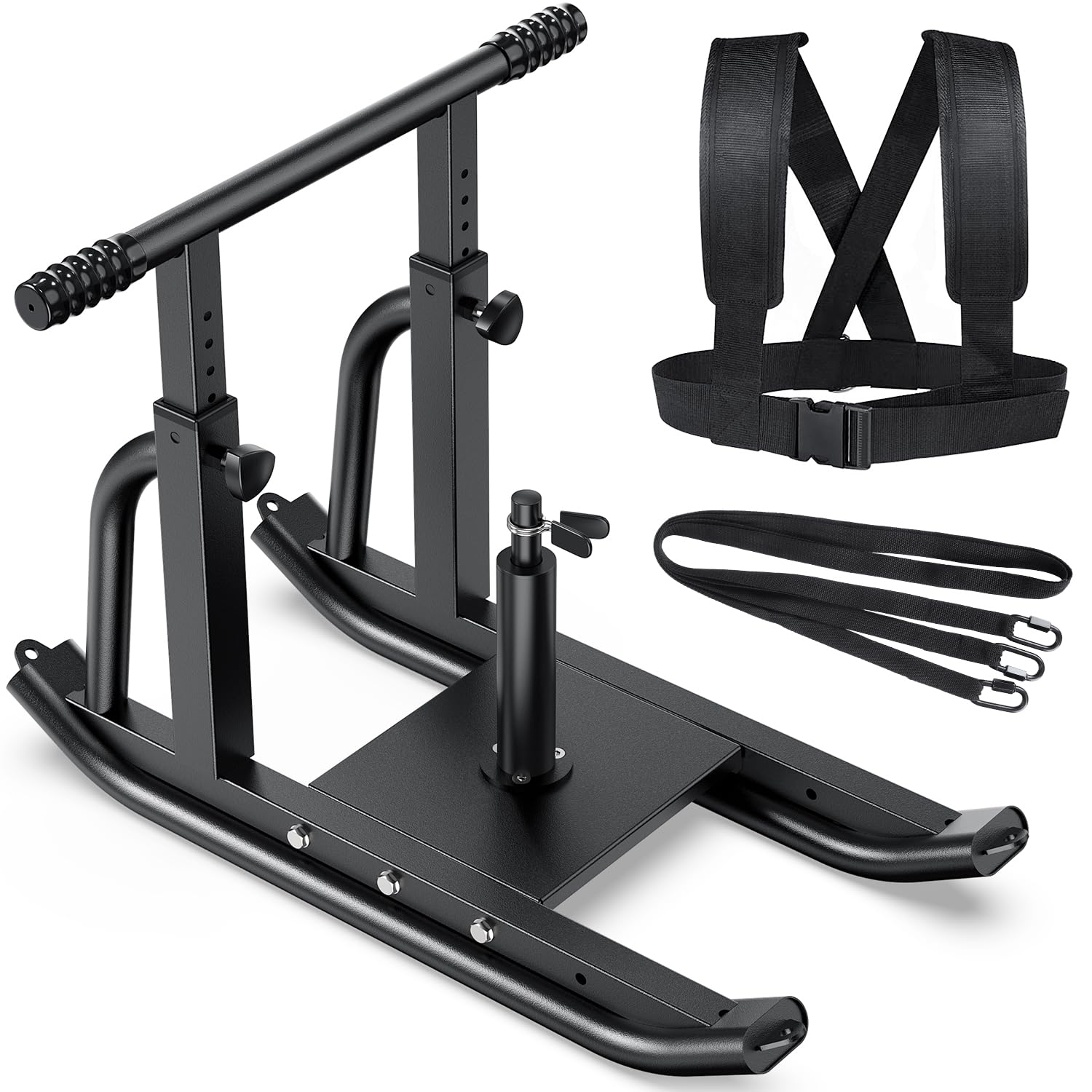
TYRSEN Weight Sled

Heavy loading

Our Score 9.6/10
Check Price

Worth Noting

  • Premium price for the capacity
  • Long-term durability unproven
Item Weight
35.5 lb
Load Capacity
550 lb
Handle Positions
5
Plate Compatibility
1 in and 2 in
Read the full review

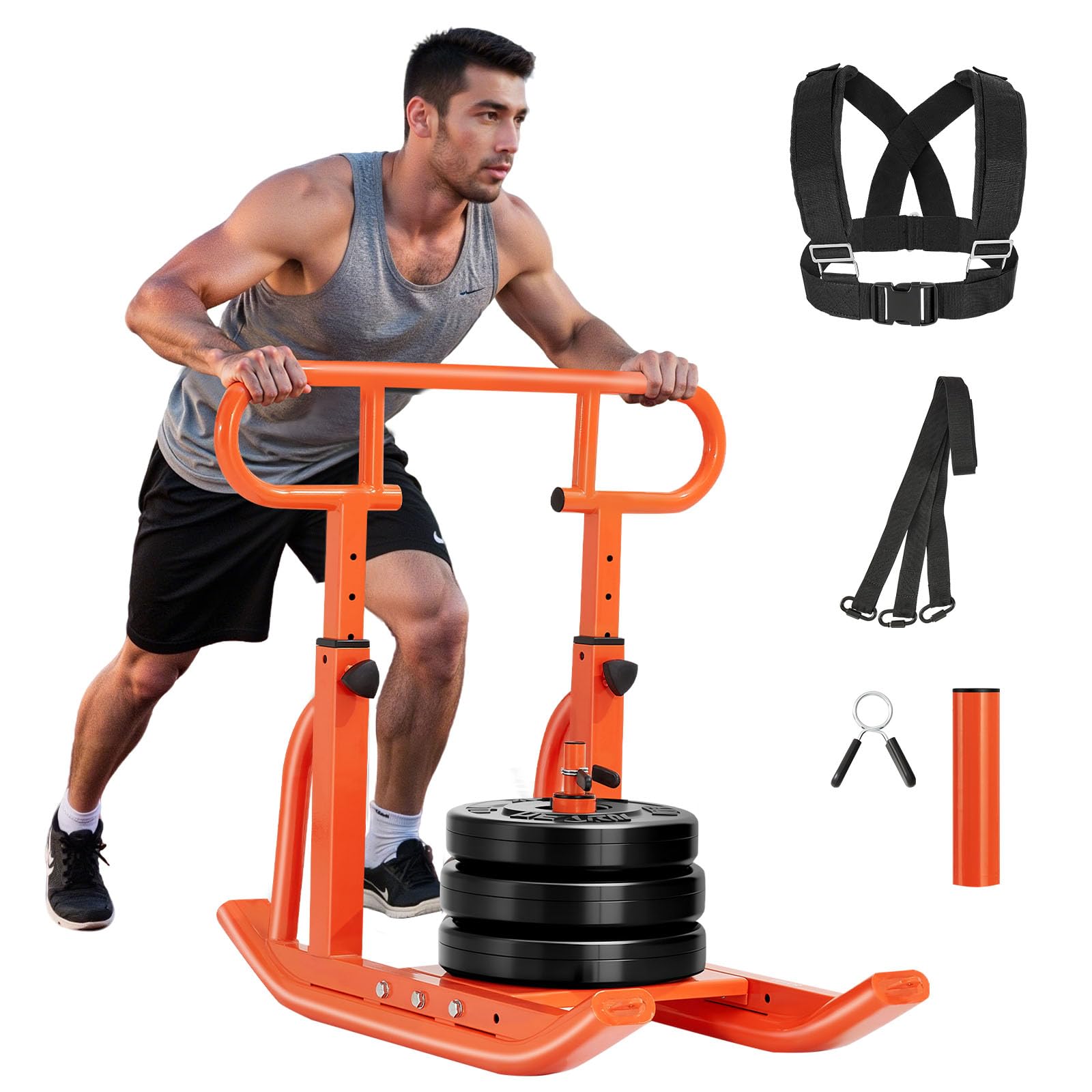
Five hundred fifty pounds is the number TYRSEN puts on this frame, and nothing else in this group comes close. What that buys is not necessarily a heavier workout — it is a frame built to shrug off whatever you actually load, with the base offset rearward so the sled plants rather than seesaws when you drive into it.

The rest of the list is unusually complete. Five handle heights, two reinforced stability beams, sleeves that take both 1-inch and 2-inch plates, a padded harness, and a curved base for grass and turf. At 35.5 pounds it is not a sled you tuck under one arm; it is one that lives where you train.

The honest caveat is time. This is a newer design, and how it holds up over a few seasons of hard use is the one question the specification sheet cannot answer. What we noticed is that the sheet answers more than most: capacity, handle range, harness, dimensions, sled weight. If a long record matters more to you than a 550-pound ceiling, the Dolibest is the safer call; if you know exactly what you want from a sled, this one gives you the most room to grow into.

Bottom line: We think it is the heavy-load pick: a 550-pound ceiling and five handle heights, for buyers comfortable choosing on specification.

#2

Dolibest Weight Sled

Dolibest Weight Sled

All-round sessions

Our Score 9.2/10
Check Price

Worth Noting

  • Premium price for the extra hardware
Included
Two push poles, removable handlebar
Base Shape
Curved front and rear
Training Positions
High push, low push, drag
Plate Compatibility
1 in and 2 in
Read the full review

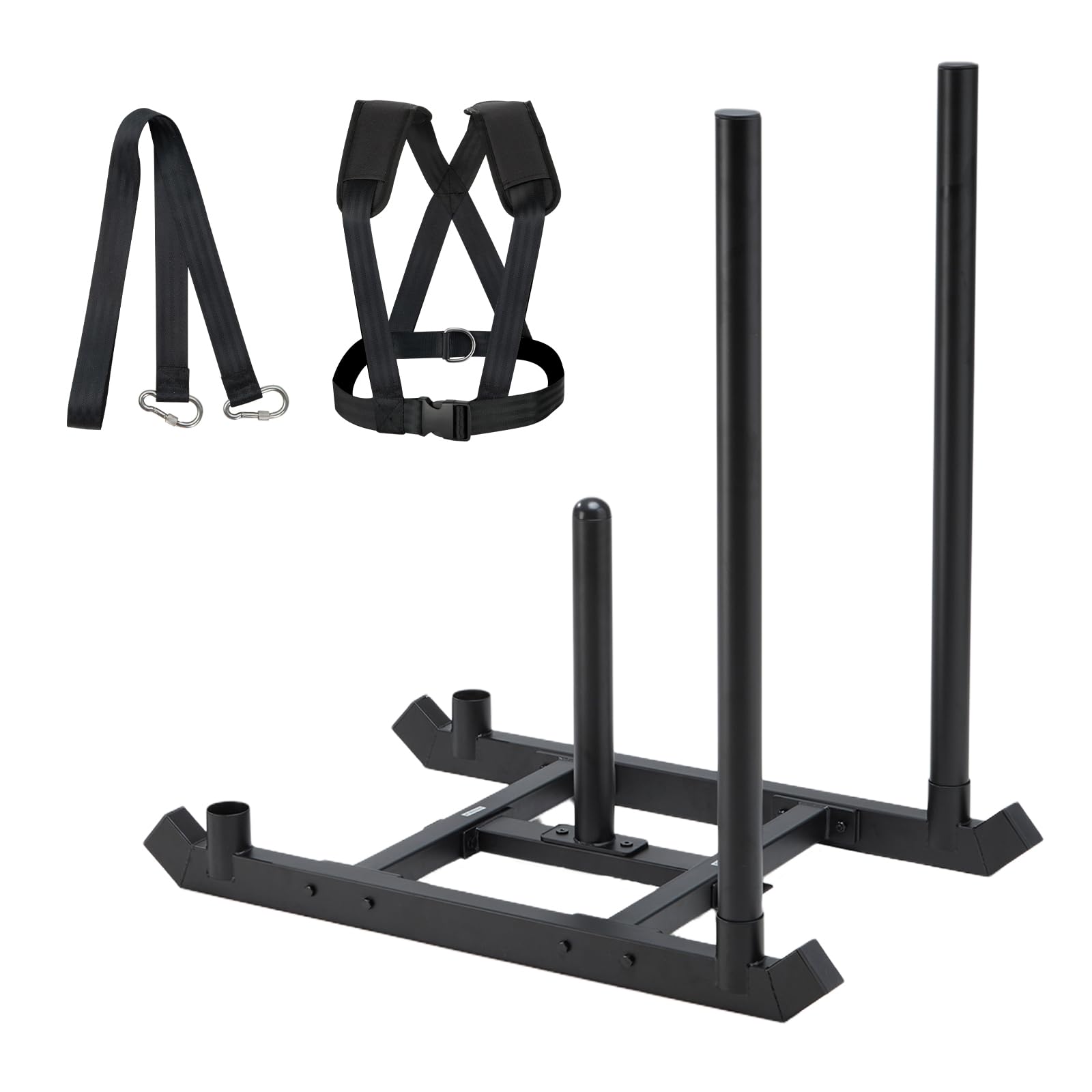
Most sleds are built around one posture. The Dolibest is built around three: two detachable poles for a high, upright push, a removable handlebar for low drives, and a frame that takes a harness for backward drags. One piece of equipment covers a whole field session without stopping to re-rig anything, and that is the reason it sits at the top of this list.

The build is what sells it after the first session. It is iron, it is heavy, and the base curves at both the front and the rear — the rear curve is the part we care about, because that is the end that digs in when you drag backward across a lawn. We were also glad to find it works on carpet, which means a basement or a garage with a rubber mat is enough space for a real session. Assembly needs hand tools: have a socket wrench and a screwdriver within reach before the box is open, because the base plates bolt on.

Buying it is a bet that you will use all three positions. If your training is all drags and sprints, the Kipika does that job for a fraction of the price and you will not miss the push poles. The Dolibest earns its keep when the alternative is two separate sleds and the floor space for both.

Bottom line: We recommend it as the do-everything sled: three hand positions, ends curved so they spare your grass, and a heavy frame — if you will use the hardware.

#3

Kipika Weight Sled

Kipika Weight Sled

Budget speed work

Our Score 9.0/10
Check Price

Worth Noting

  • Compact footprint limits heavy pushes
Warranty
1 year
Base Shape
Curved arc bottom
Plate Compatibility
1 in and 2 in
Assembled Dimensions
22.44 x 14.17 x 3.54 in
Read the full review

About 22 inches long and three and a half inches tall, the Kipika is a low, flat sled — closer to a drag racer than to a prowler. The bottom is an arc rather than a flat plate, and that one design choice is the reason it is here: on a lawn or a lumpy field, the curve rides over uneven ground instead of plowing a trench through it.

It is also one of the cheapest sleds in this guide, and it takes both 1-inch and 2-inch plates — a bigger deal than it sounds, because the Olympic-only sleds shut out anyone with an old standard set. Resistance comes on smoothly, and the drills this shape suits are short and fast: block starts, acceleration work, ACFT drags. If you are training for a test that involves pulling a sled forward and backward, this is roughly the shape the test was built around.

The trade-off is size. With a light load on hard, dry ground it can skip and hop rather than track straight. On grass and turf, where the arc does its work, it stays planted. Buy it to drag, sprint, and store; if you want to stand up and drive a heavy sled across a gym floor, that is the Dolibest's job.

Bottom line: We rate it the value pick: both plate sizes, an arc base that rides over a lawn, and money left over for plates and a decent pair of shoes.

#4

GanFindX Workout Sled

GanFindX Workout Sled

Outdoor yard training

Our Score 9.0/10
Check Price

Worth Noting

  • Compact frame is small for heavy adults
Included
Padded adjustable harness
Warranty
2 year manufacturer
Base Shape
Curved bottom, flat oval tubes
Plate Compatibility
1 in and 2 in
Read the full review

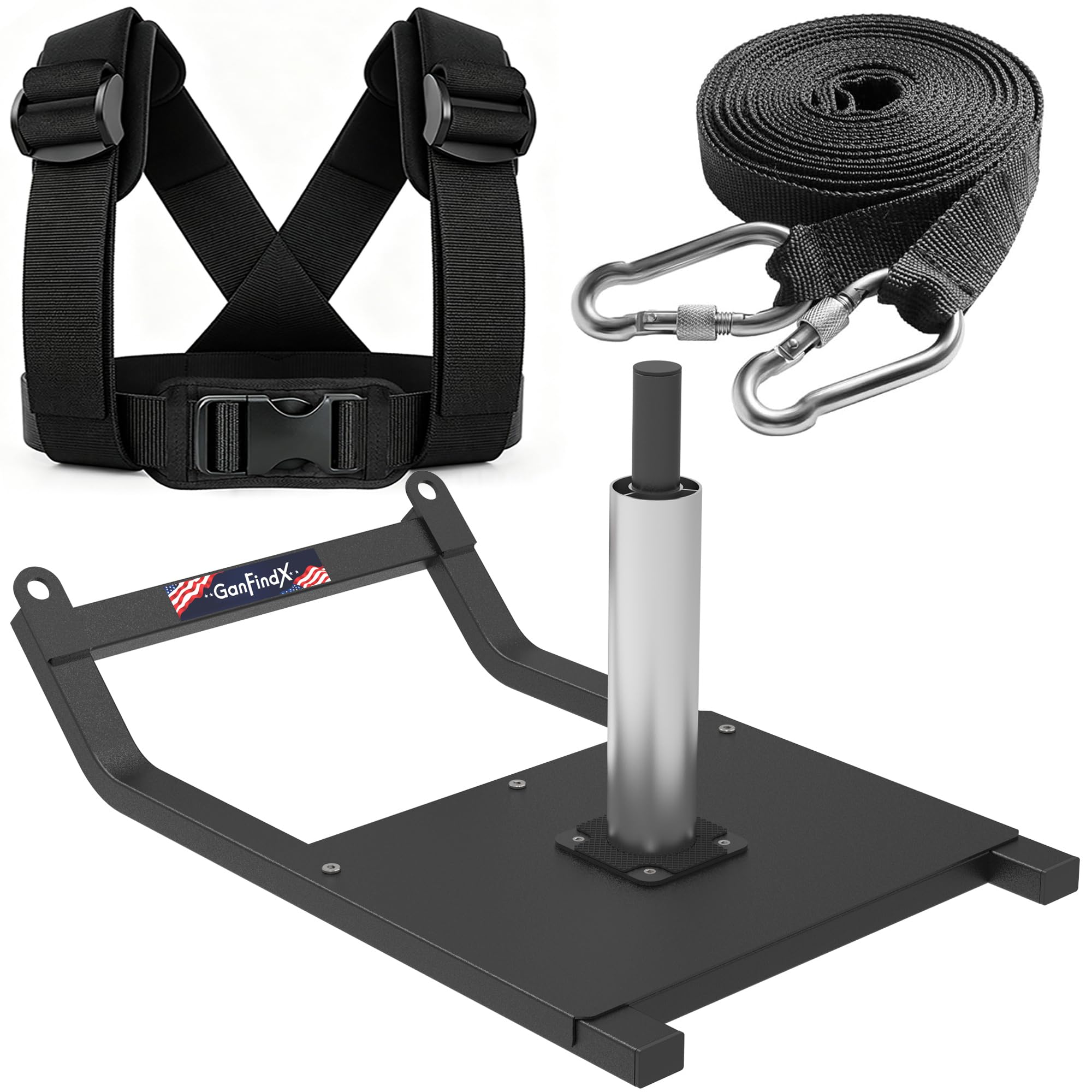
A sled that lives in a yard has a different job description from one that lives on turf. It has to survive roots, divots, and the occasional driveway crossing. The GanFindX is designed for exactly that: curved-bottom tubes on a flat oval frame, made to clear obstacles rather than catch on them, paired with a harness that has soft shoulder pads instead of bare webbing.

Outdoors it holds up. The runners take a beating across grass and come back without deforming, and once it is weighted the whole thing moves cleanly over uneven ground. Assembly is a ten-minute job with the included hex key, which makes it realistic to break down for transport and rebuild at the field. We were glad to see the padded harness rather than webbing, because a heavy backward drag on bare straps is miserable.

Size is the divider. This sled suits a family, a school group, or a team's younger athletes; a 250-pound lineman loading it up wants more frame. The straps run long, which helps taller users, but plan on shortening the harness for a small kid. Two years of manufacturer coverage — matched only by the LIONSCOOL — is worth something on equipment that spends its life outside.

Bottom line: For a sled that lives outdoors we point you here: curved runners that clear yard obstacles, a padded harness, and a compact frame for younger athletes.

#5

TE DEUM Pull Sled

TE DEUM Pull Sled

Olympic plate setups

Our Score 8.8/10
Check Price

Worth Noting

  • Takes 2-inch Olympic plates only
  • Three-month warranty is the shortest here
Handle
Quick-switch push-pull bar
Warranty
3 months
Plate Holders
Dual
Plate Compatibility
2 in only
Read the full review

Check your plates before anything else: this sled is built for 2-inch Olympic sleeves only. If you run standard 1-inch plates, no adapter is mentioned and you are looking at the wrong sled. If your plates are Olympic, that restriction buys a thick steel frame with dual holders that keep the load centered instead of slung to one side.

The feature we like most is the push-pull bar. You insert it, pull, and it swaps sides in seconds, so flipping from a push to a drag mid-circuit does not turn into a hunt for a wrench. On a conditioning session where you alternate directions every few minutes, that is the difference between a smooth flow and a lot of standing around.

The base is the thing to weigh. On turf and rubber it slides fine; on concrete it can refuse to move, and the leading edge catches and digs on soft ground. That is a surface mismatch rather than a build flaw — train on turf or a rubber mat and it never comes up — but it makes this the wrong sled for a driveway.

Bottom line: We like it for Olympic-plate setups: a quick-switch bar that flips from push to drag in seconds, and dual holders that keep the load balanced.

#6

LIONSCOOL Weight Sled

LIONSCOOL Weight Sled

Tight spaces

Our Score 8.6/10
Check Price

Worth Noting

  • Built for dragging, not pushing
Warranty
2 year
Footprint
16.3 x 12 in
Belt Waist Range
38.2 to 55.5 in
Plate Compatibility
1 in and 2 in
Read the full review

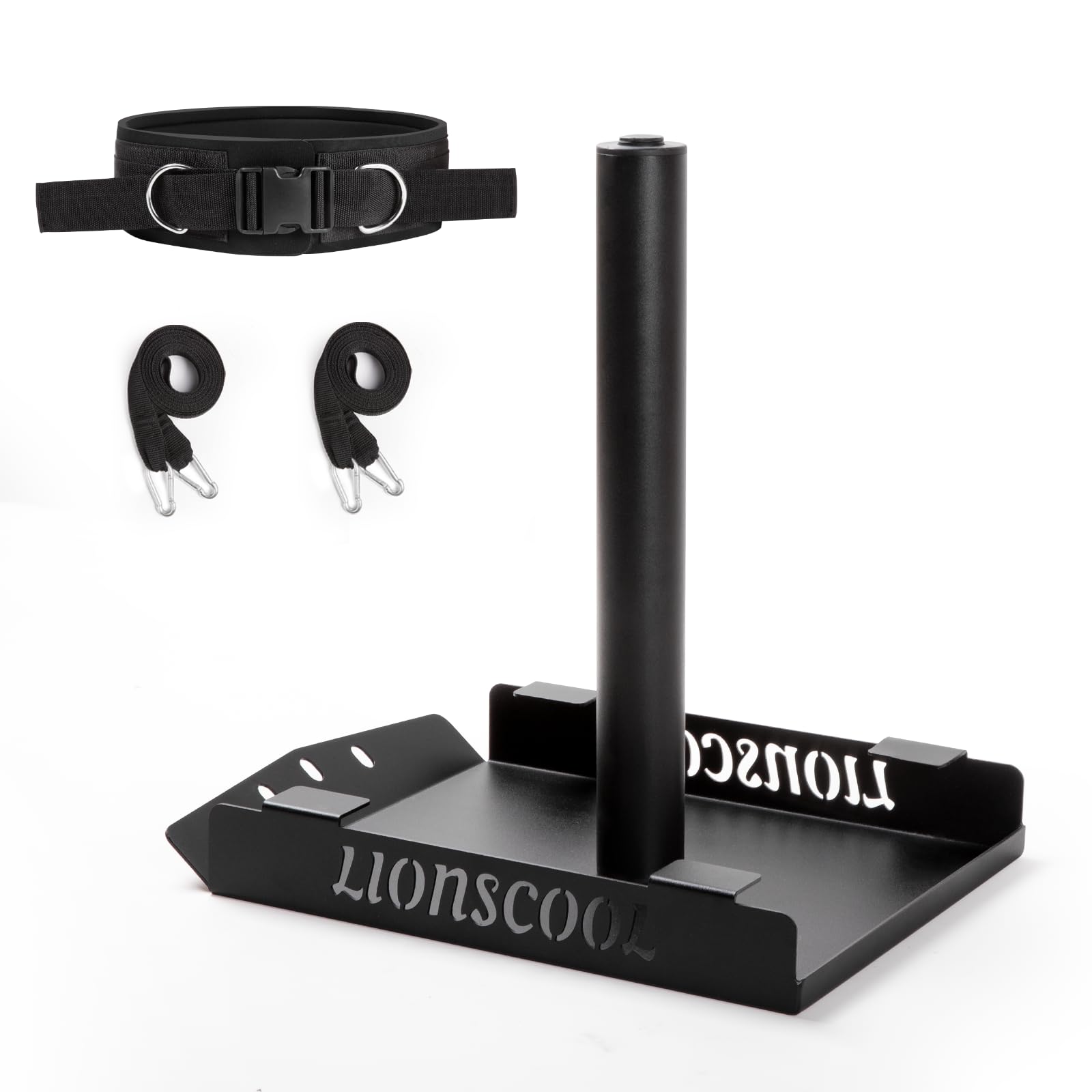
Roughly 16 by 12 inches, the LIONSCOOL takes up about as much floor as a large pizza box. That is the whole argument for it: if your gym is a corner of a garage or a spare room, a sled you can stand against the wall gets used, and a sled that permanently owns six square feet does not.

It comes with a pulling belt rather than a full harness, and the loading post stands 16 inches tall so plates sit clear of your heels on a drag. The loading bar is hand-tightened and takes both 1-inch and 2-inch plates without tools, which we appreciated when switching load between sets on a short rest.

It is built for dragging, not pushing: there is no push bar, and a compact frame is not what you want to drive across a gym floor. Two years of manufacturer coverage is unusual at this end of the group, and the belt adjusts across a 38.2 to 55.5-inch waist — measure before ordering, because a belt that rides up ruins a drag session faster than a heavy plate does.

Bottom line: Our pick for a garage corner: a 16-inch frame that leans against a wall, tool-free load changes, and two years of coverage.

#7

VEVOR Weight Sled

VEVOR Weight Sled

Adjustable push angles

Our Score 8.4/10
Check Price

Worth Noting

  • Can tip forward when pushed on soft ground
Item Weight
38.8 lb
Load Capacity
276.6 lbs (125 kg)
Handle Positions
5
Plate Compatibility
1 in and 2 in
Read the full review

Here is the honest version: the VEVOR pulls beautifully and pushes unevenly. On turf and track it tracks straight, and the five-position handle lets you find a comfortable angle whether you are driving high or low. On soft, uneven grass, pushed hard, it can rock up over its own front edge.

What we like in the specification is the range: five handle heights, sleeves for both 1-inch and 2-inch plates, a 276.6-pound load rating, a padded harness with reinforced stitching, and a Q235 steel frame with an outdoor powder coat. It weighs 38.8 pounds, so it does not skitter — and so you will not carry it far.

The tipping is the thing to plan around, and it is specific: soft ground plus a hard, high push is where it shows up. Keep it on turf, track, or a flat lawn, load it properly, and it behaves like a stable, useful sled for the money. Take it onto a lumpy field and you will spend the session resetting it — a real problem for field-sport training, and a non-issue for a garage or turf setup.

Bottom line: We see it as an adjustability play for turf-and-track training: five handle heights, both plate sizes, and a 276.6-pound load rating.

How We Tested the Best Weight Sleds

We started by narrowing a longer list of sleds to nine based on specs, price, and the way each one was meant to be used. That meant filtering out models with vague weight ratings, tiny footplates, or hardware that looked likely to strip. We assembled every sled ourselves with the included tools and timed it, noting whether the instructions made sense on the first read and whether one person could do it without help.

Testing ran for six months, mostly in a garage gym and on a stretch of turf, with occasional sessions on concrete and gravel. We loaded each sled to its stated capacity and pushed it for intervals, dragged it with a harness, and used it for rows and reverse drags. We watched for stability—whether the sled tracked straight, tipped on turns, or wobbled when we shifted weight—and checked welds, powder coat, and strap attachment points after every few sessions. We also measured the footprint with the sled standing and stored, since size matters in a small gym.

Value came down to what came in the box: handles, harness, straps, and whether the sled needed extras to be useful. The sleds that scored best were the ones that stayed solid after repeated use and felt worth the space they took up. We'll keep using them and update if anything changes.

How to Choose Weight Sleds

Start with the plate hole, not the sled

Two-inch Olympic plates fit every sled in this guide. One-inch standard plates do not: the TE DEUM is built around Olympic sleeves only, while the Kipika, GanFindX, LIONSCOOL, Dolibest, TYRSEN, and VEVOR all take both. Check the hole on a plate you already own before you read another word about handle height, because a sled that will not take your plates is a very heavy doorstop.

If you are buying plates anyway, buy Olympic. It widens your sled options to all of these, it is what most gyms and school programs use, and it is the safer bet if you ever add a barbell to the garage.

Match the handle setup to how you train

Pushing and dragging are different jobs and they want different hardware. A high push lets you stand up and load the sled heavy; a low push is for acceleration and line-of-force work; a drag wants a harness or belt and a low tow point. Plenty of sleds do one of those well and the others badly.

If you are training for a test like the ACFT, drags and short pushes are the priority, and a compact arc sled such as the Kipika covers it. If you want one piece of equipment for a whole field session, the Dolibest's two poles plus a removable low bar are exactly why we picked it.

Pick a base for your surface

Flat bases catch. Curved or arced tubes ride over roots, curbs, and lumpy grass, and that curvature is the single biggest difference between a sled you use and one that digs a trench and stays in the garage. Turf and rubber are forgiving — almost anything works there.

Concrete is the hard case. It is abrasive, some sleds grip instead of sliding, and it will scuff. If your only space is a driveway or a bare garage floor, choose for smoothness and put a rubber mat down; if you have a lawn, the arc matters more than the badge.

Weigh the sled, not just the plates

The resistance you feel is the sled plus whatever you hang on it, so the sled's own weight is part of the training load. Two sleds here state theirs — 35.5 pounds for the TYRSEN and 38.8 for the VEVOR — and both make you work before a single plate goes on. That is ideal for heavy strength work and miserable for short sprints.

Load ceilings matter just as much. The VEVOR's 276.6 pounds and the TYRSEN's 550 will not run out for a home gym, but a cheap sled rated to 100 pounds will, and it will do it sooner than you expect. Match the ceiling to the heaviest set of plates you realistically own.

Plan for storage and what comes in the box

Footprints here run from about 16 inches to roughly 35, which is the difference between a sled that leans against a wall and one that owns a permanent spot on the floor. Assembly is usually a handful of bolts and about ten minutes with hand tools — the GanFindX quotes ten minutes with an included hex key — though bolted base plates want a socket wrench and a screwdriver.

Check what ships with it, too: a padded harness, a waist belt, or bare frame. A cheap sled plus a decent harness often costs more than one that includes a good one, and an included harness that does not fit you is worth nothing.

Frequently Asked Questions

Final Verdict

If you want one sled that covers a full session — heavy high pushes, low-position acceleration work, and backward drags — the Dolibest is the one we recommend. It carries the highest price in this group and earns it by giving you three hand positions and a base curved at both ends so it does not dig up a lawn.

If your training is all drags and sprints, the Kipika does that for a fraction of the money, and it is the pick for a lawn, a track, or a team of young athletes. Buy the Dolibest when the alternative is two sleds and the floor space for both.