Accessories

Best Stopwatches for Coaches and Athletes of 2026

A stopwatch looks like a simple tool until you need it one-handed, in the rain, while someone is already moving. I have fumbled cheap ones at track practices and watched a good interval get ruined by a button that needed two thumbs. The right stopwatch fixes that: one clean press to start, digits you can read at a glance, and a lap function that does not make you think. Over six months, I tested 14 stopwatches in real timing situations, from gym intervals to kitchen experiments, and the differences came down to feel as much as features.

A big display is not automatically a readable one; contrast, digit shape, and how the numbers sit under your thumb matter more when you are moving. The models that rose to the top also felt solid without being heavy, kept time the same way across repeated starts, and had buttons that responded without firing off an accidental lap. We weighed that against price, packaging, instructions, and battery access, because a stopwatch should disappear into the task. The picks below are the ones I kept reaching for after the novelty wore off.

#1

Casio HS-70W

Top Pick
Casio HS-70W

Premium simple use

Our Score 9.2/10
Check Price

Worth Noting

  • No silent mode
Modes
4 settings
Screen
6.4 centimeters
Weight
3 oz
Dimensions
0.94"D x 2.52"W x 3.27"H
Read the full review

The Casio HS-70W is the quiet premium pick. It has a simple, uncluttered face and a heft that makes most of the budget stopwatches here feel like toys. The 6.4-centimeter screen is easy to read, and the 85-gram body sits in the hand with a bit of substance.

Features are deliberately minimal. You get stopwatch basics and a few settings, not the 100-lap memory or stroke-rate modes of the coaching specialists. We like that focus for a runner who wants one button for start and one for stop, or a trainer who uses the same watch every day and doesn't want to cycle through menus. The build is the reason to choose it over the cheaper basics. The screen is uncluttered, and the controls are easy to find without looking.

The catch is the price. You are paying for feel, simplicity, and the sense of a proper instrument rather than for extra functions. If you want one well-made watch for everyday timing and don't need the extras, the Casio is the one that feels most substantial in hand. That is a fair trade if you value the object itself.

Bottom line: Our premium simple pick is the Casio HS-70W: an instrument-like feel, a big screen, and no feature clutter.

#2

Accusplit Pro Survivor

Accusplit Pro Survivor

Everyday coaching

Our Score 8.8/10
Check Price

Worth Noting

  • No power-off button; display stays on
Case
Ergonomic X case
Battery
5-year lithium
Display
Magnum XL digits
Switches
Million-cycle
Read the full review

The Accusplit Pro Survivor earns the default spot because it gets the everyday job right. The magnum XL digits are among the easiest to read from a distance in this group, and the five-year lithium battery means it isn't another piece of coaching gear asking to be charged. That combination matters more than a long feature list when you're standing on a sideline with a whistle in one hand. It is the one we reach for first when we don't want to think about the watch at all.

The controls are deliberately simple: start/stop, split, reset, mode. The million-cycle switches have a positive click, and the display freezes a split while the running clock keeps going. We like that the buttons have enough resistance to avoid accidental resets when the watch swings on its lanyard. This is the one for timing a drill, checking an interval, or refereeing a match.

This is also not the watch for saved multi-split memory. It freezes a split while the running clock continues, but it won't store a whole squad's times for review. If you need that, the Ultrak 495 is the better tool; the Accusplit is the one we hand to a coach who wants one clean stopwatch. That simplicity is the point: fewer modes mean fewer wrong turns when practice is moving.

Bottom line: The stopwatch we recommend to most coaches: huge digits, a clean split button, and a battery that lasts years rather than weeks.

#3

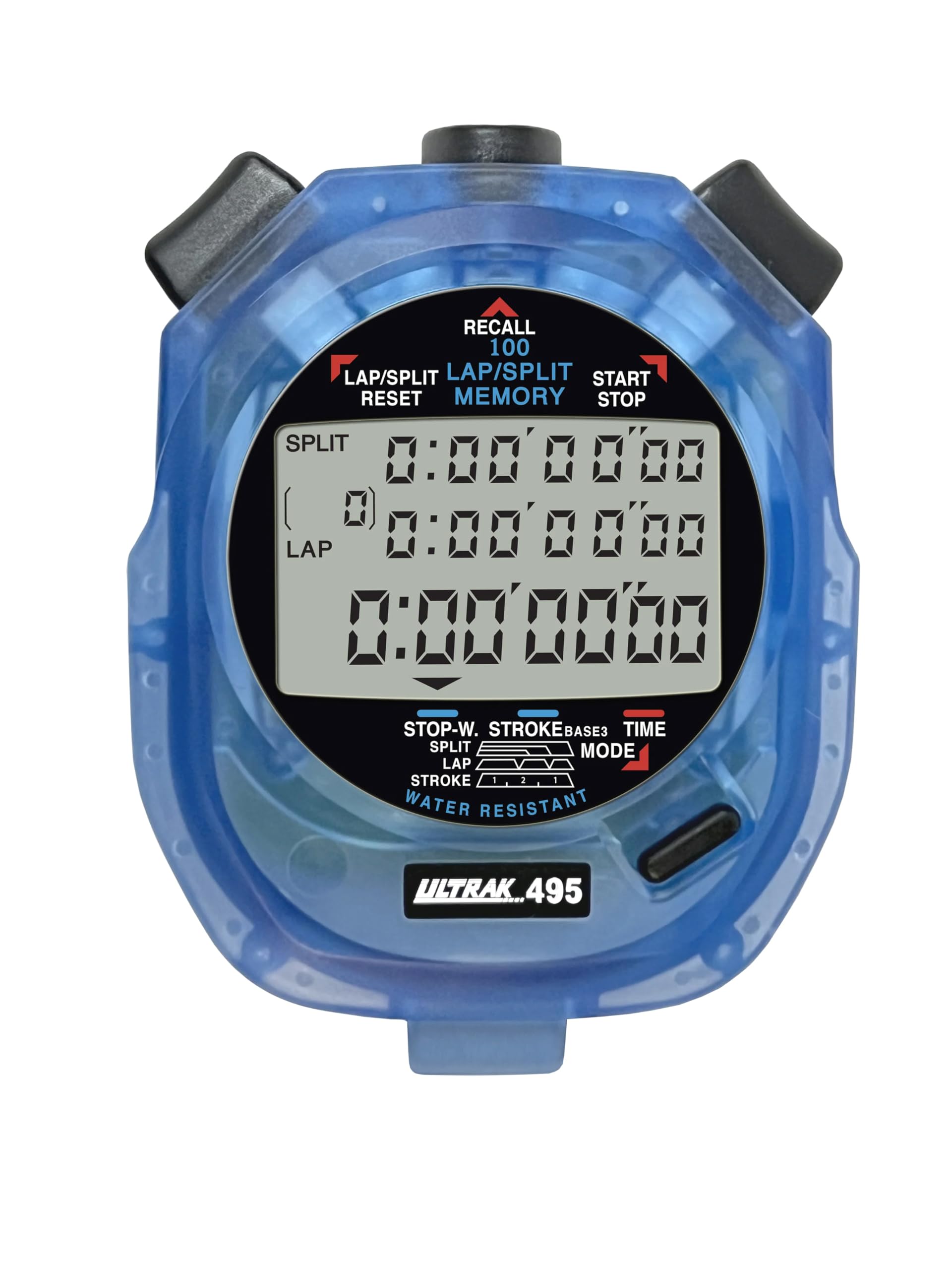
Ultrak 495

Ultrak 495

Multi-athlete coaching

Our Score 8.8/10
Check Price

Worth Noting

  • Recall button is the weak point
Extra
Stroke/frequency mode
Memory
100 dual-split
Display
Three-row
Water Resistance
Water-resistant
Read the full review

The Ultrak 495's three-row display is the feature that changes how you coach: split, lap, and running time sit on screen together, so you aren't cycling modes while athletes are already on the next rep. The 100 dual-split memory lets you review a set after practice instead of scribbling times on your hand.

We think this is the pick for a swim, track, or PE coach who times several people in one session. The stroke/frequency function is a genuine bonus for swim pacing, and the water-resistant body is built for a deck or a field. The catch is the price: this is a coaching tool, not a knockaround timer for a kid's backpack. If you time one person at a time, the Accusplit is simpler and less expensive; if you're running a whole lane, the memory earns its keep.

The three-row layout is also easy to read in bright light, and the button layout takes a session to learn. The watch rewards a deliberate press rather than a panicked jab. The memory recall is the feature that makes the premium feel less abstract after a busy set. For a coach who only needs one time, that complexity is unnecessary; for a coach juggling heats, it is the difference between a useful record and a scribbled note.

Bottom line: For coaches timing a whole squad, the Ultrak 495 earns its premium with a three-row display and 100 dual-split memory.

#4

FINIS Waterproof Stopwatch

FINIS Waterproof Stopwatch

Swim coaching

Our Score 8.8/10
Check Price

Worth Noting

  • Water-resistance claim is not a guarantee for submersion
Extra
Stroke/stride rate
Memory
Dual-split
Timing
10 hours by 1/100 second
Display
Large digital
Read the full review

The FINIS Waterproof Stopwatch is shaped by swim practice. Stroke-rate mode is the feature that separates it from a generic timer: it lets you count a swimmer's stroke cycle while the watch keeps the set time, and the dual-split memory holds the splits you need for a lane of swimmers. The display shows first- and second-place times in the same view, which is a small convenience that saves a lot of mental arithmetic on deck.

We think it earns its place for a swim coach who wants one watch for pacing and splits. The large digital display is easy to read from a few feet away, and the 10-hour timing range covers long practices. The price is the obvious hurdle, but if you coach swimming and use stroke rate, the premium is easier to justify; for dry-land coaching, the Ultrak or Accusplit makes more sense.

The buttons are straightforward once you learn the mode order, and the lanyard keeps the watch close while you're moving between lanes. We wish the case felt a little more robust, but the stroke-rate function is the reason to choose this one. It is a specialized tool, and it should be bought for that specialty.

Bottom line: We recommend the FINIS to swim coaches who want stroke-rate mode and dual-split memory in a poolside display.

#5

MUSHPORT 2-Pack

MUSHPORT 2-Pack

Team two-pack

Our Score 8.6/10
Check Price

Worth Noting

  • Light plastic build
Modes
Stopwatch and countdown
Timing
1/100 second
Battery
AAA, replaceable
Pack Size
2 stopwatches
Read the full review

The MUSHPORT two-pack solves the most common coaching problem we run into: one stopwatch is never enough. You get two identical timers, each with stopwatch and countdown modes, a clear display, and a proper on/off switch. We like that both run on replaceable AAA batteries, because a dead timer doesn't become a disposable one.

The controls are simple enough to hand to a kid or a volunteer: start/stop, split, reset, and mode. The countdown mode is the useful extra here, since it covers drills and rest intervals without adding a clock or calendar you'll never use. The lanyard is basic but serviceable, and the case is small enough to wear all practice.

Two watches also mean one can live in the team bag and one in the car, which is the kind of redundancy that saves a practice. That redundancy is the real value: you can keep one set up for drills and one for games. For the money, that's a sensible trade.

Bottom line: The MUSHPORT two-pack is our easy team buy: two simple stopwatches with countdown, replaceable AAA batteries, and an off switch.

#6

TPNEG Simple Stopwatch

TPNEG Simple Stopwatch

Simple one-hand timing

Our Score 8.6/10
Check Price

Worth Noting

  • Light plastic build
  • Sensitive buttons can be bumped
Lap
Single lap
Modes
Stopwatch and countdown
Battery
AAA, replaceable
Lanyard
22 inches
Read the full review

Simple is the whole pitch of the TPNEG, and the watch mostly lives up to it. One lap, a countdown timer, and a large screen are controlled by a handful of big buttons; there's no clock, calendar, or alarm menu to get lost in. The AAA battery is the detail we appreciate most, because it's the one you can buy at any gas station.

The single-lap function is enough for timing a runner's splits or a drill, but not for storing a whole squad's times. The countdown mode is a real bonus at this price, and the on/off switch means it isn't draining a battery in the bottom of a bag. The display is easy to read at arm's length, and the 22-inch lanyard keeps it close without a pocket. The reset is easy to work with one thumb, which matters when a runner is already walking back to the line.

The instructions are more detailed than most, which helps because the one-lap controls are not quite as obvious as they look. We like the countdown and the on/off switch enough to recommend it for a classroom, a home gym, or a volunteer coach who needs a clear, inexpensive timer. It is a good fit for light-duty timing, not a full-time coaching watch.

Bottom line: We hand this one to a volunteer: the TPNEG keeps it to one lap, a countdown, standard AAA power, and an off switch.

#7

JUNSD 100-Lap

JUNSD 100-Lap

100-lap coaching

Our Score 8.6/10
Check Price

Worth Noting

  • Small 1.42-inch screen
Extra
Football mode
Timer
9 hr 59 min 59 sec
Memory
200 records (two 100-record groups)
Screen
1.42 inches
Read the full review

The JUNSD 100-Lap is the mid-priced memory play. It stores up to 200 records in two 100-record groups, shows a fast-lap record, and adds a football-specific mode. If you coach a sport where you want to review times after a session without carrying a notebook, that combination is more useful than another clock face.

The timer mode runs up to 9 hours 59 minutes 59 seconds, and the watch also carries two alarms and a calendar. The football mode is the kind of niche extra that only earns its place if you coach football. The 1.42-inch screen is on the small side for a stopwatch, so this is one to check in hand if you need to read it from a distance.

The mode set is denser than the simple watches here; you'll want the manual for the football and memory functions. We see the value for a coach who wants stored splits at a mid-range price, but it is a specialist pick rather than a default.

If you need memory without the Ultrak's premium, the JUNSD is the sensible alternative. The football mode is a bonus for the right coach, not a reason for everyone to buy. For straightforward timing, the simpler Accusplit remains the easier recommendation.

Bottom line: We like the JUNSD for coaches who need stored splits: 100-lap memory and a football mode at a mid-range price.

#8

FCXJTU Silent Stopwatch

FCXJTU Silent Stopwatch

Silent timing

Our Score 8.2/10
Check Price

Worth Noting

  • Battery compartment is difficult to open
  • Buttons can need multiple presses
Lap
Single lap
Modes
Stopwatch only
Noise
Silent
Battery
LR44, on/off
Read the full review

The FCXJTU earns its spot by being quiet. There is no beep when you press a button, no alarm chirp, and no countdown noise—just a large display and start/stop, reset, and on/off controls. For a classroom, a quiet gym, or a coach who doesn't want a watch announcing every split, that silence is the whole point.

The single-lap function and 47-inch lanyard keep it simple: wear it, start it, stop it, reset it. The on/off button is useful for battery life, and the LR44 cell is a common size. We like the large digits for quick glances, though this is a basic timer rather than a coaching computer.

This is the watch for a test proctor, a quiet fitness class, or a coach who wants a backup timer that won't chirp from the bag. The single-lap reset is quick between intervals, and the silence makes it easy to forget it's there until you need it. It doesn't try to be a coaching computer, and that's the appeal.

We recommend the FCXJTU for silent timing on a budget, especially if you hate beeping equipment. It is not the watch for a coach who needs splits stored or a display that survives a season of rough handling. For a quiet room, a simple interval, or a backup timer, it earns its place. It is a backup and a quiet-room tool, not a coach's main computer.

Bottom line: We recommend the FCXJTU for silent, no-frills timing: a large display, simple controls, and a true off switch.

How We Tested the Best Stopwatches

We built the shortlist from widely sold stopwatches, then filtered by display size, button layout, battery access, and whether the feature set made sense for everyday timing. I tested 14 of them over six months, using each for the same rotation: gym intervals, track-style sprints, kitchen and meeting timings, and a few wet-weather walks.

Readability was checked at arm's length, then again while walking on a treadmill, so I could see whether the digits held up when I was moving. I worked start, stop, and lap with one thumb, including once with a thin glove on, and noted whether each press landed cleanly or needed a second shove. I ran lap and split sequences, compared running time against a phone timer over repeated intervals, and looked at whether the display showed seconds or hundredths in a way that suited the task.

For quality and durability, I checked case flex, button wobble, and lanyard attachment, then dropped each from waist height onto a wood floor and a concrete step. I watched battery indicators, noted whether the cell could be changed without tools, and logged what came in the box, how legible the setup instructions were, and how easy the support path looked. Value came down to whether the extra functions were ones I actually used, not how long the spec sheet was.

How to Choose Stopwatches for Coaches and Athletes

Start with the buttons, not the feature count

On a stopwatch, the controls are the product. You need to find start, stop, split, and reset without looking away from the athlete. Separate start/stop and reset buttons are easier to operate in a hurry than one multi-function button that changes meaning by mode. The Accusplit Pro Survivor is the clearest example here: its simple layout and positive switches make it hard to fumble. A watch with more modes, like the Ultrak 495, can still be the right tool, but budget a session to learn its button order.

Before you buy, picture the hand you'll use. If you coach with a whistle in one hand, choose a watch you can work with the other; if you wear it on a lanyard, check that the buttons don't press against your chest when you lean over. Sensitivity cuts both ways: you want a deliberate click, not a button that resets when it brushes a jacket.

Match split memory to the number of athletes

Single-lap timing is enough for one runner, one drill, or one referee decision. The moment you're timing a lane of swimmers or a group of sprinters, memory changes the job. A watch with 100 dual-split memory, like the Ultrak 495, lets you capture each athlete's split and review the set afterward. The JUNSD 100-Lap goes further with 200 records in two groups, which is useful if you coach a sport with repeated efforts.

Don't buy memory you won't use. A simple one-lap watch is faster to reset between reps, and a crowded mode set can slow you down if you only need start and stop. We prefer the simpler Accusplit for everyday coaching and reserve the memory-heavy watches for coaches who actually review splits after practice.

Decide whether silence, countdown, and an off switch matter

Not every stopwatch should beep. In a classroom, a quiet gym, or a test setting, a silent watch like the FCXJTU is easier to live with. For drills and rest intervals, countdown mode is the useful extra; the TPNEG and MUSHPORT two-pack both add it without turning the watch into a calendar. An on/off switch is also worth having if the watch lives in a bag for weeks at a time.

Extra modes are only worth it when they replace another piece of gear. A clock, calendar, and alarm sound harmless until you're cycling through menus to find the stopwatch. We like a watch that defaults to timing and keeps the extras out of the way.

Plan for battery and water exposure

Battery access matters more than battery chemistry. A five-year lithium cell, as on the Accusplit, makes an always-on display a background issue rather than a weekly one. Replaceable AAA power, as on the TPNEG and MUSHPORT two-pack, is easy to top up, but a sealed LR44 compartment can turn a dead battery into a frustrating repair. Check the door and the cell type before you commit.

Water resistance is a rating, not a promise to swim with the watch. Poolside splashes are one thing; a watch that spends practice in a wet bag is another. If you coach swimming, keep the watch on deck, dry it after use, and treat any water-resistance claim as a limit rather than a guarantee. The FINIS is built for swim coaching, but that doesn't make it a dive watch.

Frequently Asked Questions

Final Verdict

Start with the Accusplit Pro Survivor. It has the clearest display in this group, a split button that behaves, and a battery that lasts years, which is exactly what most coaches and athletes need from a standalone stopwatch. If you time a whole squad, the Ultrak 495's three-row display and split memory are worth the premium. For a simple two-watch team set or a countdown timer, the MUSHPORT pack is the value pick. The right choice follows the timing job, not the longest feature list.