Accessories

Best Step Platforms of 2026

A step platform really has one failure mode that matters: it moves when you don't. A deck that skates an inch across the rug mid-step-up, a riser that rocks because the clip never fully seated, a top surface that goes slick the second your hands or socks get sweaty — any one of those turns a simple cardio circuit into something you're bracing against instead of working out on. The right one disappears under you: same height every rep, no shuffle, no creak, and it breaks down small enough to live under the couch between sessions. That's the whole promise, and it's what makes a platform worth owning instead of a bench you'd rather avoid.

I've logged a lot of steps on these over the years, starting in an apartment where a platform was my only cardio equipment and continuing in a basement where it now shares floor space with a rack. Over the past six months, my team and I have run a dozen step platforms through full workout rotations, from basic single-height decks to adjustable systems with a dozen settings. The thing that surprised me most is how little the deck material matters next to the risers and the feet underneath — that's what decides whether you trust the thing at rep 40. Some of the picks ahead are built for heavy daily use, others are better as a light option you carry room to room; what they share is that none of them will slide out from under you.

#1

Original STEP Health Club Step

Top Pick
Original STEP Health Club Step

Step aerobics

Our Score 9.4/10
Check Price

Worth Noting

  • 20 pounds to lift and put away
Height Options
4", 6", 8"
Platform Weight
20 lb
Weight Capacity
350 lb
Stepping Surface
43" L x 16" W x 4" H
Read the full review

Forty-three inches long and 16 inches wide is the number to hold on to, because this is the same deck you've stepped on in a health club class: long enough for a full side step, wide enough that you stop checking where your feet are. The top is a grooved cushion pad rather than bare plastic, and the difference registers before anything else — landings are quieter and less jarring than on a hard shell.

We ran it at 4, 6, and 8 inches and never felt the platform give underfoot, and what we appreciated most was how little it moved. On tile it stayed planted through fast knee-lift combinations, and we never had to reset it mid-song. The stated 350-pound capacity leaves room for a hard landing, and the four risers stack cleanly for the three standard heights.

Before you order, put a tape measure on the floor. Forty-three by 16 inches is closer to a coffee table than a footstool, so this deck wants a semi-permanent home — the gap beside the couch, the space under a bed, a clear wall in the basement — rather than a shelf in a closet.

Bottom line: If you want the deck you already know from a gym class — 43 inches long, four risers, and no wobble underfoot — this is the one we point home steppers to first.

#2

Reebok Fitness Adjustable Step

Reebok Fitness Adjustable Step

Frequent height changes

Our Score 9.4/10
Check Price

Worth Noting

  • No low setting
  • Highest price in this group
Deck Width
13.27 in
Deck Length
47.83 in
Height Levels
5.9, 7.9, and 9.8 in
Platform Weight
15.7 lb
Read the full review

A height change you can make mid-song is the whole pitch: three settings at 5.9, 7.9, and 9.8 inches, each one clicking and locking into place instead of being rebuilt from a pile of blocks. That mechanism gives it the easiest adjustment of anything in this group, and we changed heights between sets more than once just because it took a second.

The shape is unusual for a step. At 47.83 inches it's the longest deck here, and at 13.27 inches wide it's one of the narrowest, which suits forward-and-back stepping more than wide lateral work. The printed target zones on the deck are more useful than they sound when you're learning to land in the middle rather than near an edge.

It's also the priciest deck in this set, and what you're paying for is the locking mechanism and the finish rather than more surface area. If you mostly leave a platform at one height for a thirty-minute class, that money is doing less for you than it does for someone who alternates between squats at six inches and step-ups at ten.

Bottom line: We think it's worth the premium if you change heights often: the click-and-lock settings are the easiest here, though the lowest is nearly six inches, so it isn't the deck for a gentle start.

#3

WF Athletic Stepper Set

WF Athletic Stepper Set

Starting out

Our Score 9.4/10
Check Price

Worth Noting

  • Only two heights, topping out at 6 inches
Included
Step, two 2-lb dumbbells, measuring tape
Height Levels
4", 6"
Platform Size
26.77" L x 11.02" W
Weight Capacity
550 lb
Read the full review

Two 2-pound dumbbells and a tape measure come in the box, which reads like a gimmick until you notice this is the least expensive way into step training here. For a first deck the extras earn their place: a pair of light weights turns plain stepping into something closer to a circuit, and the tape gives you a reason to track what changes.

We think it earns its spot as a starter or a small-space deck. At 26.77 by 11.02 inches the platform is compact, and the two risers give you 4 or 6 inches — enough for basic combinations, step-ups, and a decent sweat, and short of what a full-length class will ask of you.

The floor matters more here than usual. On hardwood it can creep under speed, so give it a mat or a carpeted corner. Otherwise the design is sensible: the risers nest underneath the platform, so the whole set stays together between workouts instead of scattering across the room.

Bottom line: A sensible first step platform for a small space or a tight budget, with light dumbbells included and only two heights to grow through.

#4

ZENY 43-Inch Aerobic Step

ZENY 43-Inch Aerobic Step

Full-size on budget

Our Score 9.2/10
Check Price

Worth Noting

  • Grip-mat edges can lift with wear
Height Options
4", 6", 8"
Platform Weight
18.3 lb
Weight Capacity
550 lb
Stepping Surface
43" L x 16" W
Read the full review

If our top pick's footprint is right and its price isn't, this is the same 43-by-16-inch deck for less. The dimensions match what most gyms use, the textured top grips well enough that you stop thinking about your shoes, and the four risers give the familiar 4, 6, and 8 inches.

The difference shows up when you move it. The risers sit in the deck without a real lock, so lift the platform by the sides with both hands — grab it by one end and the stack shifts out of alignment and you're rebuilding it on the floor. Set it down where you'll actually work out and that stops being a problem worth mentioning.

We think the trade is worth making for a home gym that wants a full-size surface without paying for the badge. The listed 550-pound capacity is the highest in this group, which is the kind of margin that matters when two people share a deck or when you're stepping with dumbbells in your hands.

Bottom line: Our pick for a full-size deck without the full-size price, as long as you're willing to lift it by both sides and keep an eye on the grip mat's edges.

#5

Fitvids High Step Platform

Fitvids High Step Platform

Hip thrusts, plyo

Our Score 9.2/10
Check Price

Worth Noting

  • 16-inch deck rules out long lateral steps
  • Risers need a firm press to seat fully
Height Range
4" to 12"
Platform Size
16" L x 16" W
Platform Weight
12 lb
Weight Capacity
400 lb
Read the full review

Twelve inches is the headline, and nothing else in this group reaches it. Stack all four risers and you have a 16-by-16-inch box at 4, 6, 8, 10, or 12 inches — five heights out of the same four pieces, which makes it the most adjustable platform in this set.

A 16-inch square suits work where you move up and over rather than along: step-ups, split squats, hip thrusts with your shoulders on the couch, plyo taps. In a room where a 43-inch platform would live permanently in the way, this one tucks against a wall and comes out when you train.

Sturdiness is where it surprised us given the 12-pound weight. The stack holds still through fast step-ups, and the deck didn't flex noticeably at 10 or 12 inches — which is exactly the height where a light platform usually gives itself away.

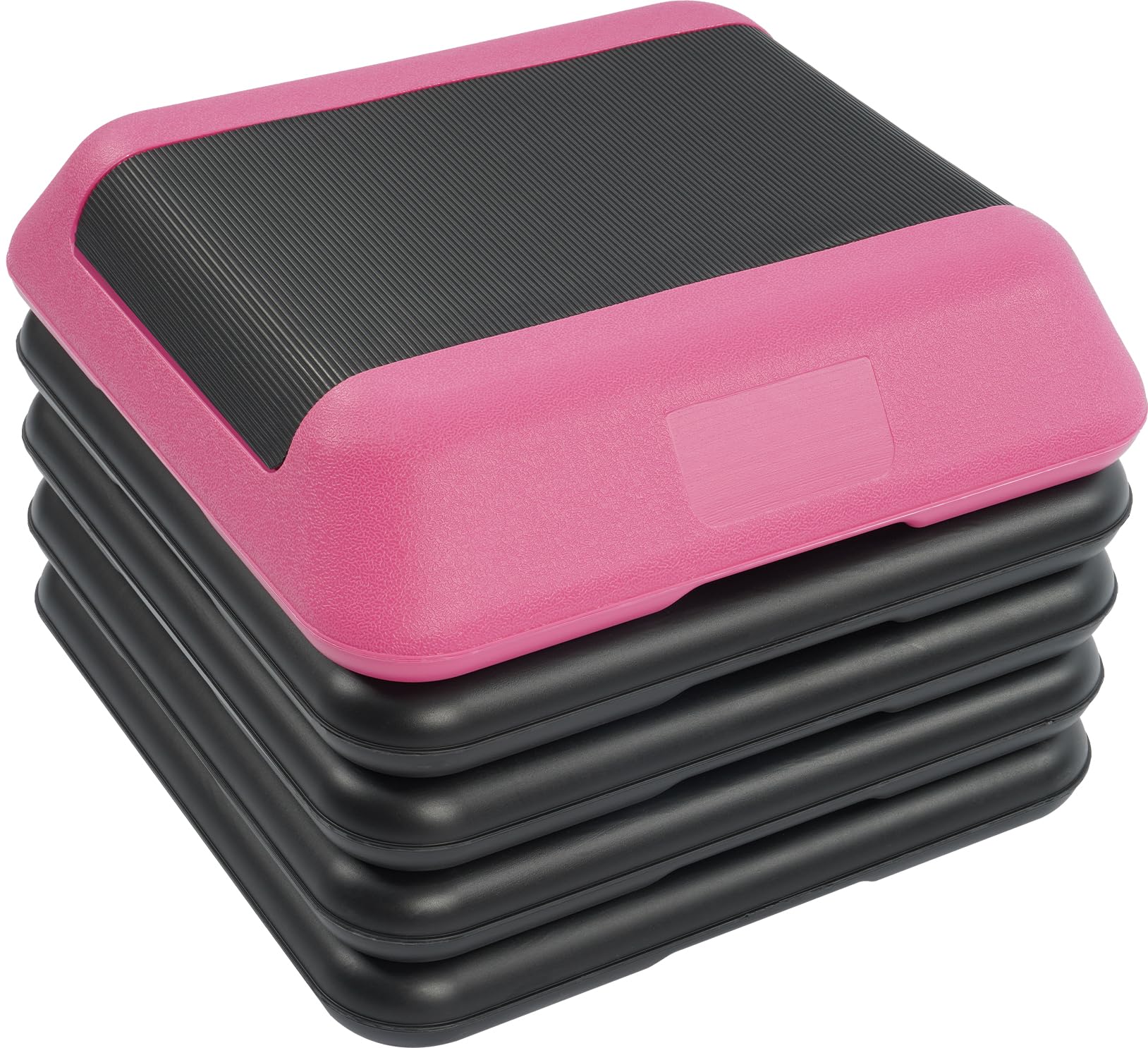
That combination is why this is the deck we name for hip thrusts, elevated split squats, and plyo work in a small room. The four risers lock underneath the platform when you're done, so it stores as one 12-pound piece that slides under a bed and never leaves a block behind to trip over.

Bottom line: Buy it for the height, not the length: it's the only deck here that stacks to 12 inches, and the 16-inch top is built for stepping up rather than sweeping across.

#6

STEP Mini Platform

STEP Mini Platform

Tight spaces

Our Score 9.2/10
Check Price

Worth Noting

  • 18-inch deck is short for wide side steps
  • Risers can separate when it's carried
Height Range
3" to 5"
Platform Size
18" L x 11" W
Platform Weight
3.51 lb
Weight Capacity
330 lb
Read the full review

The case for this deck is floor space. At 18 inches long and 11 wide it sits in the corner of a room that couldn't take a 43-inch platform, and with the risers nested into the bottom it slides under a bed between workouts. We think that makes it the right buy for a small apartment, a hotel room, or a physio routine — and the wrong one for a choreographed class, because 18 inches is short enough that a wide side step puts you off the edge.

Heights run 3 to 5 inches, which is deliberately low: this is a platform for calf raises, step-ups, and rehab progressions rather than for driving your heart rate through a long combination. It carries a 330-pound stated rating, well past what most people will ever put on it.

If you've been balancing on a stack of books or the bottom stair, this is a steadier and more consistent height to work from, and it adds a second setting as you progress. That's the narrow job it does well, and it's a genuinely useful one.

Bottom line: Worth it only if floor space is the constraint: it handles calf raises, rehab, and travel, and it will frustrate anyone chasing a real step routine.

#7

Amazon Basics Aerobic Step

Amazon Basics Aerobic Step

Rehab and stretching

Our Score 9.0/10
Check Price

Worth Noting

  • Six inches is the maximum height
Height Levels
4", 6"
Platform Size
26.8" L x 11" W
Riser Storage
Under the platform
Weight Capacity
400 lb
Read the full review

The risers clip underneath the deck for storage, which stops mattering right up until you've kicked a loose riser across the living room for the third time. It's a 26.8-by-11-inch platform with 4- and 6-inch settings and a stated 400-pound capacity — generous for a deck this compact.

Carpet and rubber are where it feels most at home; on a polished floor it can slide a little, and that's the one thing to plan around. A mat under it settles the question, and the low profile means your foot isn't traveling far on the way down.

Where we think it fits is the low end of the job: physical therapy, stretching, balance work, a five-minute step break at the desk. Six inches is plenty for those, and the 400-pound rating is more than you'd guess from something you can slide under a couch with one hand.

Bottom line: The one to get if your workouts are therapy, stretching, and low step-ups rather than a class — small, light, and rated well past its footprint.

How We Chose and Tested Step Platforms

We built the shortlist by pulling every platform we could find that published a real weight capacity, a stated height range, and enough customer feedback to show a pattern, then cut it down to 12 for hands-on testing across six months. Testing started with baseline measurements and ended with a final weigh-in and inspection, so we could see what changed with use rather than just how each platform felt on day one.

Each platform lived through the same rotation: two weeks in a living room for morning step circuits, two weeks in a basement on bare concrete for strength work with dumbbells, plus a week of whatever it was clearly designed for — rehab-style step-ups, incline presses, partner passes. We did step-ups barefoot and in sneakers, ran 20 lateral shuffles and 10 two-foot jumps on every deck, and watched for the things you actually feel: a deck that flexes under a landing, a riser that clicks but doesn't seat, a surface that gets slick once your hands are damp. We also checked footing on carpet, on a rubber mat, and on hardwood, since a platform that holds on one floor and skates on another is one you quietly stop using.

Height and size got the most measuring. We recorded the true gap between settings (some step in 2-inch increments, some in 4), whether the top height was actually comfortable to step onto, the deck's length and width against a shoulder-width stance, and how small each one broke down for storage under a couch, on a closet shelf, or in a trunk. At the six-month mark we re-weighed every platform, checked the rubber feet for flattening, the deck for the polished slickness that comes with wear, and the edges and clips for hairline cracks. Value came last: within each price tier we asked what the money bought — extra risers, a wider deck, a mat, a warranty that covers the deck and not just the hardware — and whether more height settings made a platform genuinely more useful or just gave us more parts to lose.

How to Choose a Step Platform

Deck length sets what you can actually do

Forty-plus inches is the class standard, and it's what lets you take a full side step, sweep over the top, and stay in rhythm without shortening your movement. Our top pick and the ZENY both measure 43 by 16 inches. The compact decks around 27 by 11 inches, like the WF and the Amazon Basics, handle basic combos and step-ups comfortably, but a long lateral step will run you off the edge.

The trap worth naming: compact in a listing means it fits under a couch, not that it fits a step routine. Measure the floor where the deck will live before you measure anything else, and if you can spare the space, buy the length.

Height range: the bottom setting matters as much as the top

Four risers giving 4, 6, and 8 inches covers almost every step workout you'll stream, and 8 is plenty for a hard session. The Reebok starts higher, at 5.9 inches, which suits someone who already trains but leaves no gentle setting for a beginner or a sore knee.

At the other extreme, the Fitvids stacks to 12 inches. That height belongs to hip thrusts, elevated split squats, and plyo work, not to stepping to music. If you're rehabbing anything, the 4-inch setting is the one that matters.

Stability is three things, and only one of them is the deck

The top surface, the riser interface, and the feet on your floor all have to hold. A grippy deck on a stack that shifts is worse than a plain deck on a solid one, because the movement arrives right when you commit your weight.

Before your first workout, set the deck to your working height and push it hard from the side. A sound stack flexes and settles; a loose one walks apart. On carpet, check that the feet aren't perched on the pile rather than pressing into it.

Risers, storage, and living with the thing

Press-on risers are the norm below the premium tier and they don't travel well: lift the platform by the deck with both hands, or the stack separates on the way to the living room. The Reebok's click-and-lock system is the exception here.

Weight runs from 12 pounds on the Fitvids to 20 on the Original, and several decks stow their risers underneath, which is the difference between a piece of furniture and a pile in the closet. Decide where the deck lives before you order, not after.

Frequently Asked Questions

Final Verdict

The Original STEP still wins on the combination nothing else here matches: a genuine 43-inch class deck, a cushioned grippy top, four risers, and a stack that stays put when you're moving fast. Buy it if you have the floor space and want to stop thinking about your equipment.

If you don't, the Reebok is the one to stretch for when you change heights constantly, and the Fitvids is the smarter buy when your training is hip thrusts and plyo in the corner of a bedroom rather than a step class.