Accessories

Best Running Water Bottles of 2026

Three miles from home is a bad place to find out your bottle leaks. A good running bottle should mostly disappear: it sits still in your palm or your vest pocket, gives up water without breaking your stride, and comes out of the dishwasher tasting like nothing at all. The wrong one announces itself every step — sloshing, bouncing, or leaving a cold stripe down your back.

Over the past four months, I've run with 16 bottles — handhelds, collapsible soft flasks, and vest-ready models — on easy morning loops, long weekend efforts, and a few treadmill sessions I'd rather forget. The differences were smaller than you'd expect and more irritating than you'd hope: a valve that weeps in a pocket, a flask that's too fat for the sleeve once it's full, plastic that clings to sports drink long after you've rinsed it. The picks below are the ones that stayed quiet.

#1

AONIJIE Soft Flask 2-Pack

Top Pick
AONIJIE Soft Flask 2-Pack

Vest flasks

Our Score 9.2/10
Check Price

Worth Noting

  • Coloured mix stains the clear TPU
Pack
Two flasks
Valve
Silicone bite valve
Capacity
500 ml each
Material
TPU
Read the full review

A soft flask earns its keep at the end of the sip. The 500 ml AONIJIE collapses down to a flat scrap of TPU, so the water stops sloshing around and the pocket space comes back as you drink. Rigid bottles cannot do that, and it is the reason flasks and running vests were made for each other.

The bite valve seals between sips — bite, squeeze, release — and the flasks are rated from 0 to 40 °C, so they can go in the freezer the night before a hot long run. They are hand wash only: TPU holds water in its folds, so shake them out and hang them to dry rather than towelling them off. Coloured electrolyte mix will stain the clear material over a season, which is cosmetic rather than fatal, but worth knowing if you like your kit to look new.

These are the flasks we point vest runners toward. Half a litre is a real bottle rather than a gel-sized top-up, and getting two in the pack means water in one and mix in the other without a second system. Fit is the one thing to check: they stand 9.7 inches when full, which is longer than some vest pockets, so measure the pocket before a race rather than at the start line.

Bottom line: The best soft flask here for vests: 500 ml each, collapsing as you drink, with two in the pack for water and mix.

#2

Nathan ExoDraw & ExoShot 2.0

Nathan ExoDraw & ExoShot 2.0

Grip-free long runs

Our Score 9.0/10
Check Price

Worth Noting

  • 400 ml is smaller than the 18 oz name suggests
Carry
Hand strap with rigid spine
Weight
2.88 oz
Capacity
400 ml
Stash Pocket
Small, for a gel or key
Read the full review

The ExoDraw's trick is that your hand can open. A strap crosses the back of your hand and a rigid spine runs down the flask, so the bottle hangs there while your fingers relax — we spent a whole run with a loose grip and never once reached to steady it. Nothing else here carries itself like that.

That harness is why it earns the top spot. It removes the two things that sour a handheld, a clenched fist and a bottle swinging off your palm, without asking you to wear a belt or a vest. And the soft flask pulls out of the sleeve, so the same bottle drops into a vest pocket on days you want your hands completely free. Empty, it weighs 2.88 ounces, which is light enough that the strap does all the work.

Capacity is the number to read twice. Nathan gives 400 ml in the product details and 18 ounces in the name, so plan on the smaller figure: this is an hour-long bottle, not a marathon one. The push-pull Race Cap is the other thing to handle properly — click it fully shut before the bottle goes anywhere near a phone or a car key, because a half-closed cap is where a handheld starts weeping.

The stash pocket takes a gel or a key, which is more than most handhelds manage, and the whole thing rinses clean in a sink. It sits at the top of the price range here, and you are paying for the harness rather than the plastic — which is fine by us, because the harness is the part that works.

Bottom line: For most runners this is the one to buy: the hand strap lets your fingers relax, and the flask pulls out for vest duty.

#3

Runtasty 10 oz 2-Pack

Runtasty 10 oz 2-Pack

Belt replacements

Our Score 9.0/10
Check Price

Worth Noting

  • Needs a belt
  • Ten ounces runs out on long runs
Cap
Push-pull
Care
Top-rack dishwasher safe
Pack
Two bottles
Capacity
10 fl oz each
Read the full review

The Runtasty pair exists for one job: replacing the bottles that came with your hydration belt, or the ones that leaked until you stopped wearing the belt at all. Two 10-ounce bottles, a push-pull cap, a round body that drops into the holsters most fuel belts use. That is the whole pitch, and it is the pair we reach for when a belt needs bottles.

Ten ounces empties faster than you expect on a warm morning, so a pair buys you two hours or one bottle of water and one of electrolyte mix. The cap is right for belt duty: it opens with a thumb or your teeth and closes flat, so there is nothing to unscrew at pace. Both bottles are top-rack dishwasher safe, which matters more than it sounds when they live in a gym bag between runs.

What you do not get is a way to carry them — no strap, no clip — so these are refills, not a first bottle. If you do not already run with a belt, start with the ExoDraw instead. If you do, measure the holster opening before you order, because a body that is a fraction too wide will ride up or pop out on a descent. Up to a half marathon with a refill stop, the size is fine.

Bottom line: Buy the pair if your belt's own bottles leak or have gone missing: ten ounces each, a cap that opens one-handed, and no fuss.

#4

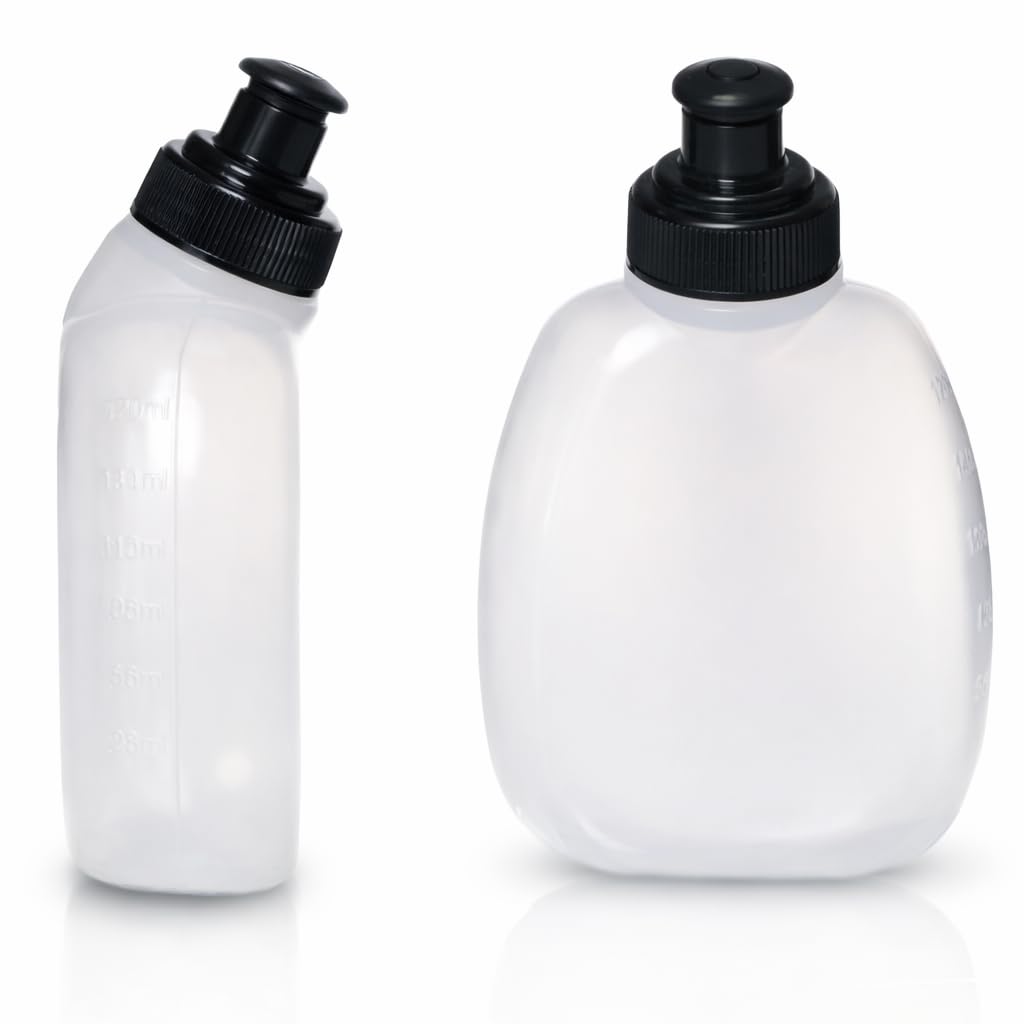
Azarxis 170 ml 2-Pack

Azarxis 170 ml 2-Pack

Pocket spares

Our Score 9.0/10
Check Price

Worth Noting

  • 170 ml is only a few mouthfuls
  • Hand wash only
Cap
Push-pull with silicone straw
Pack
Two bottles
Weight
33 g each
Capacity
170 ml each
Read the full review

At 170 ml the Azarxis bottles hold a few swallows each, and that is the point. They weigh 33 grams, they slip into a belt holster or a vest pocket without a bulge, and they put water where a full bottle gets in the way.

We kept a pair in the belt on short runs and forgot about them, which is the highest praise a bottle this size can get. The push-pull cap has a silicone straw, so you drink without tipping your head back, and the squeezable oval body lets you push water out instead of waiting for gravity. Small things, but they matter when you are breathing hard.

Two bottles is the right call at this size, because one will not get you far: both are empty inside an hour on a warm day. Azarxis sells the same bottle in 250 and 280 ml, and if you want one bottle to cover a whole long run, the AONIJIE flasks are the better answer. These are hand wash only too, which is one more thing to remember than a dishwasher-safe bottle.

Bottom line: For short runs and spare pockets, buy these: 33 grams each, a cap you can work one-handed, and no bulge.

How We Put 16 Running Bottles Through Four Months of Mileage

We started with the bottles our testers and a handful of running-club regulars actually carry, then filtered by capacity, valve style, and price, cutting anything that wouldn't slide into a standard vest sleeve or a handheld strap. That left 16 — hard bottles, soft flasks, and a few handhelds with built-in grips. Each one logged at least six runs across four months: weekday morning loops, long weekend efforts, treadmill sessions, and a couple of rainy outings that made every seam matter.

Leak-proofing got the harshest treatment. We filled each bottle with water and a splash of cranberry juice, shook it, flipped it upside down, and squeezed hard, then checked the outside of the bottle and the inside of the vest pocket it rode in. To judge fit, we filled each to its stated capacity and tried pulling it out of a front sleeve one-handed mid-run, and weighed every bottle both empty and full to see how much the difference wore on a hand or a shoulder.

Durability meant deliberate clumsiness: drops from waist height onto pavement, repeated top-rack dishwasher cycles, and close inspection of cap threads and bite valves for chewing and hairline cracks. For odor, we left each bottle filled with electrolyte mix overnight, washed it, and smelled it again a week later — the silicone and plastic that held onto a smell never really let go. Capacity was measured against the label with a measuring cup, since several bottles held noticeably less than promised, and value came down to how many runs a bottle survived before something gave out.

How to Choose Running Water Bottles

Pick the carry before the bottle

Handheld, belt, or vest settles almost everything else. A handheld lives or dies by its strap: a wide one with a thumbhole lets your fingers open, while a bare bottle means a clenched fist for the whole run. A belt bottle is only as good as the holster it slides into, so measure the opening — a body a couple of millimetres too wide rides up, too narrow and it pops out on a downhill. A vest flask has to match pocket depth, because a tall flask in a short pocket presses against your chest with every stride.

Size for your longest run, not your average one

Capacity is where runners under-buy. A few mouthfuls is fine for a fast 5K and useless at mile nine, and the figure in the product name is not always the volume you actually get, so read the details as well as the title. Ten ounces empties faster than most people expect on a warm morning; 500 ml is a genuine fill rather than a top-up. If you are between sizes, buy the pair — two small bottles on a belt or in a vest carry better than one big one, and you can run water in one and mix in the other.

Leaks start at the cap, not the body

Nearly every leak we have chased came from a cap or a valve. Push-pull caps weep when they are not clicked fully shut or when the thread is cross-threaded; bite valves weep when grit or dried mix gets under the seal. Seat the cap properly before the bottle goes into a pocket next to a phone, rinse the valve after an electrolyte mix, and never overtighten a screw cap because it distorts the gasket. A soft flask with a clean valve is the most reliable thing you can carry; a rigid bottle with a tired cap is the least.

Cleaning decides how long you keep it

Bottles are retired over taste more often than over damage. Soft flasks have to be shaken out and hung to dry, since TPU traps water in its folds and that is where the stale flavour comes from; rigid bottles go in the top rack and dry overnight on a rack rather than in a closed cabinet. Coloured mix stains clear flasks and leaves a film inside valves, so rinse the same day you run. A bottle that still tastes of last week's drink is one you stop taking with you.

Frequently Asked Questions

Final Verdict

Start with the Nathan ExoDraw & ExoShot 2.0. It is the only pick here that carries itself, and because the flask pulls out of its sleeve, one purchase covers handheld days and vest days. Runners who already wear a belt get more for less from the Runtasty pair — two bottles, a cap that works at pace, and nothing to hold.

Vest runners should go straight to the AONIJIE flasks, and the Azarxis pair is what we keep in the bag for short runs and hot afternoons when a few swallows is the whole plan.