Accessories

Best Lifting Straps of 2026

The last rep is where your grip gives out. Your back is still strong, your hips still have another inch of drive, but your fingers open a half centimeter and the bar starts to roll — and that's the rep you'll think about on the drive home. Lifting straps solve exactly that problem: they lash your hands to the bar so your lats, hamstrings, and glutes decide when the set ends instead of your forearms. If your pulls keep stalling at rep six for reasons that have nothing to do with your legs, this is the cheapest fix in the gym.

I spent years with one chalk-stiffened pair of cotton straps and never thought about them until I borrowed a friend's and realized the loop was cutting off the circulation in my hand. Since then my team has put 16 pairs through four months of pulling, from thin nylon figure-8s to wide cotton loops, and the differences are not subtle. Fit and comfort do most of the work — a strap that's too long tangles between your fingers, one that's too narrow digs into your wrist at lockout, and one with lazy stitching starts fraying by week three. One thing worth knowing before you buy: nylon starts slick and stays slick until it's broken in, while cotton gets grippier as it absorbs sweat, so a strap can feel worse on day one and better by week six. The ones that earned a permanent spot in my gym bag are below.

#1

Gymreapers Lifting Straps

Top Pick
Gymreapers Lifting Straps

Everyday strength work

Our Score 9.4/10
Check Price

Worth Noting

  • Can slip on smooth or coated bars
Sizing
One size
Material
Cotton webbing
Wrist Pad
Neoprene
Strap Length
18 inches
Read the full review

The pad on the Gymreapers sits exactly where the strap crosses the back of your wrist, and the section that meets the bar is bare cotton. That split is the whole design, and it's the right one: cushioning where the webbing presses on skin, nothing soft or slippery where you need the strap to bite. At 18 inches the tail ends before it reaches your fingers, so there's no loose end swinging around between reps.

Of everything here, this is the pair we reach for on a mixed training day — deadlifts, then rows, then shrugs — because a lasso goes on in a couple of seconds and works on any bar you can get a hand around. Cotton is also the right material for a chalked bar: it grabs knurling instead of skating over it, and it feels better after a few sessions rather than worse. Nothing on it needs adjusting, tightening or replacing, which is not something every strap here can claim.

Length is the compromise. Eighteen inches covers a standard power bar with room to spare, but on a thick handle you run out of strap before you run out of bar, and the 23- and 24-inch options here give you another two turns. If your gym has a fat bar or an axle, start with one of those. On a normal bar we never wanted more.

Bottom line: We recommend the Gymreapers as the default pair for general strength training: padded where it counts, quick to wrap, and proven on every pulling lift we tried.

#2

Ekkovision Cuffed Straps

Ekkovision Cuffed Straps

Cushioned pulling

Our Score 9.4/10
Check Price

Worth Noting

  • Cuff cinches tight on larger wrists
Grip
Non-slip rubber
Style
Cuffed D-ring
Padding
Thick cushioned
Material
Cotton
Read the full review

The D-ring is what you notice first. The strap hangs from a metal ring sewn into the cuff, so the cuff stays open and you can push a hand through and drop the loop over the bar in one motion. That sounds like a small convenience until you're loading and unloading plates alone and the alternative is threading a lasso with your fingers.

The cuff itself is thick and heavily padded, and the strap carries a rubberised non-slip face. On a heavy pull the load spreads across the wrist rather than biting into the crease, and there's enough structure in the cuff that it doesn't roll over on itself mid-set. Nothing about it feels like a basic cotton strap with a logo on it.

Our call: this is the pick for heavy pulling when your wrists are the limiting factor. The cuff does most of the work, the rubber face holds a bar that has gone slick, and the D-ring means you're not fighting the strap between sets. It's more strap than most people need, and the right amount for anyone pulling twice a week or more.

Bottom line: This is the pair we hand to a heavy puller whose wrists give out first: thick padding and a one-handed setup that keeps you moving between sets.

#3

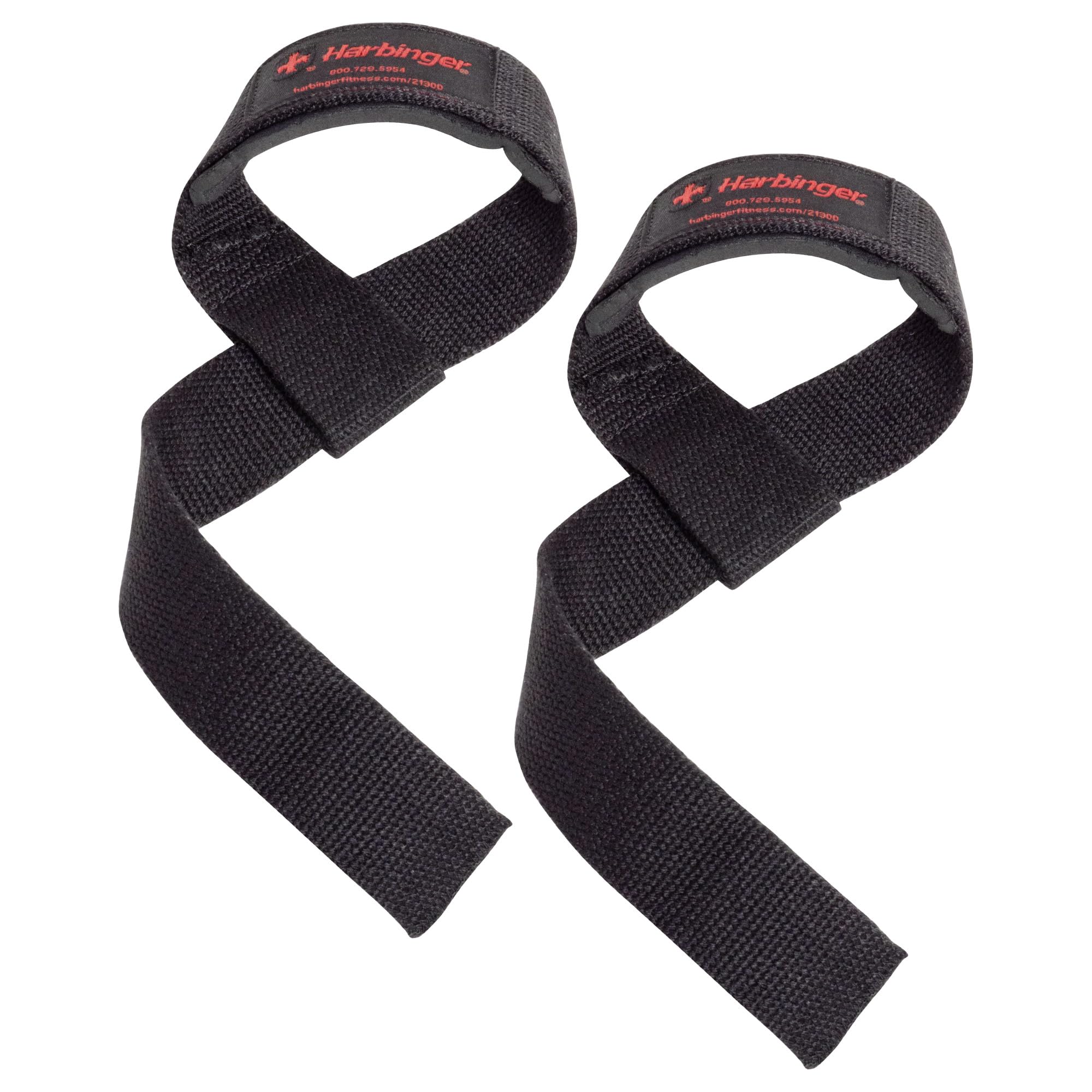
Harbinger Padded Straps

Harbinger Padded Straps

Cheap long wraps

Our Score 9.4/10
Check Price

Worth Noting

  • Seams can open where the strap folds
  • Padding can lift away from the webbing
Width
1.5 inches
Wrist Pad
NeoTek cushioned
Strap Length
21.5 inches
Read the full review

One and a half inches of width is the detail that separates the Harbinger from most of the cotton straps here. Wider webbing spreads the load across more of the bar, and on a long grind that comes through as less pressure in the fingers. It's the kind of thing you notice on the last rep rather than the first.

At 21.5 inches it sits in the middle of this group — longer than the Gymreapers, shorter than the BEAST RAGE — which works out to two or three wraps on a standard bar. The NeoTek pad on the wrist is soft and sits where the strap crosses, and the cotton takes chalk without going slick.

This is the value play here: a long, wide, padded cotton strap for less than most of the group. It's the pair we hand to a lifter who wants reach and padding without paying for hardware, and it does everything a basic strap should. Treat it as a consumable, though, and it will serve you well.

Bottom line: A long, wide, padded cotton strap for very little money, worth buying as long as you check the seams before every heavy session.

#4

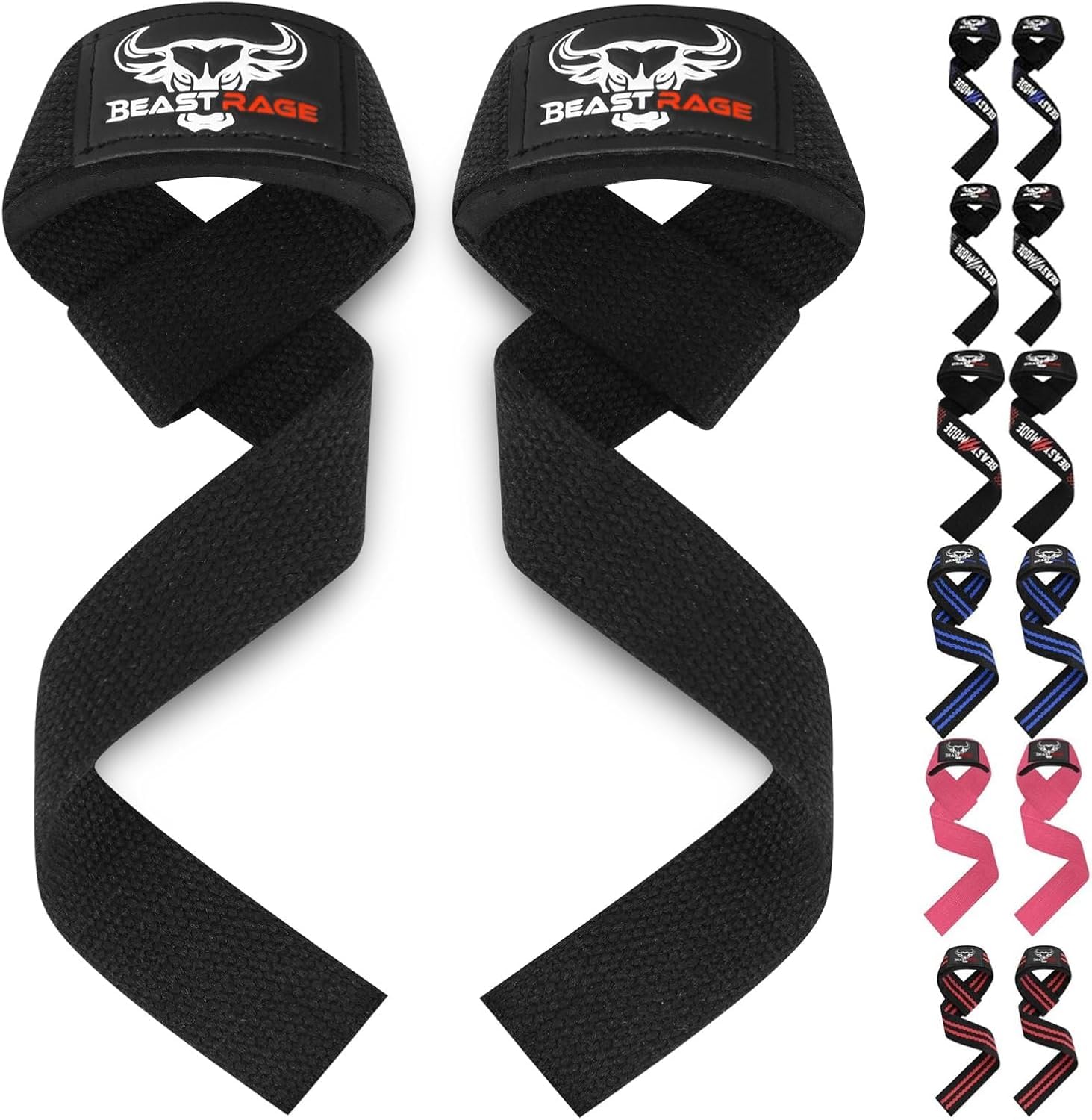
BEAST RAGE Lifting Straps

BEAST RAGE Lifting Straps

Budget deadlift day

Our Score 9.2/10
Check Price

Worth Noting

  • Long tail gets in the way on slim wrists
Grip
Silicone texture
Width
1.5 inches
Material
Cotton with neoprene
Strap Length
24 inches
Read the full review

Twenty-four inches is the longest strap in this group, and that single number is why we keep a pair in the gym bag. On a thick handle or an axle you still get two full turns, and on a normal bar the extra length costs you nothing except a slightly longer tail. For the least expensive strap here, that's a lot of reach.

The padding is a 4 mm neoprene layer across the wrist, placed on the loaded side rather than wrapped all the way round, so the strap stays flat when you pull. There's a light silicone texture on one face as well. It's mild — you won't mistake it for a rubber grip — but it adds a little bite on a bar that has gone shiny.

Where they earn their keep is volume work: rows, Romanian deadlifts, shrugs, anything where the strap comes on and off between sets. The lasso is quick, the tail is long enough to find without looking, and the whole thing feels like a strap that expects to be used rather than admired.

Bottom line: We keep a pair of these in the bag for thick bars and thin budgets: 24 inches of reach, soft padding, and nothing fussy to break.

#5

Fitgriff Lifting Straps

Fitgriff Lifting Straps

Smaller wrists

Our Score 9.2/10
Check Price

Worth Noting

Sizing
Two sizes
Material
Cotton
Wrist Pad
Neoprene
Strap Length
Approx. 23 inches
Read the full review

Fitgriff is the only lasso-style strap here sold in two sizes, and that changes the decision more than any material claim on the label. There's a standard cuff and a smaller one, with the standard cut for wrists above 6.3 inches. If you have ever had a one-size strap close past itself and bunch up under the pad, this is the fix.

At roughly 23 inches it sits between the 18-inch Gymreapers and the 24-inch BEAST RAGE, which works out to two or three wraps on a standard bar. The version we tried carries a textured grip face; a plain cotton version is sold alongside it. Worth knowing: the texture is on one side only, so the strap has a right way round — a small thing until you're setting up in a hurry and have to flip it.

That face is where the Fitgriff earns its place next to our top pick. Plain cotton is fine on a chalked, grooved bar. On a smoother one, the silicone pattern holds while cotton alone starts to creep, and we noticed it most on high-rep rows, where a slow slide is more irritating than a clean failure.

Fit is the catch, and it's the reason to read the size chart rather than assume. Near the 6.3-inch line the standard cuff closes only just, so a wrist right at the threshold is better off with the smaller size. Get that right and this is the most comfortable strap here over a long session: the neoprene is soft, the cuff doesn't dig, and the length leaves nothing dangling.

Bottom line: Buy the Fitgriff if a one-size cuff has never sat right on you; the size choice and textured face make it the tidiest fit here for slimmer wrists.

#6

Warm Body Cold Mind V1

Warm Body Cold Mind V1

Olympic lifts

Our Score 9.2/10
Check Price

Worth Noting

  • Stiff canvas needs a break-in period
Width
2.5 inches
Sizing
One size, left/right labelled
Material
Cotton canvas
Strap Length
13 inches
Read the full review

Olympic straps are built for a different moment than deadlift straps. At 13 inches long and 2.5 inches wide, these hook over the bar rather than wrapping around it, and they clear the bar the moment you let go at the top of a lift. That release is the point: you're not unthreading anything between attempts.

The width is the other half of the design. Two and a half inches of canvas spreads the pull across the wrist instead of concentrating it in a line, which is what you want when the bar is moving fast and the load is high. The pair is labelled left and right, which sounds fussy until you're chalking up between attempts and don't want to think about it.

Cotton canvas is the material that ages best in this group. It takes chalk, it doesn't glaze over the way a synthetic face can, and the edges soften into shape rather than fraying. The construction is plain, and it's plain in the way a strap should be: webbing, stitching, and nothing between your hand and the bar.

If you lift Olympic, this is the pair. If you deadlift, it isn't: 13 inches gives you a single wrap on a power bar, and the width that helps on a fast pull only gets in the way on a slow grind. Buy these for the snatch and the clean, and keep a lasso in the bag for everything else.

Bottom line: We recommend these to Olympic lifters without hesitation: short, wide and easy to release, and the wrong shape entirely for a slow deadlift grind.

#7

RDX Figure 8 Straps

RDX Figure 8 Straps

Heavy deadlifts

Our Score 9.2/10
Check Price

Worth Noting

  • Built for barbells, not dumbbells or cables
Sizes
Three (S, M, L)
Style
Figure 8
Material
Cotton
Stitching
Three-layer cross-stitch
Read the full review

Figure-8 straps are the most secure thing in this roundup and the least flexible, and the RDX pair shows both sides. Two cotton loops joined by a short bridge: you put a hand through each loop, the bridge goes under the bar, and from then on the bar is tied to your wrists. Nothing wraps, nothing slips, and nothing works loose mid-rep.

For a heavy deadlift or a rack pull that's exactly what you want, because the strap takes the load off your fingers completely. The basket-weave cotton with three-layer cross-stitching on the bridge is built for the abrasion that comes with it. The trade is commitment: the loops hold you to the bar, so a lift you might need to dump in a hurry isn't the place for them.

Sizing is the whole game with a figure-8. RDX builds three, starting with a small sized around a 6.5-inch wrist, and the loops have to sit snug — a loose figure-8 slides on the bar instead of locking to it. Measure your wrist at the crease before you order, and if you land between two sizes, take the smaller one.

Bottom line: We reach for the RDX figure-8 when a deadlift lockout is failing on grip: nothing here holds a bar more securely, and nothing here is less forgiving.

#8

Fitgriff Elite Straps

Fitgriff Elite Straps

Fast transitions

Our Score 9.0/10
Check Price

Worth Noting

  • Sizing depends on an accurate measurement
Grip
Natural rubber
Sizing
Four sizes
Closure
Hook-and-loop
Wrist Pad
Neoprene
Read the full review

The Elite is built around a rubber bulge on the working face of the strap and a hook-and-loop cuff that peels the strap away from the bar. Set it once, pull, open your hand, and the strap drops clear instead of staying threaded through your fingers. That's a different idea from every cotton lasso here, and it changes how a session feels.

On a deadlift day with short rests, that release is the reason to pay for it: we spend less time re-threading and more time pulling. The rubber face also holds a smooth bar better than the plain cotton on our top pick, which matters in a gym where the knurling has been polished off half the bars. It's the most convenient strap in this group, and it's priced like it.

Four sizes is more choice than any other strap here, and the trade is that fit is decided before the bar ever moves. What you get for the money is the fastest strap to get on and off in this roundup, with neoprene padding that needs no breaking in. A lasso is simpler and cheaper; for a lifter who pulls on a schedule, this is the one that disappears into the routine.

Bottom line: We recommend the Elite to anyone who deadlifts several times a week and wants a strap that comes off as fast as it goes on; the rubber face is the bonus.

How We Tested the Best Lifting Straps

We started with roughly 40 straps we'd seen on gym floors, recommended by powerlifters and strength coaches, or sold by brands with a long track record, then narrowed by specs: cotton versus nylon webbing, loop versus figure-8, strap width and length, and whether the stitching ran in a load-bearing pattern or just looked decorative. Sixteen made the cut. A few were cut for being so long that the tail whipped us in the face mid-set, and a couple of budget pairs were dropped after the seams visibly loosened during a single unboxing inspection.

Testing ran four months, split between a garage gym and a commercial floor. Every pair went through the same rotation: heavy conventional deadlifts, Romanian deadlifts for high reps, dumbbell and barbell rows, shrugs, and pull-up work where we let the straps hang rather than grip the bar. We also ran a deliberately hostile session with each pair — no chalk, 90-degree garage, sweaty hands after a row block — because that's when a slick strap announces itself.

Along the way we measured each strap's length and width with a tape, counted how many times it had to wrap a standard bar versus a thicker axle-style bar, and timed how long it took to wrap one-handed between sets with the clock running. We checked the wrist crease after every lockout for pinching or bunching, counted the wraps needed before a strap stopped slipping, and inspected seams and stitching weekly for fraying, fuzzing, or pulled threads. Lifters with wrists from about 5.5 to 8 inches tried every pair so we could tell which straps ran short for big hands and which swallowed small ones.

How to Choose Lifting Straps

Start with how the strap attaches

A lasso strap loops through itself around the bar and takes a couple of seconds to set. It works on any bar you can get a hand around, which is why it's the pair we tell most people to buy first. A figure-8 has two fixed loops and a short bridge: nothing wraps, nothing slips, and you are tied to the bar until you open your hands. A cuffed D-ring keeps the strap open on a metal ring so you can set up one-handed, usually with more padding and a higher price.

If you own one pair, make it a lasso. Add a figure-8 only when a deadlift lockout is being limited by grip rather than by your back or legs.

Length and width decide how many wraps you get

Lasso straps here run from 18 to 24 inches, and the difference shows up on thick handles rather than on a standard power bar. Eighteen inches is a clean two turns on a normal bar; the longer straps give you a third turn on an axle or a fat grip. Width works the same way. Most cotton straps are 1.5 inches wide, while Olympic straps run around 2.5 inches to spread a fast, heavy pull across more of the wrist.

The trap is assuming longer is better. On a standard bar a 24-inch strap leaves a tail that swings against your forearm between reps, and plenty of lifters end up tucking it under the cuff. Buy length for the bars you actually pull on.

Fit and padding: get the cuff right

A padded cuff is not automatically a snug cuff. One-size straps rely on how far you can close the loop, and a slim wrist often ends up with the cuff closed past itself and a long tail to manage. If your wrist measures near a size boundary, a strap sold in two or more sizes is worth the extra step; measure around the wrist crease, not the widest part of your forearm.

Padding placement matters more than thickness. The neoprene should sit where the webbing crosses the back of the wrist, and it should stop before the part of the strap that meets the bar so the working section stays thin enough to bite.

Material, chalk and what wears out

Cotton webbing is the default for a reason: it takes chalk, grips knurling, and softens over a few sessions instead of glazing. Rubber-faced and silicone-textured straps hold a smoother bar better, but the texture needs a reasonably clean surface to stay tacky. Olympic-style canvas is the stiffest of the three out of the package and the slowest to break in.

We treat straps as consumables, not heirlooms. The webbing thins where it folds over the bar and where it meets aggressive knurling, and a strap that has lost half its width is no longer doing the job you bought it for.

Frequently Asked Questions

Final Verdict

The Gymreapers is our default: padded where the wrist needs it, short enough to wrap without a dangling tail, and quick enough to live with on a busy training day. If your gym has thick-handled bars, the BEAST RAGE buys you the extra reach for very little.

Pull heavy and often, and the Fitgriff Elite's quick release and rubber face are worth stepping up for. If you compete in Olympic lifting, the Warm Body Cold Mind straps are the only pair here built for the way you actually lift.