Strength & Weights

Best Grip Strengtheners of 2026

The pickle jar wasn't the problem — the problem was standing in my kitchen for a full minute deciding whether to ask a neighbor for help. Grip is one of those things you don't notice until a lid, a gallon of milk, or the last rep of a deadlift reminds you it's slipping. A grip strengthener fixes that with a few minutes a day, squeezed into dead time at your desk or on the couch. My team and I spent four months with 16 of them, and the gap between a loose spring and a properly built trainer shows up fast.

Here's what nobody tells a first-time buyer: tension ratings aren't standardized, so the number molded into the handle means little until you've actually squeezed it. What separates a trainer you'll keep using comes down to adjustability, how the handle sits in your palm, and which part gives out first. A few of these also stretch your fingers back open, which matters more than it sounds. The picks below cover desk fidgeting, serious training, and the rehab-ish middle ground.

#1

GD Iron Grip

Top Pick
GD Iron Grip

All-around strength

Our Score 9.6/10
Check Price

Worth Noting

  • Premium price for a hand gripper
  • At 489 g it stays home, not in a pocket
Weight
1.08 lb
Handles
Knurled aluminum
Handle Width
3 positions
Resistance Range
26–181 lb (12 levels)
Read the full review

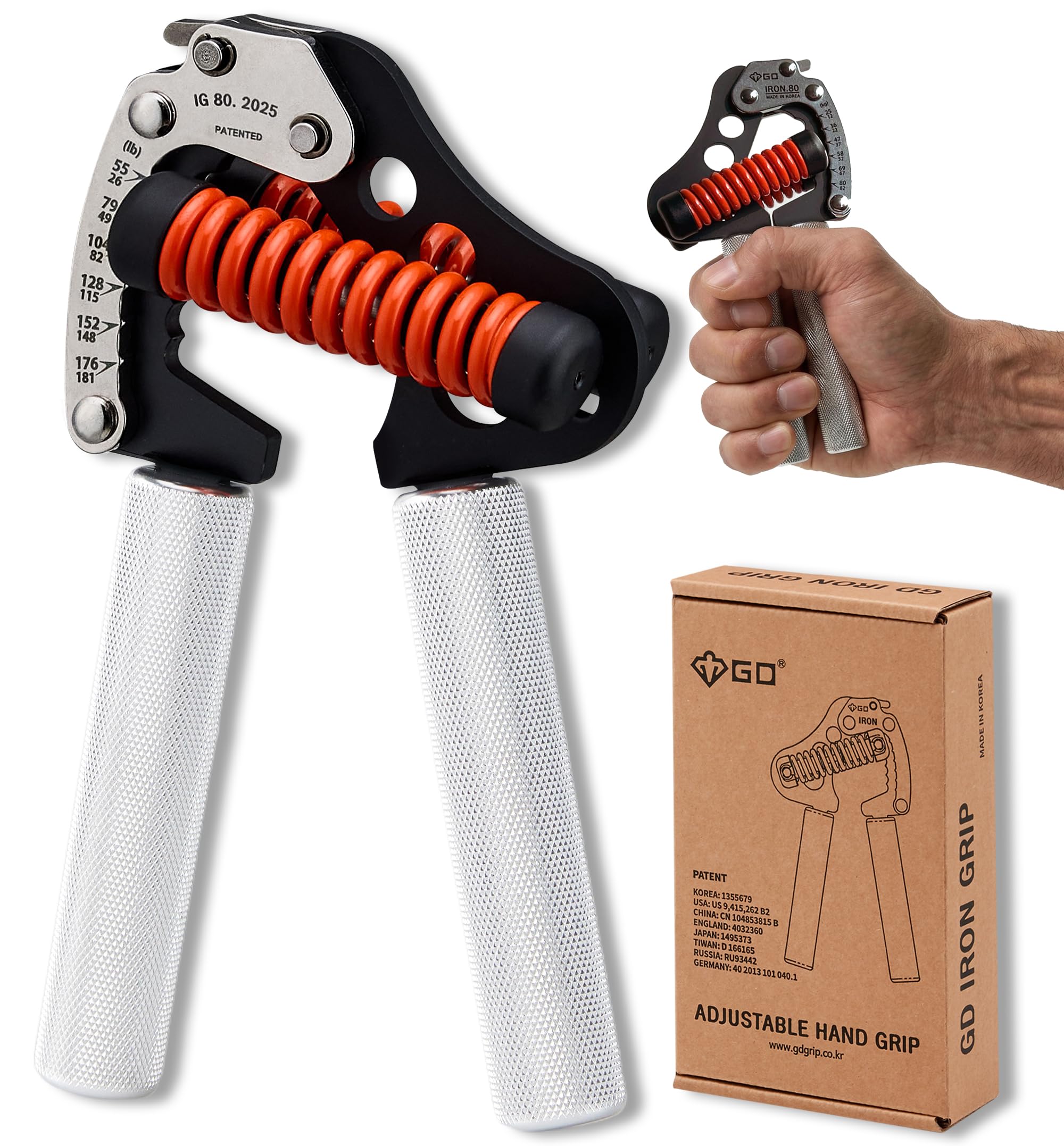
More expensive than anything else here, and still the one we point people to. The GD Iron Grip is a machined tool rather than a plastic toy: knurled aluminum handles, a 4T steel frame, and a compression spring with twelve settings between 26 and 181 lb. That's the widest range in this group, which means the same gripper works for a first-timer and for someone already closing 150 lb.

Twelve steps buy you a gentler curve. On a fixed-level gripper, going from a 100 lb tool to a 150 lb one is a wall; here the next notch is a nudge, and you can sit at a level for a few weeks without stalling. The knurling is the detail to know about — it's machined for grip, so it bites, and high-volume sets leave your palms marked. A wrap of tape or a pair of gloves fixes it, and we prefer handles that bite to handles that slip once the spring gets heavy.

Handle width adjusts across three positions, which reads like a spec-sheet line until you have short fingers or a wide palm. Narrowing the span gives smaller hands a workable reach; opening it up changes the feel of the exercise. It's also quiet in use, so nobody in the next cubicle will hear your set.

So the case is simple: this is the only gripper here that will follow you from a 30 lb first set to a heavy working set, and the build suggests it'll still be doing it in a few years. The price is the real objection, and the NIYIKOW covers the basic job for far less. If grip work is going to become a habit, this is the one that won't need replacing.

Bottom line: We recommend the GD Iron Grip to anyone who wants one gripper to keep: twelve steps from 26 to 181 lb, a metal build that takes heavy use, and handles that adjust to your hand.

#2

IronMind Captains of Crush

IronMind Captains of Crush

Heavy strength work

Our Score 9.6/10
Check Price

Worth Noting

  • No adjustment
  • Handles run short for large hands
Weight
4 oz
Handles
Knurled billet aluminum
Resistance
100 lb (fixed)
Read the full review

There is no dial on a Captains of Crush. You buy one resistance — this listing is the 100 lb version — and that is what you train with until you're strong enough to buy the next one. For anyone who has worn out a plastic adjustable gripper and found it wanting, that fixed certainty is the whole appeal: the number on the tool is the number you closed.

The build is why it has a reputation. Knurled billet aluminum handles, a proprietary spring, made in the USA, four ounces in the hand. We like that it feels like a piece of equipment rather than an accessory. The knurling is aggressive enough that bare-handed sets leave marks, so chalk or gloves make it civil — and if you don't want callouses, this isn't the tool for you.

Its limits are honest ones. A beginner who buys the wrong level owns a paperweight until they're strong enough for it, so pick a level you can close for five clean reps rather than the one that sounds impressive. This is a strength standard, not a starter kit.

Bottom line: Buy the Captains of Crush if you want a fixed, gym-standard gripper to measure yourself against; skip it if you need one tool that grows with you.

#3

D'Addario Varigrip

D'Addario Varigrip

Finger independence

Our Score 9.4/10
Check Price

Worth Noting

  • Lightest tension is still fairly firm
Weight
2.56 oz
Tension
Adjustable per finger
Material
Silicone
Dimensions
2.36 x 2.76 in
Read the full review

Most grippers work the hand as a single unit. The Varigrip splits it: each of the four fingers gets its own spring and its own tension adjustment, so a weak ring finger can train lighter than the index finger beside it. For a guitarist chasing an even fretting hand, or anyone whose grip came back unevenly after an injury, that difference is the entire product.

The detail for string players hides under the grip: pop off the reversible molded pad and you find a simulated string ridge that builds calluses where a fretboard would. It's a small thing no other pick here does, and we think it's the reason this one has lived in guitar cases for decades. What we don't love is the fingertip pressure — the pads can pinch, and a long set leaves the fingertips tender.

At 2.56 oz and roughly the size of a small wallet, it lives in a gig bag or a drawer rather than a gym. Judge it as a finger trainer and it's excellent; judge it as a grip strengthener and it's a specialist. Neither is a fault, as long as you know which one you're buying.

Bottom line: For fingers that need to work independently — guitarists, recovering hands, anyone with an uneven grip — the Varigrip is the most useful small tool in this group.

#4

Logest 7-Pack Grip Set

Logest 7-Pack Grip Set

Long-term progression

Our Score 9.4/10
Check Price

Worth Noting

  • Wide jumps between resistance levels
  • At 1.89 kg it stays in one place
Weight
4.17 lb
Handles
Aluminum
Resistance Levels
7, from 50 to 350 lb
Read the full review

Seven grippers, 50 lb to 350 lb, in one box. Where an adjustable tool asks you to trust a dial, this set gives you a physical ladder: you know exactly what you closed, because each gripper is a single fixed load. That's a different kind of motivation — you're not fiddling with a setting, you're moving up a rung.

The build is alloy steel with aluminum handles, and the whole set weighs 1.89 kg, heavy enough that it lives in one place rather than travelling. The handles are bumpy and rough, and on the heavier grippers they raise blisters on bare hands; a pair of work gloves or a wrap of tape makes longer sessions bearable.

The gaps are the catch. The steps between grippers are wide, so a jump can take months and some of the seven will barely get used. That's the trade for knowing precisely where you stand, and it's a trade plenty of lifters are happy to make.

Where it beats the adjustable picks is longevity: there's nothing to adjust, nothing to drift, and a 200 lb gripper stays a 200 lb gripper. For a home gym where several people train at different levels, or for one person who wants a decade of progress from a single purchase, this is the set we point to.

Bottom line: A seven-gripper ladder from 50 to 350 lb that never needs adjusting — the pick for anyone chasing a big close over months rather than weeks.

#5

NIYIKOW Grip Trainer

NIYIKOW Grip Trainer

First gripper

Our Score 9.2/10
Check Price

Worth Noting

  • Resistance markings are hard to set precisely
  • Tops out at 132 lb
Weight
4.94 oz
Dimensions
6.1 x 3.93 in
Resistance Range
22–132 lb
Read the full review

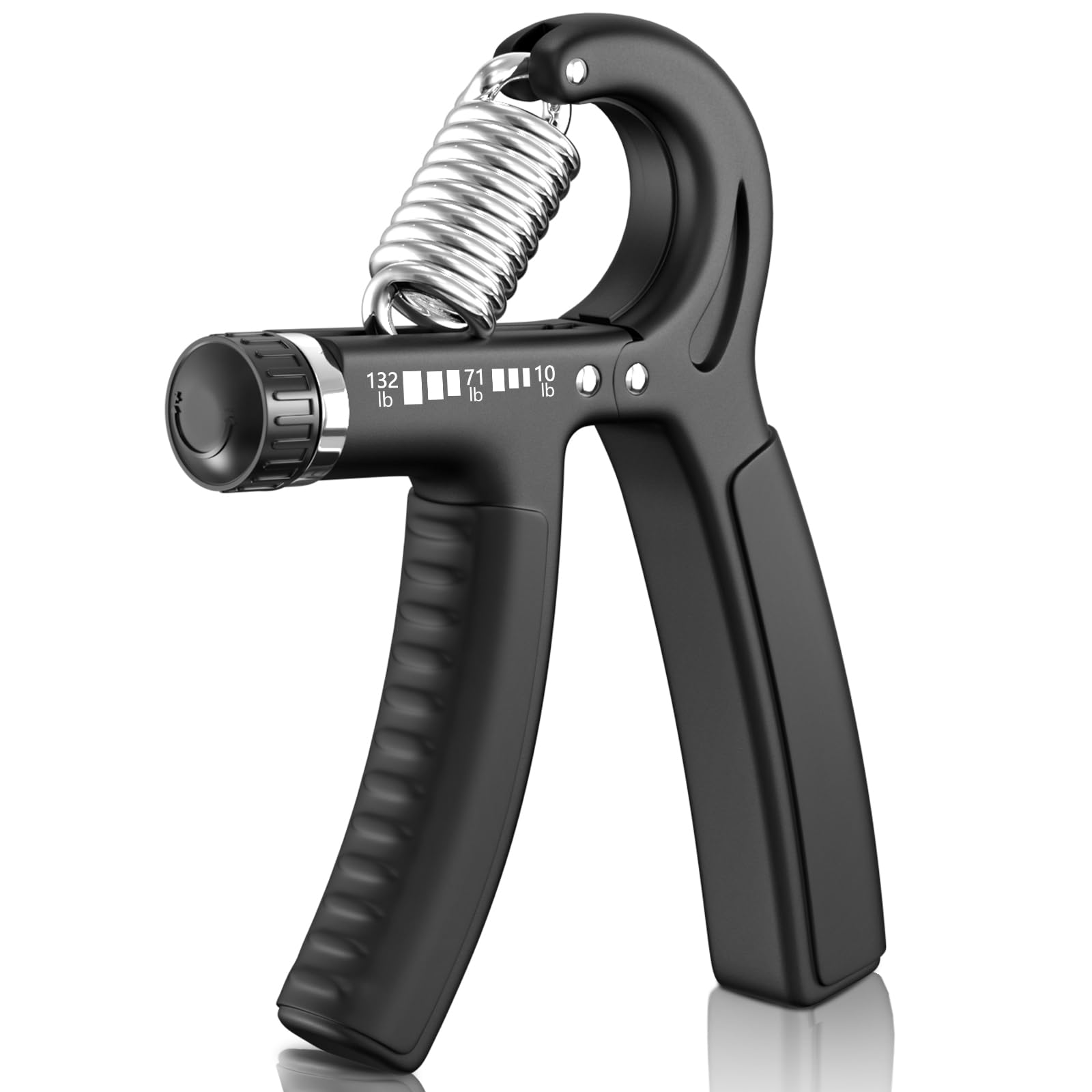
At 140 g and a little over six inches long, the NIYIKOW disappears into a jacket pocket or a desk drawer, and the resistance runs from 22 lb to 132 lb on a twist dial. That is a genuine beginner-to-intermediate span for the least money in this group, which is why it ends up in cars and cubicles.

The build is honest about what it is: plastic body, metal spring, a dial that steps up as you turn it. Nothing about it feels premium and nothing about it needs to. The dial does the one job an adjustable gripper has to do, which is let you start light and add load without buying a second tool — and it's comfortable enough in the hand to use while you're watching something.

The spring is the part to watch. On plastic-bodied adjustable grippers the failure is sudden rather than gradual — a snap mid-rep rather than a slow loss of tension — and it tends to arrive after months of use at the top of the range. Keep this one in the middle of its range and treat 132 lb as somewhere you visit. As a first gripper, or a second one for the office bag, it earns its place.

Bottom line: The gripper we tell beginners to buy: twenty-two to 132 lb on a dial, light enough to carry anywhere, and inexpensive enough that an abandoned one isn't a loss.

#6

FitBeast Adjustable Grip Trainer

FitBeast Adjustable Grip Trainer

Rehab and beginners

Our Score 9.2/10
Check Price

Worth Noting

  • Printed resistance numbers are approximate
Weight
5.64 oz
Dimensions
6.2 x 4.5 in
Resistance Range
10–132 lb
Read the full review

Ten pounds is the lowest starting point in this group, and that alone earns the FitBeast a place here. This is the adjustable gripper we point to for a hand coming back from surgery or for someone who has never trained grip at all: it runs 10–132 lb on a dial, weighs 160 g, and costs almost nothing, so there's no reason to put off starting.

Two things to know. The numbers around the dial are a rough guide rather than a scale, so set it by feel and by reps instead of by the figure. And the plastic body has a ceiling — grippers like this can let go at maximum resistance, so keep it in the lower and middle part of its range and move to metal when you outgrow that. Used that way, it's the least intimidating tool here.

Bottom line: The one to start with after an injury or a long layoff: ten pounds of resistance at the bottom, a dial to grow into, and very little money at risk.

#7

IMENSEAS 7-Pack Kit

IMENSEAS 7-Pack Kit

Varied routines

Our Score 9.0/10
Check Price

Worth Noting

  • Gripper tops out at 88 lb
  • Finger stretchers run small
Pieces
7
Finger Stretchers
6.6–11 lb per finger
Gripper Resistance
22–88 lb
Read the full review

Seven pieces in one bag: an adjustable gripper rated 22–88 lb, three finger stretchers from 6.6 to 11 lb per finger, plus a grip ring and a stress ball. It covers both directions of hand work — closing the hand and opening it — which is more than most grippers here attempt.

The stretchers are the part worth having. Grip training is mostly about closing, and the muscles that open the fingers get ignored; banding the fingers and pushing out is a useful counterweight, especially for anyone who types all day or spends their evenings on a climbing wall. The variety also keeps a routine from going stale, which matters more than it sounds for a tool you're meant to pick up daily.

The ceiling is the catch. The gripper here has the lightest adjustable maximum in this group, so a halfway serious trainee will outgrow it within a few months and want a second tool. Buy the set for variety and for the extension work, and expect to add a heavier gripper later rather than replace this one.

Bottom line: A good first kit for someone building a routine rather than chasing a number: seven tools, both directions of movement, and a gripper that will need replacing before the stretchers do.

#8

Pnrskter Hand Grip Set

Pnrskter Hand Grip Set

Light rehab

Our Score 8.8/10
Check Price

Worth Noting

  • Finger rings run small for adult hands
  • Rubber is stiff even in the light set
Weight
3.2 oz
Material
Silicone
Kit Contents
3 finger stretchers, 3 hand grips
Read the full review

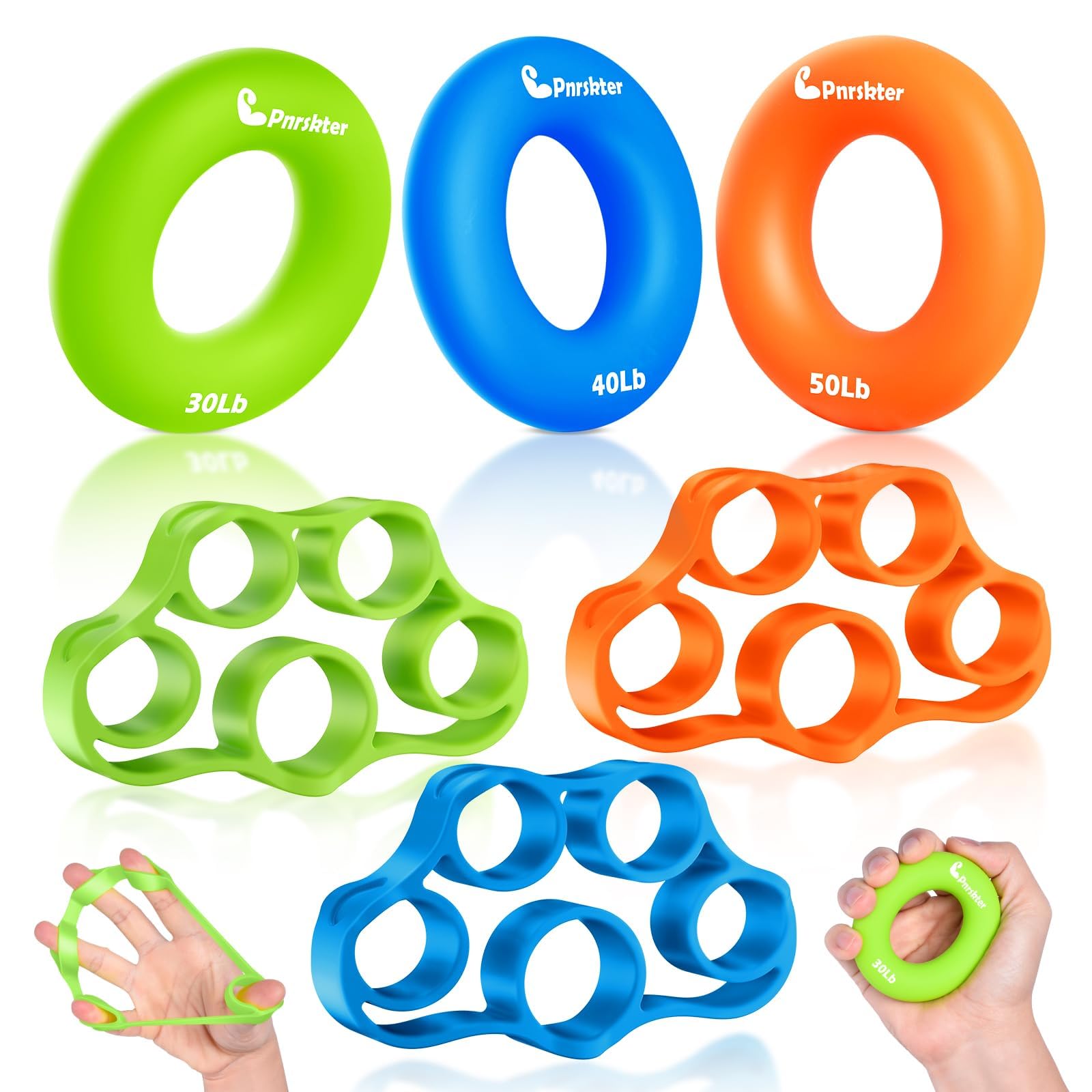
This is the least expensive way here to get both halves of grip training: three silicone hand grips for squeezing and three finger stretchers for opening. As a light rehab kit for smaller hands it does the job, and it costs little enough that trying it isn't much of a decision. If you wear large gloves, look elsewhere.

The silicone wipes clean, which matters more than it sounds when the set gets shared or lives in a bathroom drawer. Durability is the trade at this price — the rings are the first thing to go, and a tear takes one out of the set. Treat it as a starter kit that will need replacing rather than equipment you'll keep for years.

Bottom line: A cheap, honest starter set for light rehab and smaller hands — buy it to find out whether finger training suits you, not to train hard for years.

How We Tested 16 Grip Strengtheners

We started with a long list of roughly 40 models pulled from retail listings and training-forum threads, then narrowed by design type — fixed spring, adjustable dial, and the ones that open your fingers as well as close them — along with stated tension range, handle material, and whether replacement springs were sold separately. Customer reviews did most of the filtering: cracked plastic collars, springs that went soft within weeks, handles too wide for smaller hands. That left 16, from pocket-size units to full-handle trainers.

Testing ran four months. Every model went into rotation where people actually use them: one at a desk during calls, one in a kitchen drawer, one in a gym bag between sets, one on the coffee table during commercials. At the start and again at the end, we hooked each handle to a luggage scale and pulled until the arms closed to see whether the printed tension matched reality — the spread was wide enough that most labels were close to meaningless.

Comfort and texture caused the most argument. Five of us with noticeably different hand sizes squeezed everything, noting whether the handle sat in the palm or dug into the webbing, whether the knurling bit into calluses, and how the grip felt after 20 reps rather than two. We tallied reps to failure on each hand so progress was measured rather than guessed, and we counted squeezes on the two most-used units to catch springs that faded early. Two models spent a week on a sunny dashboard; one collar cracked.

The finger stretchers got their own check — whether the bands held their shape after a month and whether the loops stayed put (three didn't). Anything that seized, broke, or stopped adjusting went back in the box with a note taped to it.

How to Choose Grip Strengtheners

Adjustable or fixed resistance?

Dial grippers let you creep up in small steps, which suits anyone starting out or coming back from a layoff; the FitBeast single bottoms out at 10 lb for exactly that reason. Fixed grippers such as the Captains of Crush and the Logest set delete the mechanism entirely, and that is a durability argument as much as a training philosophy.

There's a trap in the dial: the numbers printed on a plastic gripper are approximate, and 132 lb on one tool isn't the same effort as 132 lb on a rated coil. Set the load by feel. If you can't close it cleanly for a set, back it off a notch.

Squeezing is only half the job

Every gripper here trains the muscles that close the hand. The small muscles that open the fingers get far less attention, which is why the kits with bands and rings earn a place. If you type all day, climb, or play an instrument, the extension work is the part that keeps the hand feeling even.

The IMENSEAS kit and the Pnrskter set both cover it, but neither of their grippers is the strongest here, so treat them as a supplement to a proper gripper rather than a replacement for one.

Fit your hand, not the photo

Handle span matters more than most listings admit. A gripper sized for a large palm is miserable in a small one, and the reverse is just as true. The GD Iron Grip adjusts handle width across three positions, which is the only real answer to this in the group; for everything else, the practical fix is choosing a compact tool or adding a glove.

Aggressive knurling is the other fit question. The Captains of Crush and the Logest grippers bite hard on bare hands, so budget for chalk, tape, or a pair of work gloves if you plan long sets.

What actually breaks

Springs. On the plastic-bodied adjustable grippers, the failure is a snap at high resistance rather than a slow fade, and it tends to arrive after months of use rather than on day one. That doesn't make them bad value — most people never reach the top of the range — but a cheap gripper bought for maximum settings is money badly spent.

Buy metal if you intend to train heavy, and check the spring and pin area on anything that has sat in a drawer before you load it.

Frequently Asked Questions

Final Verdict

If you want one gripper that will still be useful when 26 lb feels easy, we point you to the GD Iron Grip: twelve steps, a metal frame, and handles that adjust to small hands as well as large ones. It costs more than everything else here, and it's the only pick that won't need replacing as you get stronger.

The NIYIKOW is the sensible alternative if you're not sure grip work will stick — it does the basic job for far less, tops out at 132 lb, and its spring is the part to watch. Start there if you're testing the habit; buy the GD if the habit is already there.