Strength & Weights

Best Adjustable Dumbbells of 2026

A rack of hex dumbbells is the honest way to train — nothing to adjust, nothing to jam — but it swallows a wall of your garage, and the pairs you actually reach for are the same four over and over. Adjustable sets promise to collapse that wall into a couple of square feet of floor space. The catch is that some of them feel like gym equipment and some feel like a science project, and you genuinely cannot tell which from the product photos.

I've lifted at home for years, first in the corner of a living room and later in a garage with rubber mats, and I've learned that the number stamped on the side matters less than how the dumbbell feels at rep twelve. My team and I have spent the past eight months living with 10 sets — pressing, rowing, and re-racking them through full training blocks — and the gap between the good ones and the frustrating ones shows up in the first week. The picks below are the ones that stayed loaded.

#1

Eisenlink 50 lb Pair

Top Pick
Eisenlink 50 lb Pair

Tray-free floor space

Our Score 9.4/10
Check Price

Worth Noting

  • Slower to change than a dial set
  • Thick grip suits larger hands
Locking
Threaded bolts, no tray
Footprint
11.2"L x 7.2"W x 7.2"H
Increments
5 lb
Weight Per Hand
10 to 50 lb
Read the full review

Nothing in this design needs a base, and that's the reason it earns a place here. The plates are square and interlock, a bolt at each end holds the stack, and when a set is done you can put the dumbbell on the floor, on a step or on the seat of a chair. In a garage where the bench moves around, or a living room with no permanent gym corner, that freedom is worth more than a one-second changeover.

Each dumbbell runs from 10 to 50 pounds in 5-pound steps, with a couple of 2.5-pound plates in the box for trimming. At 11.2 by 7.2 by 7.2 inches they're compact for the load, the plates seat with a snap rather than a wiggle, and the square profile means they don't roll off a bench. Nothing rattled at working weight for us, which is more than we can say for every set here.

Five-pound steps are the compromise: going from 30 to 35 in one jump is fine for rows and split squats and coarse for lateral raises. Straight sets don't care. If you superset and drop-set, a dial set will keep you moving faster, and that's the honest reason to look elsewhere.

Bottom line: We point to this one when there's nowhere to dock a tray: square steel plates, 50 pounds a hand, and nothing to line up.
#2

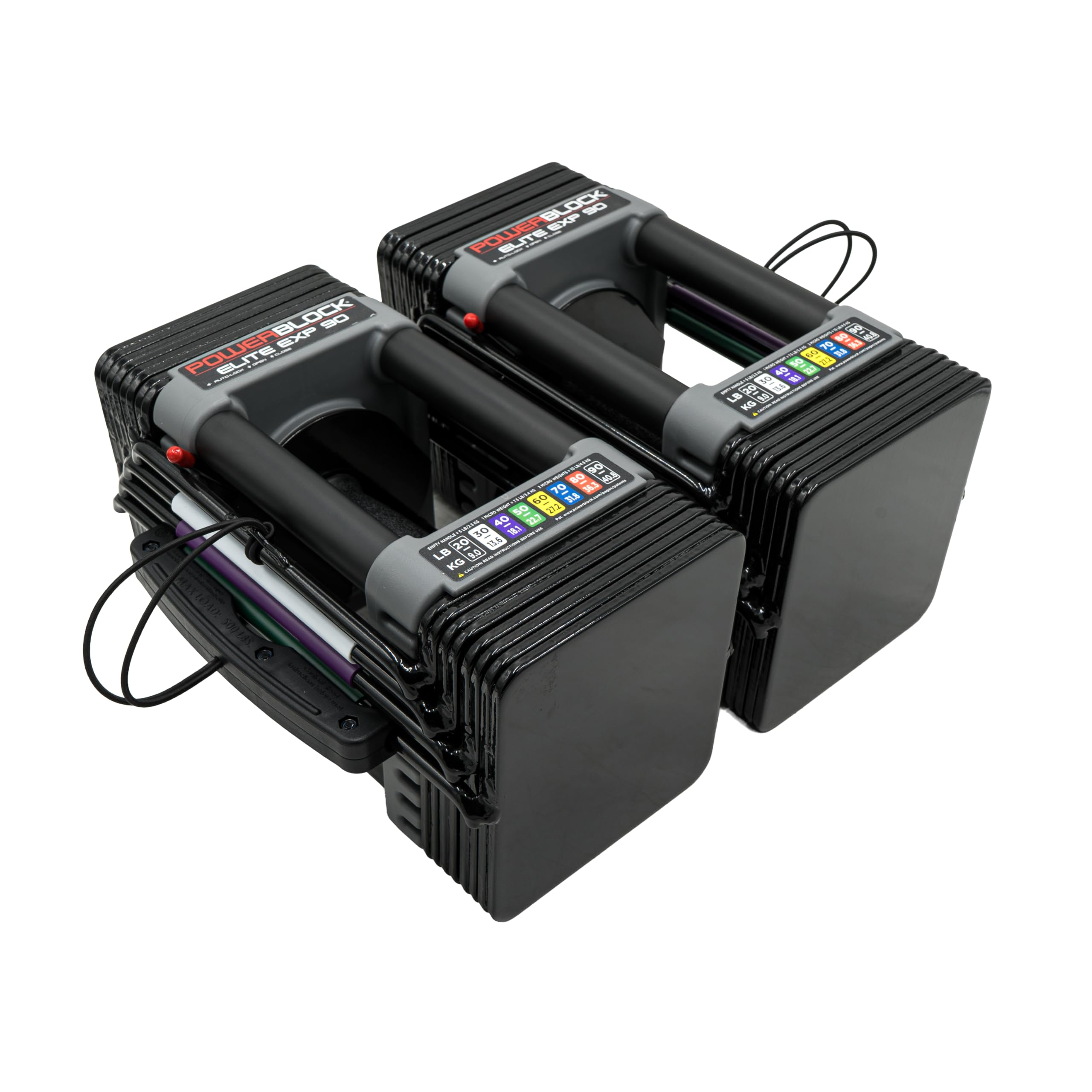
PowerBlock Elite EXP 90

PowerBlock Elite EXP 90

Small home gyms

Our Score 9.2/10
Check Price

Worth Noting

  • Block shape shifts balance at heavy settings
Expansion
Kits to 70 and 90 lb
Footprint
12"L x 6.25"W
Increments
2.5 lb micro weights
Weight Per Hand
5 to 50 lb
Read the full review

A pair of dumbbells that stops at 50 pounds is a pair you eventually outgrow, and the Elite EXP is the only set here with an answer to that. Stage 2 and Stage 3 add-on kits take each hand to 70 and then 90 pounds, so what you spend now isn't spent again in eighteen months. In between there are 16 settings from 5 to 50 pounds, including 2.5-pound micro weights — the small jump that decides whether an overhead press session is a set or a stall.

Weight selection is a magnetic pin through the handle, and it doesn't need the dumbbell docked in a tray to work. We moved from a warm-up to a working set without breaking stance, which in a small room is worth more than it sounds. The whole stack measures 12 by 6.25 inches and stands in for 16 pairs, and the rubberized handles stay comfortable through a full session.

The shape is the trade. These are rectangular stacks rather than round bells, so the mass sits further forward in your hand than it does on a traditional dumbbell, and adding micro weight shifts the balance again. We noticed it most on close-grip presses and curls and stopped noticing it on rows, squats and anything overhead. Against the rest of this group, that's a small price for the widest expandable range and the smallest footprint here.

The five-year limited warranty is the longest of the sets we cover, and the powder-coated steel has no plastic cradle to crack. If you want round dumbbells in your hands, or you only ever train at one weight, this isn't the pair. If you plan to still be lifting in three years, it's the one that grows with you.

Bottom line: We think it's the set to buy if you're buying once: 5 to 50 pounds a hand, kits to 90 later, and the smallest footprint in this group.

#3

Rendpas 80 lb Set

Rendpas 80 lb Set

Heavy strength work

Our Score 9.2/10
Check Price

Worth Noting

  • Long body at the heavier settings
  • Docking needs careful alignment
Settings
16
Footprint
17.44"L x 8.98"W
Increments
5 lb
Weight Per Hand
5 to 80 lb
Read the full review

Eighty pounds per hand is the number that separates this set from everything else we cover. It runs from 5 to 80 in 5-pound steps across 16 settings, and the dial only turns while the dumbbell is seated in its tray — a deliberate lock that stops you changing weight mid-rep with a loaded bell over your head.

Heavy rows, Romanian deadlifts, split squats and walking lunges are where it makes sense, and the knurled steel handles hold their grip at the top end. What we noticed is the length. At the heavier settings the dumbbells grow, and in a Romanian deadlift the two ends come close enough to touch at the bottom of the rep. That length is also awkward for close-grip pressing, which is not what this set is for.

The tray is 17.44 by 8.98 inches and made of PP, so it spares a wood floor; the whole set weighs about 160 pounds and wants a permanent spot rather than a shelf. Docking takes a moment of lining up, since the dial won't release if the dumbbell sits at an angle. And the 5-pound jumps are coarse for shoulder work — this is a set for the big lifts.

Bottom line: If your rows have outgrown 50 pounds, this is the pair we hand you: 80 pounds a hand in 5-pound steps, changed with a dial in the tray.

#4

Amazon Basics 38 lb Set

Amazon Basics 38 lb Set

Tight budgets

Our Score 9.2/10
Check Price

Worth Noting

  • Caps at 19 lb per hand
  • Chrome can flake at the threaded ends
Plates
Four 2.5 lb, four 5 lb, four 0.5 lb
Storage
Hard case with handle
Set Weight
38 lb
Handle Diameter
1 in
Read the full review

A black plastic case with a carry handle is the detail that makes this set livable. Every plate, both handles and all four collars go back in the box, the box goes on a shelf or under a bed, and nothing is left on the floor to trip over. In a shared apartment or a dorm room, that isn't a small thing.

Inside are two 3-pound handles, four 5-pound plates, four 2.5-pound plates and four 0.5-pound collars, threaded so the plates spin on and lock down. Assembly takes a minute or two the first time and seconds after that, and the 1-inch handles are the diameter most people already expect in their hands.

The knurling is sharp — sharp enough that long sets want a pair of gloves, and that is the whole fix. Otherwise this feels like hardware rather than a fitness product, which we mean as a compliment: steel plates, metal collars, nothing proprietary to lose.

As a first set it earns its place. It's complete enough for a full arm and shoulder session, tidy enough to keep in a cupboard, and cheap enough to try without much thought. Buy it to start, not to finish.

Bottom line: The cheapest way into adjustable weights here, and the case makes it livable — we recommend it for a first set, not a last one.

#5

Lifepro 25 lb Pair

Lifepro 25 lb Pair

Small spaces

Our Score 9.2/10
Check Price

Worth Noting

  • Large grip for smaller hands
  • Selector dial can bind between settings
Footprint
13.6"L x 6.7"W
Increments
2.5 lb
Handle Diameter
1 in
Weight Per Hand
5 to 25 lb
Read the full review

Twenty-five pounds per hand is where this set ends, and that single figure decides whether it's for you. As a primary strength set it isn't. As the pair you keep beside a desk, in a spare room or in a cupboard by the sofa, the small footprint and 2.5-pound steps make far more sense than a rack of light fixed dumbbells.

The dial moves in 2.5-pound steps from 5 to 25, and the tray that holds the unused plates doubles as the stand — one object, roughly 13.6 by 6.7 inches, on the floor. We found the changeover clean and the plates sat tight in the tray, and the alloy steel build has a smooth finish that doesn't look out of place in a living room.

The joint where the plates meet the handle is the part to keep an eye on: on a set that lives in a closet and comes out twice a week, check everything is seated before you load it overhead. Nothing about the construction feels improvised, but this is a lighter-duty build than the sets above.

What it does well is make light training convenient — 2.5-pound jumps for a shoulder program, a tray that keeps plates off the floor, a footprint you can walk around. What it can't do is grow. If your pressing is already past 25 pounds a hand, spend your money on one of the sets above instead.

Bottom line: We keep it for light work in a tight space: 2.5-pound steps to 25 pounds a hand in a footprint you can walk around.

#6

NordicTrack Select-A-Weight 55

NordicTrack Select-A-Weight 55

Fine weight steps

Our Score 9.0/10
Check Price

Worth Noting

  • Selector can jam between settings
Settings
15 per dumbbell
Handlebar
10 lb, usable alone
Increments
2.5, 5 and 10 lb
Weight Per Hand
5 to 55 lb
Read the full review

Ten pounds is what each bare handlebar weighs, and it works on its own. Pick it up and do lateral raises or a warm-up without touching a plate. That turns out to be more useful than it sounds: it's the lightest honest setting in the set, and in a household with two lifters of different strength it doubles what one pair can do.

Fifteen settings per dumbbell run to 55 pounds in 2.5, 5 and 10-pound steps, and the fine steps are the point — adding 2.5 pounds to an overhead press is how you actually get stronger. The selector is where our enthusiasm cools. The slider and pin can jam between settings if the dumbbell isn't sitting square in its tray, and a pin that hasn't seated fully is a plate waiting to drop. Check it before every lift.

The molded trays carry clear weight markings, which sounds like nothing until you're mid-session and want the same setting on both sides. The warranty runs two years, shorter than the PowerBlock's. For the outlay we wanted a mechanism with fewer moving parts, and we didn't get one.

Bottom line: We recommend it when 2.5-pound steps matter more than top-end load: 55 pounds a hand, changed fast, with a handlebar you can lift alone.

#7

Core Fitness TwistLock 50

Core Fitness TwistLock 50

Quick one-hand changes

Our Score 9.0/10
Check Price

Worth Noting

  • Plates can catch in the cradle above 35 lb
Warranty
2 year parts
Footprint
14.5"L x 7.9"W
Adjustment
TwistLock, one hand
Weight Per Hand
5 to 50 lb
Read the full review

Twist the handle and the weight changes; that's the whole idea, and it's the quickest changeover in this group. One hand does it, the dumbbell stays in its cradle, and you can move through a pyramid without breaking rhythm. For anyone training in twenty-minute windows, that speed is the feature that matters most.

The pair runs 5 to 50 pounds with a contoured, textured handle and flat ends. Flat ends are quietly useful for chest presses and for resting the dumbbell on your thigh before a set, and we liked how stable that made the setup. The footprint is 14.5 by 7.9 inches and the aluminium handle feels solid rather than plasticky.

Above about 35 pounds the plates can catch in the cradle on the way out, and the lift needs to be straight rather than angled. That's a habit rather than a fault, but it's why this sits below the picks above. The two-year parts warranty is the other thing to weigh against a five-year one.

Bottom line: The fastest weight change here, in a compact body — we keep it on the list for short, dense sessions.

#8

UNNMIIY 45 lb 5-in-1

UNNMIIY 45 lb 5-in-1

Full-body circuits

Our Score 8.8/10
Check Price

Worth Noting

  • Bulky and long at heavier settings
Plate Fill
Cement and iron sand
Configurations
Dumbbell, barbell, kettlebell, push-up stand
Handle Diameter
24 mm
Weight Per Hand
22.5 lb
Read the full review

The connector bar is why this made the list. Screw the two dumbbell handles together through the padded sleeve and you have a barbell for rows, curls and floor presses; fit the kettlebell handle and you have a swing weight. Nothing else here changes shape like that, and for someone starting from zero it replaces a shelf of single-purpose gear.

The plates are cement and iron sand in a polyethylene shell rather than cast iron, the handles are 24 mm with a non-slip texture, and the locking nuts are thicker than the ones on the flimsiest plate sets. Each dumbbell tops out at 22.5 pounds, which is the figure to hold onto — the 45 in the name is the pair, not the hand.

That ceiling is fine for circuits, rehab, lunges and high-rep work, and thin for pressing. Length is the other thing: assembled at the heavier settings the dumbbells run long, and close-grip work gets crowded. It's the line we draw when someone asks whether this is a starter set or a strength set, and it's a genuinely good starter set.

Bottom line: We like it as a first full-body kit: one box that becomes dumbbells, a barbell, a kettlebell and push-up stands.

How We Tested 10 Sets of Adjustable Dumbbells

We started with roughly 30 sets sold in the U.S. and cut anything with a ceiling under 50 pounds per hand, fewer than five weight increments, a mechanism that required two hands, or a price per pound that made a used rack look like the smarter buy. That left 10 sets, running from budget dial styles to plate-loaded pairs that cost as much as a decent barbell.

Testing ran eight months, mostly in a garage gym with rubber flooring and a bench, plus a stretch in a spare bedroom to see how each set handled carpet, a narrow doorway, and a closet shelf. Every set went through the same sessions: a timed weight change with one hand, first dry and then with sweaty palms right after a set of rows; a dumbbell press and a split squat to watch whether plates shifted at lock; a bent-over row re-rack to see if the cradle tipped; and a slow set of curls at the top increment to listen for rattle.

We weighed each dumbbell on a kitchen scale against its stamped number — plenty of sets run heavy or light — and noted which ones hung evenly in the hand and which dragged to one side. Grip was judged by handle diameter and knurling across a whole session, dry to slick. Twice we dropped pairs from bench height onto the mats to see what cracked. And we kept running notes on storage: whether the tray slid under the bench, held the plates when tipped, and could be carried across the room without shedding weight.

How to Choose Adjustable Dumbbells

Read the Weight Per Hand, Not the Set Total

A 38-pound set is two 3-pound handles plus plates, so each hand carries about 19 pounds at full load. A 50-pound pair means 50 pounds per hand — a completely different product wearing a similar name. Work out your ceiling from your strongest movement rather than your weakest: pressing overhead tops out lower than rows and Romanian deadlifts, and a set bought for pressing will run short on back day.

Fifty pounds a hand covers most home lifters for years. Twenty-five pounds a hand is a light set however it's marketed, and if you're already pressing bodyweight for reps you'll pass it in a season.

Decide How Often You Change Weight

If your sessions are straight sets, a threaded set that takes half a minute to change costs you almost nothing. If you drop-set, superset or train in twenty-minute windows, a dial or magnetic pin that changes in a second is worth paying for. Every set here falls into one of those camps.

The pattern worth knowing: the fastest mechanisms have the most parts, and the parts are what wear. A threaded bolt has almost nothing to fail; a selector with a sliding pin has more to check before every lift.

Trays, Bases and Floor Space

Most dial sets change weight only while docked in a tray. That's a good safety rule and an extra object in the room, and the tray has to sit somewhere flat and permanent. Footprints run from roughly 12 by 6 inches to more than 17 by 9, so measure the spot before you order rather than after.

If your training space doubles as living space, a tray-free set such as the Eisenlink — square plates on threaded bolts — can be set down anywhere and carried between rooms with no base to follow it.

Shape and Length at Working Weight

Round dumbbells sit in the hand a particular way, and most adjustable sets don't stay round. Rectangular stacks push the mass further from your wrist, which shows up on curls and close-grip pressing. Handle diameter matters too: 24 to 25 mm suits most hands, and a 1.4-inch grip will feel like a barbell to anyone with smaller hands.

Length grows with load. At 80 pounds a set can be long enough that both ends almost meet at the bottom of a deadlift, and long dumbbells crowd a bench setup. Check the length at your top weight against the space you actually lift in.

What Wears First

Threaded collars work loose, chrome flakes at the thread tips, plastic cradles crack and selector pins jam. None of that happens to every set, but it tells you what to inspect: seat the pin or collar fully every time, and give the mechanism a look before you load it overhead.

Warranty length is a reasonable guide to how much faith a maker has in its own mechanism. The sets here run from two years to five, and the longest belongs to the set with the fewest moving parts.

Frequently Asked Questions

Final Verdict

Buy the PowerBlock Elite EXP 90 if you want one set to carry you: 5 to 50 pounds a hand now, 90 later, in the smallest footprint in this group. The trade is shape — rectangular stacks rather than round bells — and it's a trade we're happy to make.

If you lift in a garage with nowhere to dock a tray, the Eisenlink is the one to look at: steel plates, no base, 50 pounds a hand. And if your rows have already passed 50, the Rendpas goes to 80.