Recovery

Best Peanut Massage Ball of 2026

A peanut massage ball is two firm spheres joined at a narrow waist, and that groove is the whole point — it straddles your spine or a calf instead of grinding straight over it. What separates a good one from a dud isn't visible in a product photo: the density, the width of the gap, the grip on a wood floor, whether it buzzes. I've spent four months rolling out 14 of them, from cheap rubber two-packs to rechargeable vibrating versions, and the gap between best and worst showed up within a minute of the first test.

The right one solves a very specific problem — the spot between your shoulder blades you can't reach, the calf that seizes after a run, the low back that stiffens by mid-afternoon. Here's what first-time buyers get wrong: the hardest, most painful ball isn't the one that helps most. Too firm or too big and you flinch away from the knot you were trying to reach; too soft and nothing happens. Below are the ones that got that balance right, across a range of sizes, densities, and budgets.

#1

RAD Original Peanut Massage Ball

Top Pick
RAD Original Peanut Massage Ball

Neck and spine

Our Score 9.2/10
Check Price

Worth Noting

  • Premium price for a simple roller
Weight
12 oz
Density
Medium
Material
Silicone
Dimensions
6 x 2.5 x 2.5 inches
Read the full review

The RAD is the ball we reach for when the skin needs a little grip rather than maximum hardness. Its silicone surface has more traction than smooth rubber, and the medium density lets us settle onto a tight neck muscle without the ball shooting sideways. At six inches long and 12 ounces, it is still a one-hand tool, but it feels more deliberate than the basic rubber peanuts.

The shape is built for the strip beside the spine, and the slight give makes it more forgiving on the neck and upper back. We found that useful on days when a harder ball felt like too much before we had warmed up. It is also the better choice if you work directly on skin: the silicone holds its place, where rubber can slide or drag.

The trade-off is firmness. If you want the hardest pressure for glutes or feet, the 5BILLION or SIMPLECOOL gets you there faster; the RAD's give is the point on the neck, less so on a stubborn glute. For someone whose main complaint is upper-back tightness, that is an easy trade.

Bottom line: We choose the RAD when neck and spine work is the priority, because its grippy silicone and medium density make precise pressure easier to control.

#2

Rolling With It Vibrating Peanut Ball

Rolling With It Vibrating Peanut Ball

Powerful vibration

Our Score 9.2/10
Check Price

Worth Noting

  • Premium price for a powered ball
Weight
2 lb
Battery
Rechargeable lithium-ion
Dimensions
3.75 x 3.75 x 6.75 inches
Vibration Speeds
4
Read the full review

This is the pick when a static ball is not enough. The Rolling With It adds four speeds of vibration to a 6.75-inch peanut body, and the motor has enough punch that we could feel the work through a thigh without leaning our full weight into it. It is a powered recovery tool, not a ball you roll casually while watching television.

The 2-pound weight is the trade-off. It stays planted under a hamstring or along the lower back, which we appreciated on the floor, but it is noticeably more to pack than the manual picks. The four speeds cover a useful range, from a gentle buzz to a strong, almost chair-massager feel; the highest setting is not a starting point for a sore neck.

Battery life is rated for up to an hour and the tool is rechargeable, so there is no disposable battery to hunt down. That is enough for a session or two, but it does mean another device to charge. We also missed the instant control of a static ball: when you want to stop, you have to find the button.

If vibration helps you relax into a tight spot, the extra weight and charging routine are worth it. If you want the simplest possible tool, stay with the 5BILLION. The Rolling With It is for the buyer who wants the motor to do some of the work.

Bottom line: The Rolling With It is our pick for powerful, hands-off vibration, as long as you accept a heavier tool and another battery to charge.

#3

Sports Medica Peanut Massage Ball

Sports Medica Peanut Massage Ball

Foot work

Our Score 9.2/10
Check Price

Worth Noting

  • Center joint can shift under hard pressure
Firmness
Firm
Included
Workout guide
Material
Latex-free high-density
Read the full review

The Sports Medica is the one we reach for under a foot. The rounded ends fit an arch better than a broad roller, and the light, latex-free build makes it easy to work seated without fighting a heavy tool. It is not the most precise ball here, but for foot and calf work it is a useful shape.

The double-ball form gives you a channel for the Achilles or the side of the calf, and the surface is firm without the rock-hard bite of the SIMPLECOOL. We appreciated the workout guide as a small extra; it gives a buyer who has never used a peanut ball somewhere to start.

If feet are a recurring nuisance, that underfoot shape is worth the compromise; if you want one ball for the whole body, the 5BILLION is the better default. The Sports Medica is a focused tool, and it makes more sense as a second ball than as your only one.

Bottom line: We recommend the Sports Medica for foot and arch work, where its rounded ends and light build make controlled pressure easier.

#4

5BILLION Peanut Massage Ball

5BILLION Peanut Massage Ball

All-around use

Our Score 9.0/10
Check Price

Worth Noting

  • Smaller footprint needs more passes on broad areas
  • Rubber surface can grab clothing and hair
Weight
12.6 oz
Firmness
Firm
Material
Natural rubber
Dimensions
5 x 2.5 x 2.5 inches
Read the full review

The 5-inch double-ball shape is the reason this one wins a place at the top: it sits on either side of the spine instead of pressing on it. The natural rubber is firm, firmer than a tennis ball and without the hard-plastic bite of a knobby tool, and at 12.64 ounces it feels substantial without becoming a workout to hold. That combination makes it the easiest recommendation here for a first peanut ball.

We used it most on the upper back and along the feet, where the 2.5-inch balls can work a small area without skating away. The carry bag and short workout guide are modest extras, but they make it easy to keep the ball with a gym bag or under a desk. On a smooth floor, the rubber has enough grip to stay where we put it; that same grip is why a quick wipe after use is worth the trouble.

The size is the main thing to weigh. Those 2.5-inch balls are smaller than some people picture, and if you want a broad, gentle roll over the whole back, the eight-inch TriggerPoint is easier. Around the spine and neck, the smaller footprint is exactly the point: it lets you work the muscles beside the vertebrae without the ball wandering into bone.

Nothing here needs charging, pairing, or a second person. We kept it by the couch and threw it in a bag without thinking about it, which is the highest compliment for a tool this simple. For most people, that combination of firm pressure, useful shape, and no upkeep is the whole purchase.

Bottom line: The 5BILLION is our default pick: firm, simple, and shaped to work beside the spine without charging or fuss.

#5

TriggerPoint Universal Double Massage Ball

TriggerPoint Universal Double Massage Ball

Large muscles

Our Score 9.0/10
Check Price

Worth Noting

  • Too large for neck and foot work
Weight
11.8 oz
Surface
Textured
Material
EVA foam
Dimensions
8.66 x 5.31 x 8.27 inches
Read the full review

The TriggerPoint is not a pocket ball. Its eight-inch textured body is closer to a short foam roller, and that is exactly why it earns a place: it covers the glutes, quads, and broad back in fewer passes than a five-inch peanut. The 11.84-ounce EVA foam is firm enough to press into a muscle but has a little more give than hard rubber.

We liked it for floor work after a workout, when a larger surface made the job quicker. The channel down the middle still lets it sit beside the spine, and the textured pattern gives the surface a grip that smooth foam lacks. The shape is also water-resistant and easy to wipe down, which matters for a tool that spends time on the floor.

The firmness is the deciding point. It has more give than the hard-rubber balls, which makes it easier to settle into a glute without a sharp edge, but it is not the tool for someone who wants maximum bite. The 5BILLION is firmer and more precise; the TriggerPoint is for coverage.

Bottom line: The TriggerPoint earns our recommendation for broad, textured work across glutes, quads, and the back.

#6

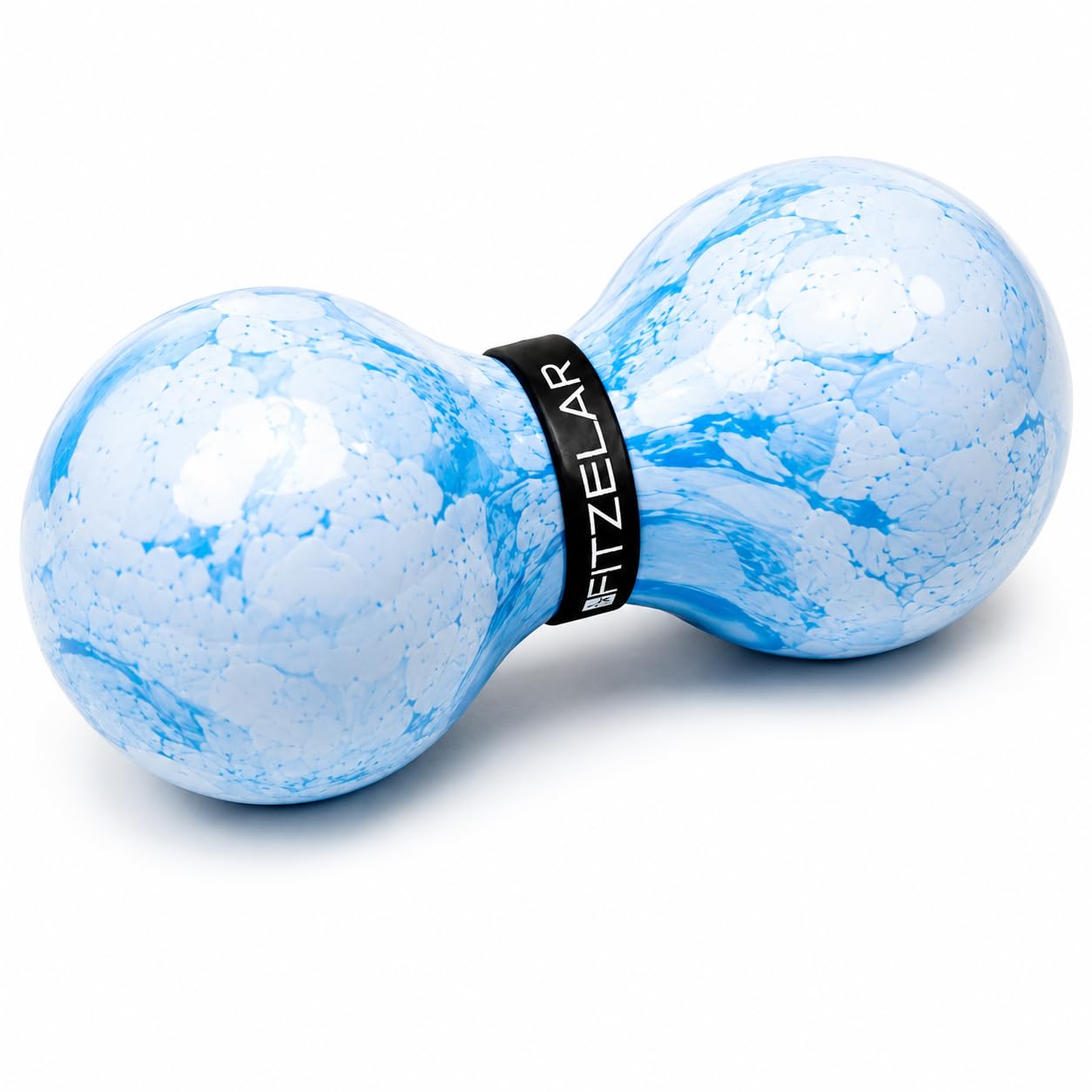
FITZELAR Double Lacrosse Massage Ball

FITZELAR Double Lacrosse Massage Ball

Firm budget pick

Our Score 9.0/10
Check Price

Worth Noting

  • Too firm for tender neck work
Weight
11.3 oz
Firmness
Moderate
Material
Natural rubber
Dimensions
5.12 x 2.56 x 2.56 inches
Read the full review

The FITZELAR is the closest thing here to the classic taped-lacrosse-ball setup, minus the tape. It is 5.12 inches long, 11.28 ounces, and made from natural rubber, with a moderate firmness that lands between a tennis ball and a golf ball. We found that a useful middle ground for someone who wants a firm ball without the extreme bite of the SIMPLECOOL.

The spacing is the important detail. The two balls sit close enough to bracket the spine but not so close that they pinch, and the rubber has enough grip to stay on a floor mat. It comes with a small bag, which makes it easy to keep with a yoga mat or in a gym bag. The shape is standard, so there is no learning curve.

The rubber has very little give, so the ball rewards controlled pressure; a wall is easier to start against than the floor. If you want a softer entry point, the RAD is more forgiving; if you want a firm, low-cost workhorse, this is the one.

We came back to it for feet and glutes because the firm edge gets through faster than the softer balls. It is not the most comfortable first peanut, but it is an easy one to keep using once you know how much pressure you like.

Bottom line: We recommend the FITZELAR as a firm, low-cost natural-rubber peanut for buyers who already know they like deep pressure.

#7

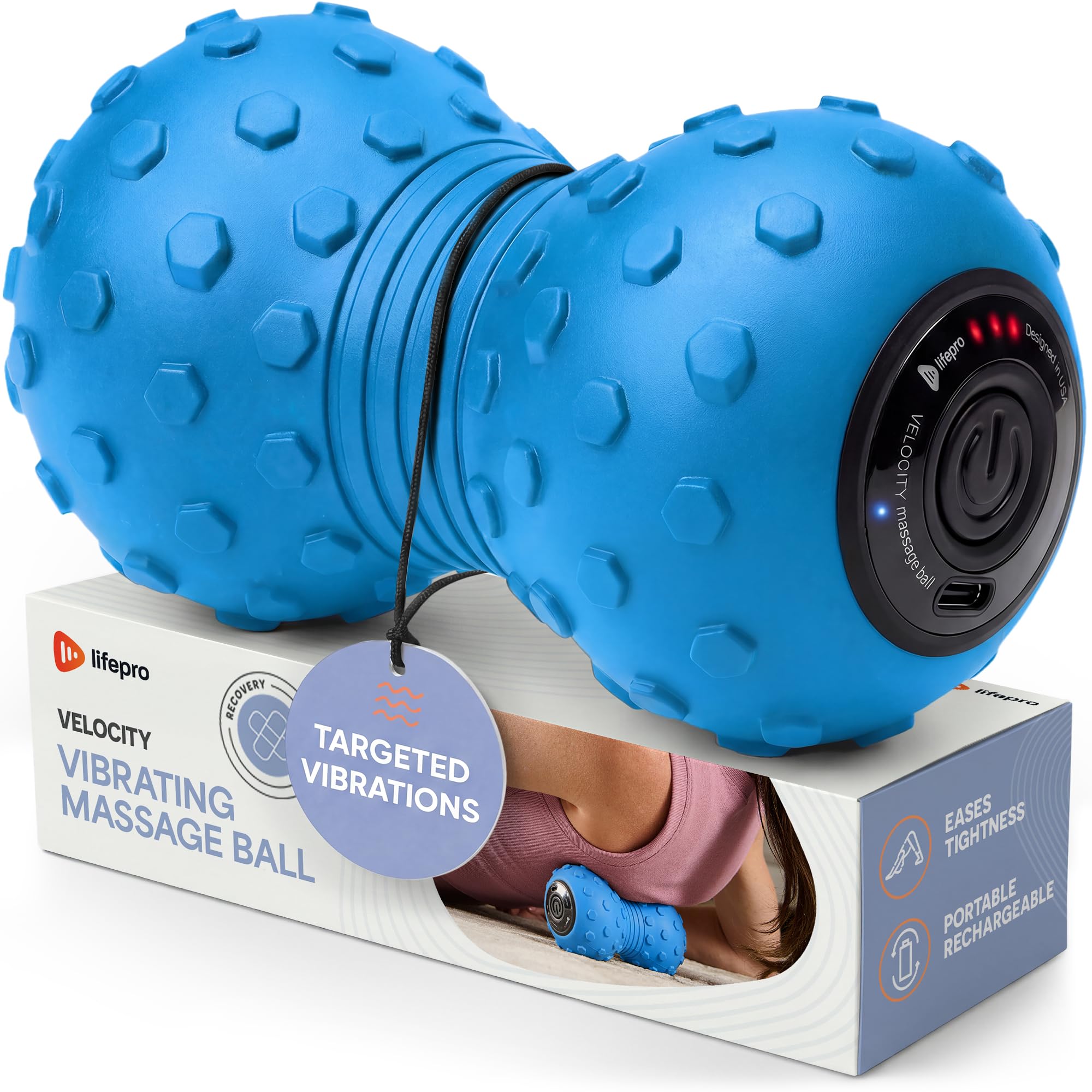
LifePro Velocity Vibrating Peanut Ball

LifePro Velocity Vibrating Peanut Ball

Budget vibration

Our Score 8.8/10
Check Price

Worth Noting

  • Battery may stop holding a charge
Weight
1.5 lb
Battery
Up to 2-4 hours
Dimensions
6.5 x 3.7 x 3.7 inches
Vibration Levels
4
Read the full review

The LifePro is the vibrating ball for someone who wants the extra movement without stepping up to the heaviest, most expensive model. At 1.5 pounds it is lighter than the Rolling With It, and its 6.5-inch body is easier to hold against a calf or thigh. The four vibration levels are strong enough to be useful, not just a token buzz.

We found the lighter weight made it easier to move around the body, though it also means the ball can wander when you press hard. The shape is a little longer and narrower than a classic peanut, which helps on legs and gets awkward in the tight space beside the neck. It is a good floor tool first, a neck tool second.

The four levels step through useful intensities, though the highest is more than we want on a neck. The 2-4 hour rating is enough for several short sessions, and the lighter body makes it easier to move from calves to hamstrings than the heavier Rolling With It. It is a simpler, less refined powered tool, and that is the point.

Bottom line: The LifePro Velocity is our lighter, lower-cost route into vibration, best for floor work and buyers who want to try the category.

#8

AllPlay Peanut Massage Ball Roller

AllPlay Peanut Massage Ball Roller

Travel

Our Score 8.8/10
Check Price

Worth Noting

  • Less firm than a true lacrosse ball
Weight
9.59 oz
Material
Thermoplastic rubber
Dimensions
5.51 x 2.36 x 2.36 inches
Read the full review

At 9.59 ounces, the AllPlay is the one that disappears into a bag. We noticed the low weight most when we moved from a floor session to a desk: it is easy to keep in a drawer and brings no rubber-tire smell with it. For travel or a small apartment, that counts for more than another degree of firmness.

The 5.51-inch length and 2.36-inch diameter make it a little longer and slimmer than the classic five-inch peanut. That helps along the calf or the side of the back, though it can feel less stable under a broad shoulder. The thermoplastic rubber surface is smooth and low-odor, and it resists the tacky feel some rubber balls get.

The low weight is the reason to buy it and the reason to think twice. It is easy to carry, but it also moves more when you lean hard, so you have to reset it more often. Keep it for travel and lighter pressure, or pair it with a heavier ball for deep glute work.

We came back to it for desk-side neck work, where a heavier ball feels like overkill. The AllPlay is for the person who wants a ball at the office, in a carry-on, or in a small drawer; it is not the one for maximum deep-tissue work.

Bottom line: The AllPlay is our travel pick: light, low-odor, and easy to keep in a bag, with moderate rather than maximum pressure.

#9

SIMPLECOOL Hard Peanut Massage Ball

SIMPLECOOL Hard Peanut Massage Ball

Extra-firm pressure

Our Score 8.8/10
Check Price

Worth Noting

  • Hardness is unforgiving on tender areas
  • Small surface needs precise placement
Weight
4.94 oz
Firmness
Hard
Material
TPR
Dimensions
2.68 x 2.52 x 4.8 inches
Read the full review

The SIMPLECOOL is the hard one. Its TPR shell has almost no give, and the 4.94-ounce body is small enough that all the pressure comes from how you position yourself. We found it best for glutes, the TFL, and the IT band, where a softer ball can bottom out before it reaches the tissue.

The non-slip texture is a real plus on a smooth floor. The ball stays put when you rotate over it, and the solid construction does not flatten under body weight. At 2.68 by 2.52 by 4.8 inches it is also compact enough to keep in a desk drawer, though the small surface area makes it fussy under a broad back.

This is not a beginner's ball. The hardness can feel sharp on the neck, and the small size means you have to be precise about where you place it. Start against a wall, keep your weight light, and use it for the large muscles that can take the pressure.

The small size also limits where it works. Under a hamstring or along the side of the back, it is easy to place; across the whole thoracic spine, it feels like a pinpoint tool.

For the right buyer, the lack of give is the feature: it delivers a clear, focused pressure that the softer balls blur. For everyone else, the 5BILLION or RAD will be easier to live with.

Bottom line: The SIMPLECOOL is the one we choose when a small, extra-hard ball needs to dig into glutes and IT bands.

How We Tested Peanut Massage Balls

We started by gathering every highly rated peanut ball we could find, then filtered that list for a spread of densities, diameters, gap widths, and prices, with a mix of plain rubber and vibrating models. From there we bought 14 and put them through four months of regular use. Testers of different heights and body types rolled on hardwood, thin carpet, and a gym floor, and we also worked each one standing against a wall, since that's how most people get at a back that's already sore.

Firmness was the first thing we logged. We pressed a thumbnail into each ball and noted how far it sank, then paid attention to whether we could hold a tight spot for a full minute or had to shift away. Size got checked against real anatomy — did the gap actually clear the spine, did the ball reach the muscles beside the shoulder blades, did it fit in a gym bag. For stickiness, we rolled each one across bare wood and watched whether it tracked straight or skittered out from under us.

On the vibrating models, we charged each to full, ran it on its highest setting until it died, and timed the result, then judged whether the power reached the muscle or just rattled the surface. Ease of use came down to small things: whether the ball stayed put when we repositioned, whether the buttons were reachable mid-roll, and whether it was quiet enough to use in front of the TV. Every tester kept a log of how they felt the next morning, since the real measure of pain relief is whether soreness eases without leaving a bruise, and we weighed what each ball cost against how often we actually picked it up. The picks below are the ones we kept reaching for once the novelty wore off.

How to Choose the Right Peanut Massage Ball

Firmness: Match the Ball to the Tissue

Firmness is a pressure setting, not a quality grade. A medium-density silicone ball such as the RAD gives you more time to breathe into a tight neck, while a hard TPR ball such as the SIMPLECOOL is better for glutes, IT bands, and feet, where you want a clear bite. If you are new to self-massage, start with a medium or firm-but-slightly-giving ball; the hardest ball in the group is rarely the easiest place to begin. We reach for the harder options only when we already know the tissue can take it.

Length and Diameter Decide Where It Works

Length and diameter decide where the ball can go. A five-inch peanut with 2.5-inch balls is the standard shape for the spine and neck; a longer 6.5-inch body can feel steadier on legs, while the eight-inch TriggerPoint covers glutes and quads fast but is too broad for precise neck work. Look at the gap between the balls, too. It should let you work on either side of the spine without pressing on the vertebrae. Small bodies suit feet and forearms; larger ones suit broad muscles.

Vibration Adds Convenience, Not Magic

Vibration adds movement and lets you apply less body weight, which can help if you tense up or want a hands-off session. It also adds weight, charging, and battery uncertainty. The Rolling With It is the more powerful, heavier choice; the LifePro is lighter and less expensive but has a battery caveat. Buy vibration for convenience, not because it promises a deeper result. If you want the simplest control, a static ball is easier to stop and reposition.

Surface, Grip, and Upkeep

Surface matters as much as shape. Natural rubber grips a floor well but can catch clothing, hair, and lint; silicone holds skin with less slip; TPR often feels cleaner and less rubbery. A textured EVA roller feels different again and is easy to wipe. If you use the ball on bare skin, grip is helpful; over clothing, a tacky surface can work against you. Wipe any ball after use, especially the textured ones, and let it dry before it goes back in a bag.

Travel, Storage, and What You Will Actually Use

Portability is mostly about weight and length. A ball around nine or ten ounces disappears into a bag; a two-pound vibrating model is a piece of equipment you plan around. The AllPlay is the easiest to carry here, while the eight-inch TriggerPoint is a floor tool, not a pocket one. Think about where the ball will live: a desk drawer, a gym bag, or the floor beside the couch. The best one is the one you will actually keep within reach.

Frequently Asked Questions

Final Verdict

Start with the 5BILLION if you want one peanut ball for general spine, neck, and leg work. It is firm enough to feel useful, simple enough to keep anywhere, and the best all-around value in this group. Choose the RAD if neck and spine comfort matter most, the Rolling With It if you want powered vibration, or the TriggerPoint if you mainly work glutes and quads. The extra-hard SIMPLECOOL is a specialist tool, not the default.