Cardio Machines

Best Treadmills for Low Ceilings of 2026

The first thing I do in a room with a low ceiling is look up, then down at the treadmill deck. A good low-ceiling treadmill isn't just a shorter machine; it's one that lets you walk or run without clipping the ceiling or feeling like you're marching in a crouch. That usually means paying attention to deck height, folded height, and how much the handlebars force you forward—not just the belt size on the spec sheet. The right pick also has to be quiet enough for a spare room, compact enough to tuck away, and stable enough that you don't feel every step through the floor.

I've been burned by bulky machines that fit the room but not the life around it. Over eight months, my team and I tested seven treadmills in basements and spare rooms with ceilings that demand respect, paying close attention to setup, portability, storage, and value. Some folded neatly behind a door; others turned a quiet room into an echo chamber. The ones below earned their place by keeping your head clear and your stride comfortable.

#1

Wilpkracy Walking Pad B01

Top Pick
Wilpkracy Walking Pad B01

Light and simple

Our Score 9.6/10
Check Price

Worth Noting

  • Narrow 15-inch belt
  • Topped out at 4 mph
Incline
5%
Deck Height
4.7 in
Unit Weight
35.8 lb
Walking Belt
15 x 35.4 in
Read the full review

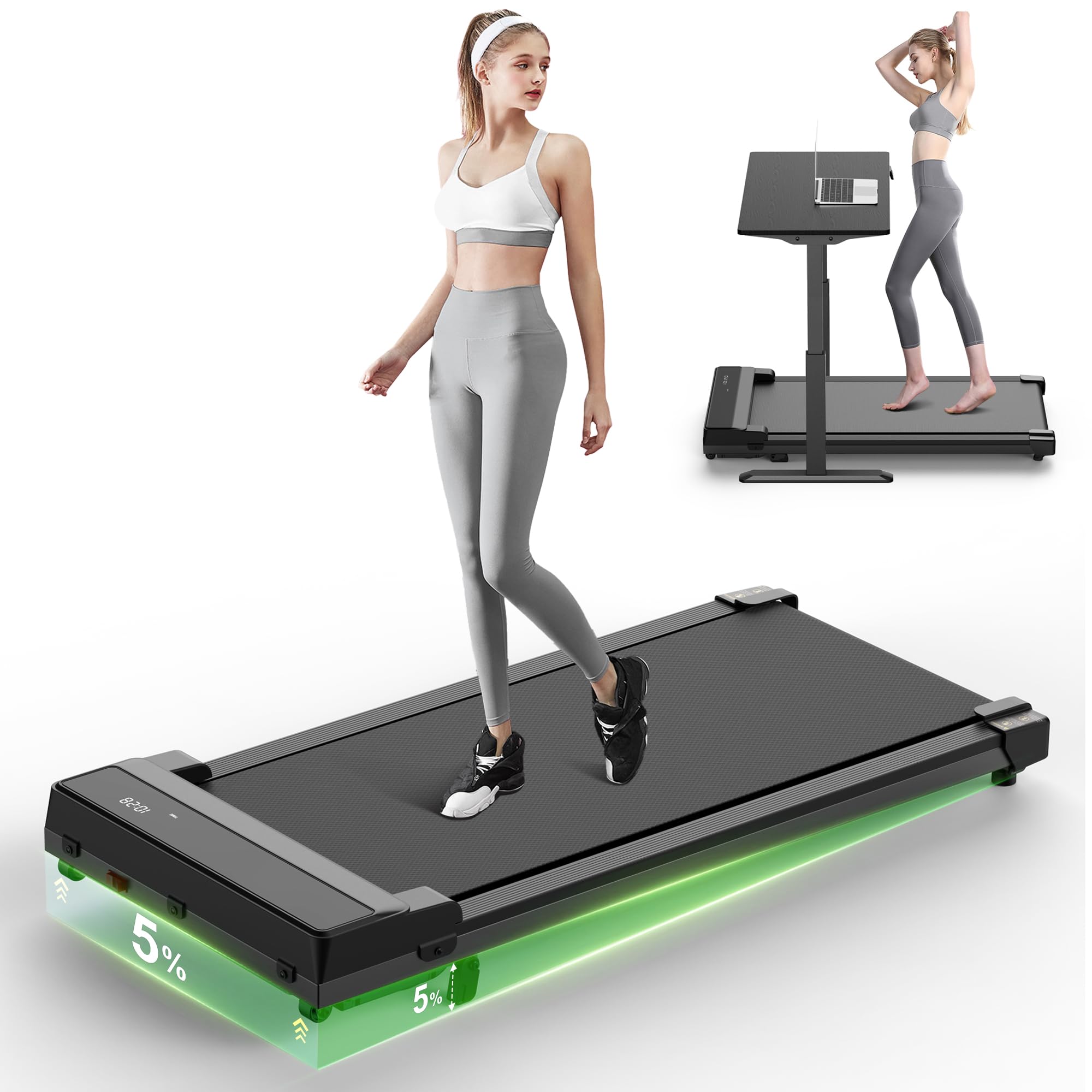
Nothing to assemble matters more in a low room than it sounds. A treadmill you have to build is a treadmill you build once, in the one place it fits, and then never move again. This one arrives as a finished 4.7-inch slab, so it goes wherever you need it that week rather than where you first plugged it in.

At 35.8 pounds it is the lightest thing in this guide, and the rollers at the front mean one hand is enough to push it under a sofa. We also rate the 5% incline plate: it is manual, so you set it before you get on, but it adds resistance to a flat walk without adding a mechanism that can fail. The remote is intuitive, the LED shows the four numbers you actually want, and the belt runs smoothly at the speeds this machine is built for.

Width is the thing to weigh. Fifteen inches is standard for the class and fine if you walk a straight line; drift, or swing your arms wide, and it will feel narrow underfoot. At 35.4 inches long there is not much deck ahead of you either. For an attic room where the alternative is no treadmill at all, that is a trade we would take.

Bottom line: At 35.8 pounds with a 5% incline and nothing to assemble, it is the one we would carry to a low attic room and slide away afterwards.
#2

Ulfario Folding Walking Pad

Ulfario Folding Walking Pad

Optional handlebar

Our Score 9.4/10
Check Price

Worth Noting

  • Bar takes two bolts and a tool to drop
  • 120 kg limit is the lowest here
Top Speed
4 mph
Folded Size
104 x 47 x 10.5 cm
Walking Belt
90 x 38 cm
Weight Capacity
264.6 lb
Read the full review

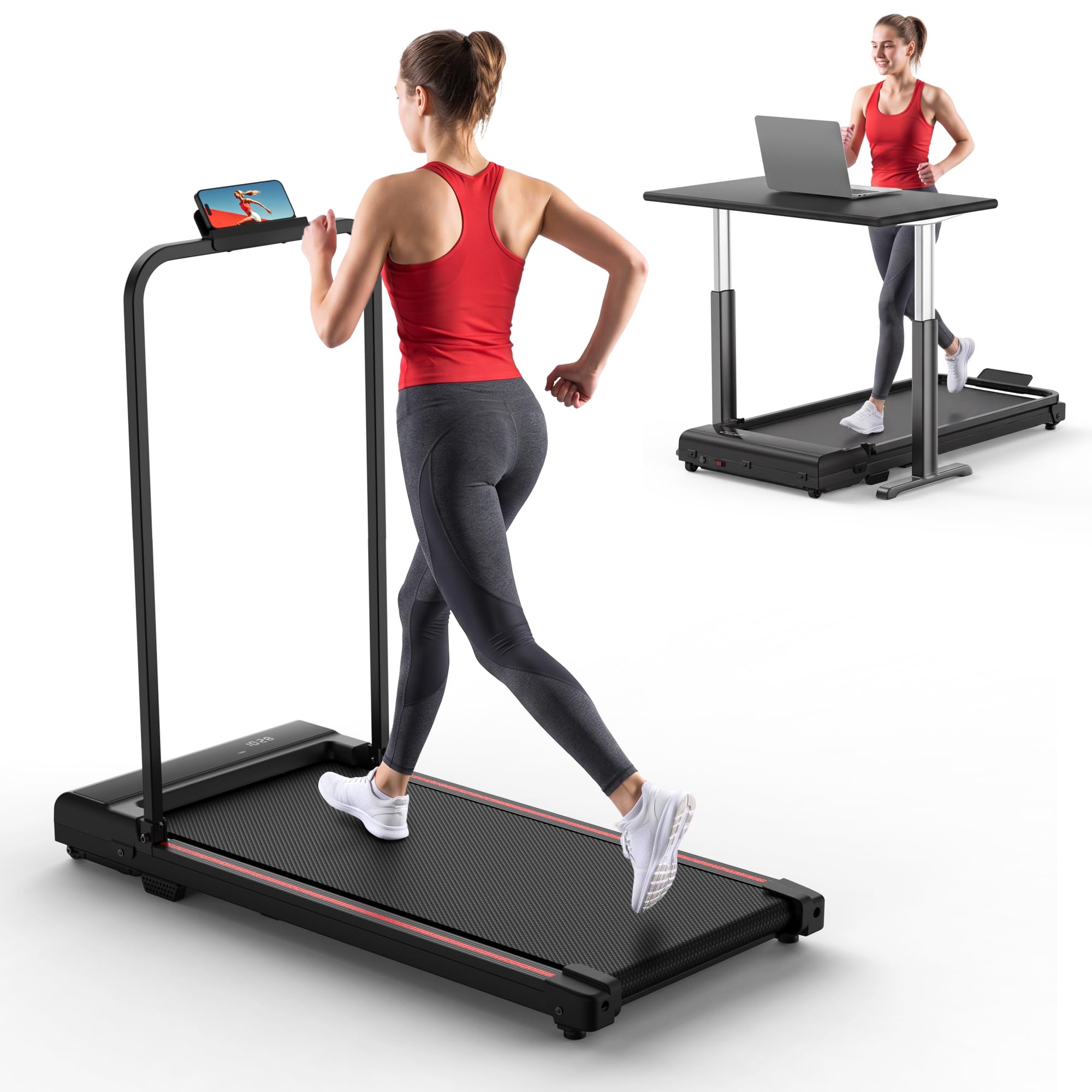
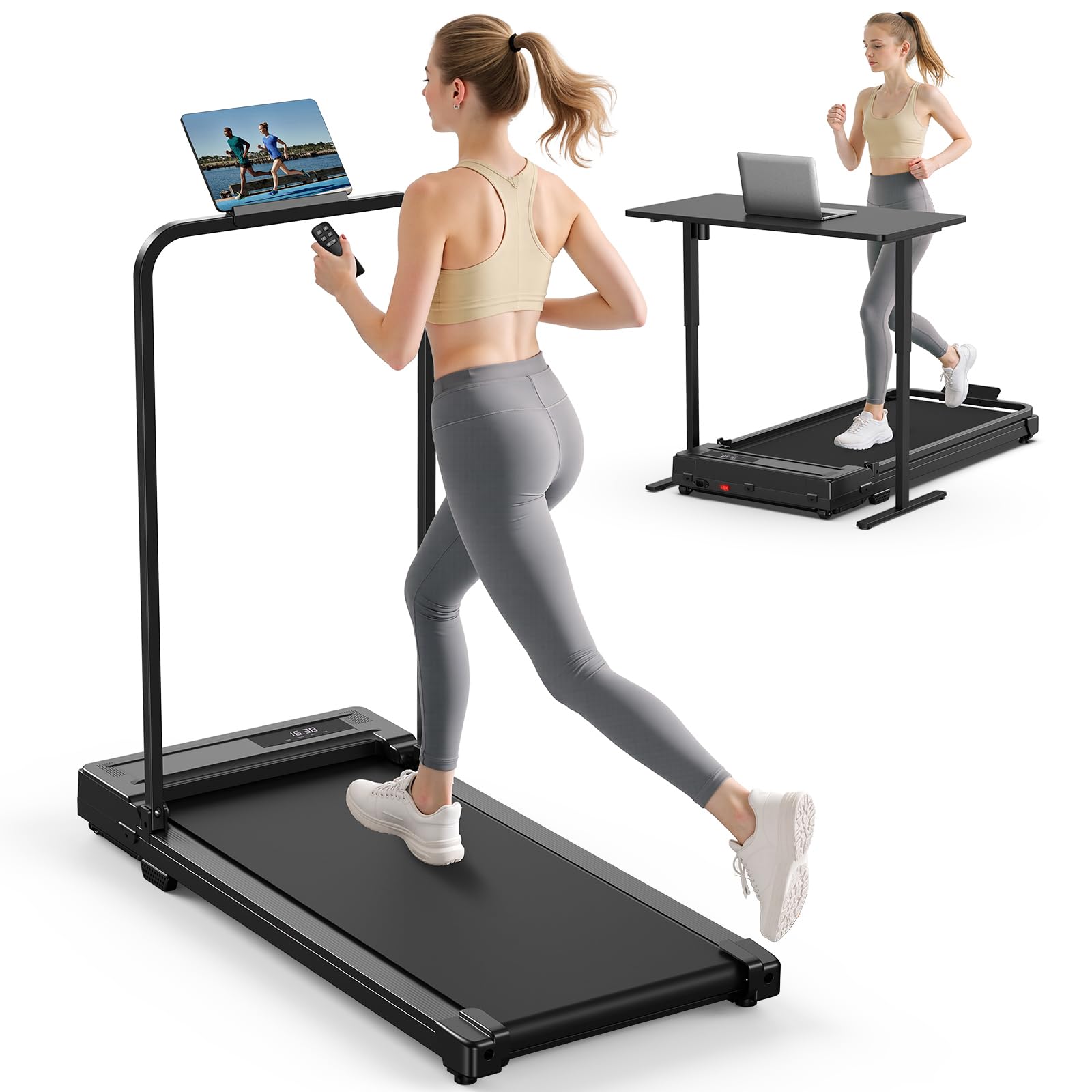
Loosen the two securing bolts and the handlebar drops or lifts away entirely, turning a supported walking pad into a 4.1-inch slab you can push under a desk. That reversibility is why this one is on the list. On most handlebar machines the upright is part of the design, so the clearance it costs you is permanent.

We like that the choice stays open. Bar up, you have something to hold at 4 mph, which makes a brisk walk feel less like balancing on a moving surface. Bar off, the unit measures 104 by 47 by 10.5 centimeters and rolls under furniture a treadmill has no business fitting beneath. The five-layer belt is 90 by 38 centimeters, enough for a walking stride and not much beyond it, and the 440-watt motor keeps things quiet enough that the sound doesn't carry through a floor.

The bolts are the catch. Dropping the bar is a job with a tool rather than a lever you flip between sessions, so decide which configuration you want before you position the machine and then leave it alone. Otherwise this is a simple, sturdy 38.5-pound pad, and the 120-kilogram limit is worth checking against the heaviest person who will use it before you commit.

Bottom line: The one we point to when you want something to hold: the bar steadies a brisk walk and comes away when the ceiling is too low to keep it up.

#3

Vhorilix Walking Pad XM-A1

Vhorilix Walking Pad XM-A1

Tightest headroom

Our Score 9.0/10
Check Price

Worth Noting

  • Remote is the only speed control
  • 264-pound weight limit
Top Speed
4 mph
Deck Height
4.33 in
Unit Weight
36.4 lb
Weight Capacity
264 lb
Read the full review

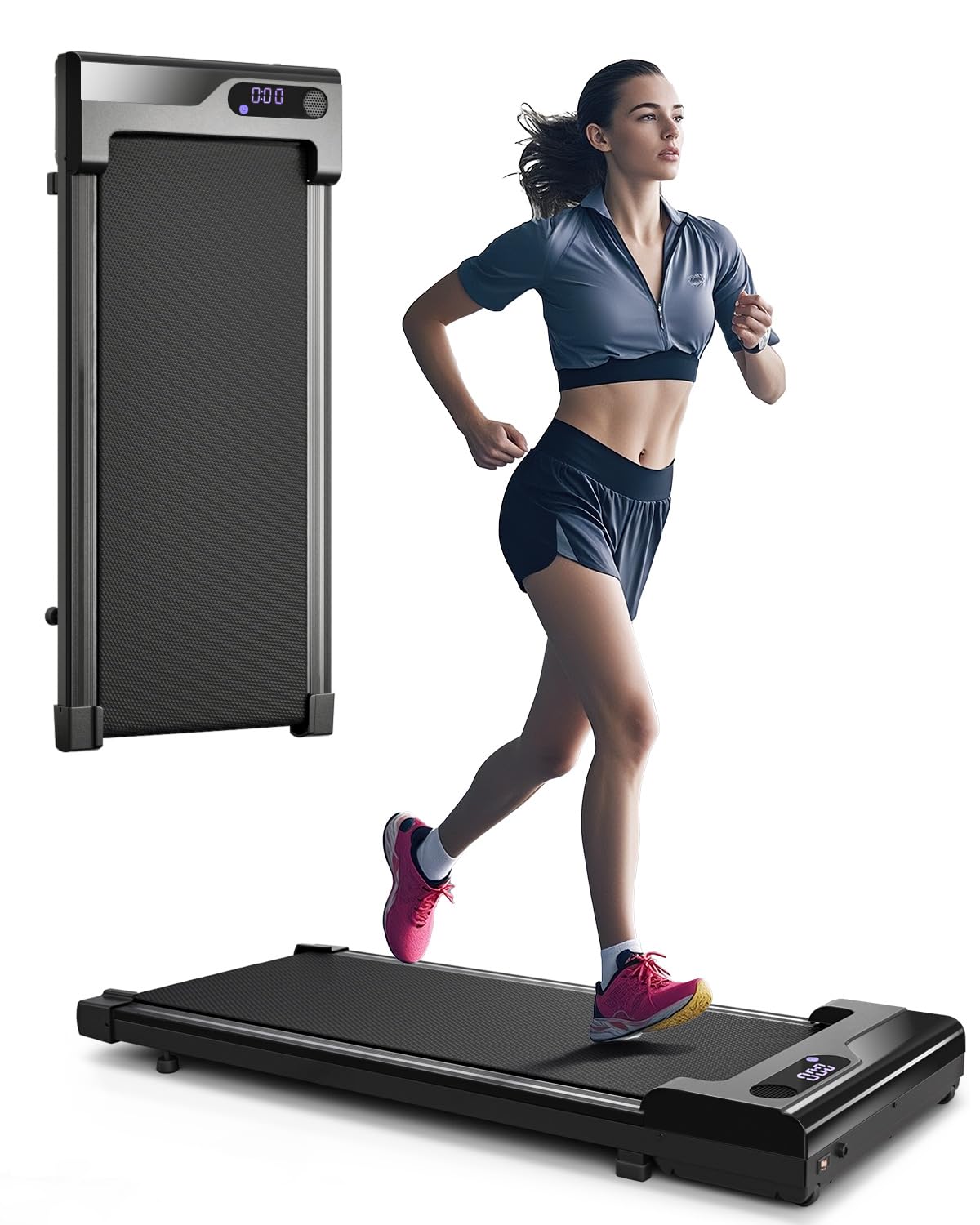
The number to fix on is 4.3 inches, because that is the entire height of this machine and there is nothing above the belt to raise it. Every treadmill with a console mast or a pair of uprights makes you reserve room for furniture you never actually touch; a pad doesn't. Add your own height to 4.3 inches and you have your clearance, which is why this is where we start when the ceiling is the reason someone is shopping.

It also turns up assembled. Nothing to bolt on, no handlebar to fit, no first-session adjustment beyond plugging it in and reaching for the remote. In a room where the machine has exactly one place it can live, that is the difference between walking on day one and walking next weekend. At 36.4 pounds with rollers at the front, we pushed it between a desk and a wall without a second thought, and the footprint is 42.9 by 19.7 inches, so it slides under a bed frame or stands against a skirting board.

Above the belt there is nothing at all, which is the point and also the honest trade. No handlebar means nothing to grab if you catch a toe, and the belt runs at walking pace rather than training pace, so this is a machine for steady steps. If you want support, look at the Ulfario or the Lacuffy; if you want the most headroom anything here can give you, this is it.

Bottom line: Our default for a genuinely tight ceiling: a 4.3-inch deck with no console or handlebar to duck under, and it arrives ready to walk on.

#4

WELLFIT Folding Treadmill TM037

WELLFIT Folding Treadmill TM037

Incline and pace

Our Score 9.0/10
Check Price

Worth Noting

  • Short power cord limits where it goes
Incline
10%
Top Speed
6.2 mph
Folded Size
49.21 x 21.25 x 6.1 in
Walking Belt
36 x 16 in
Read the full review

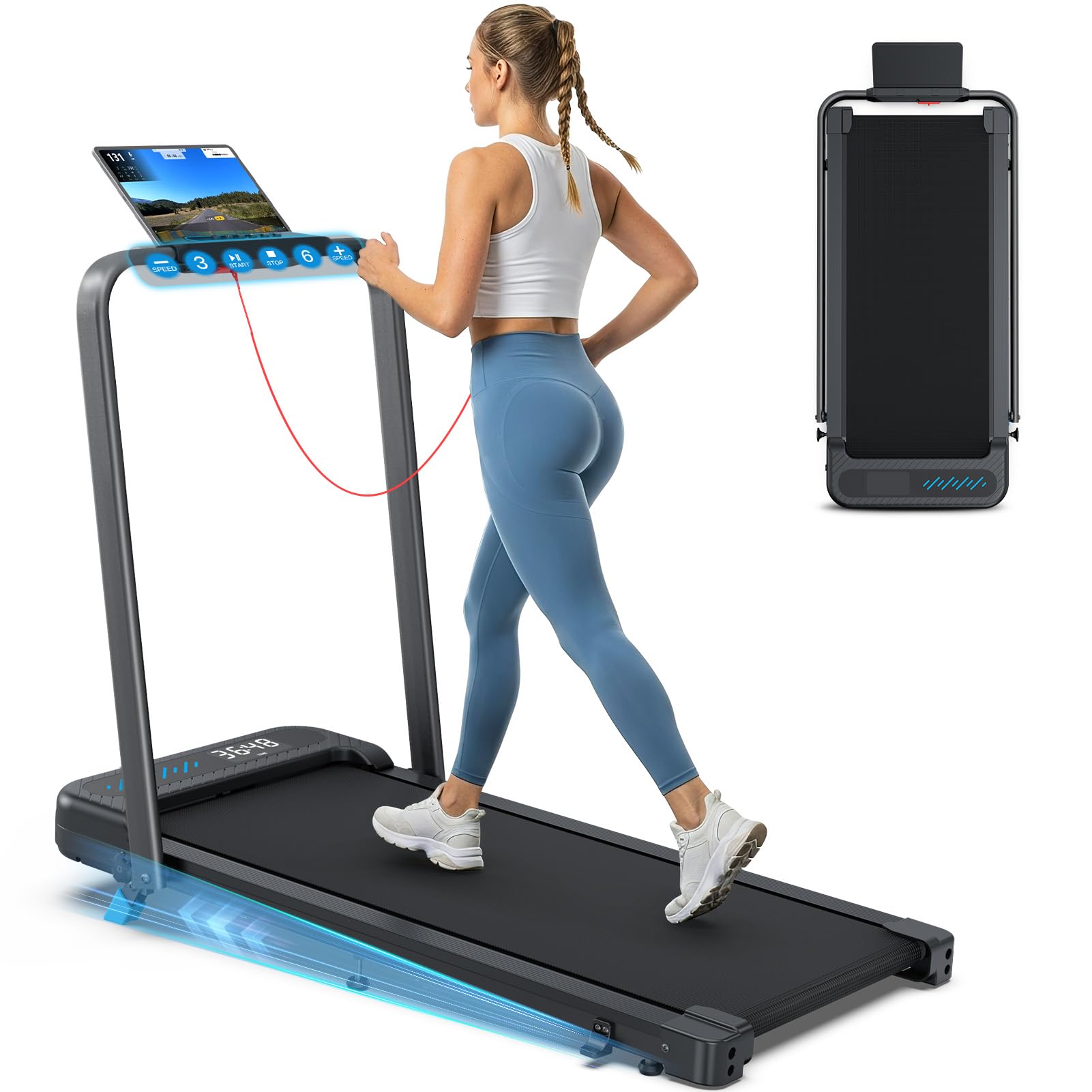
Controls under your thumbs are the detail we didn't expect to care about. Start, stop, 3 mph, 6 mph and speed up or down all sit on the handlebar, so you never break stride or bend forward to find a console, and in a low room bending forward is exactly how you find the ceiling.

The rest of the package is unusual for something that collapses to six inches. A 3 HP motor takes it to 6.2 mph, the manual incline goes to 10%, the belt is 36 by 16 inches and the widest here, and the frame carries 350 pounds. It pairs with an app if you want the numbers somewhere other than the LED, and the five-layer deck takes the sting out of a long walk on a hard floor.

What you give up for the flat fold is bar height. The handlebar sits nearer the hips than the waist, comfortable at a walk and cramped if you are tall and want to lean on it, and that short bar is precisely why the whole thing folds to six inches rather than ten. We would put this in a low room where somebody actually wants to sweat, and hand it to the shorter walker in the house first.

Bottom line: The pick for a low room where you still want a workout: 10% incline, 6.2 mph and 350 pounds of capacity from a unit that folds flat.

#5

Cybergoing T10 Walking Pad

Cybergoing T10 Walking Pad

Desk walking

Our Score 9.0/10
Check Price

Worth Noting

  • Remote pairing can drop out
Incline
Fixed 7%
Deck Height
5.7 in
Walking Belt
15 x 36 in
Weight Capacity
300 lb
Read the full review

Set the incline once, before you get on, and every walk after that has a hill in it. Seven percent is a fixed grade rather than an adjustable one, which sounds like a limitation until you notice that the flat pads here have no hill at all. You pick your angle, leave it, and stop thinking about it.

It is a well-finished unit otherwise: 5.7 inches tall with no handrails to duck under, a 15-by-36-inch belt, 300 pounds of capacity, and 36.4 pounds to move around when you want the floor back. The motor is modest, but the belt moves smoothly at walking pace and stays quiet, and the app gives you the numbers the LED display doesn't show.

We would put this behind the Vhorilix for a genuinely tight ceiling, purely on the 5.7-inch deck, and ahead of it if a hill matters more than the last inch and a half of headroom. It is the pick for a desk setup where you want some resistance in the walk and nothing standing up between you and the joists.

Bottom line: A well-finished flat pad with a fixed 7% grade; buy it for incline without a handlebar and accept a remote that sometimes re-pairs.

#6

LONTEK U20F-1 Walking Pad

LONTEK U20F-1 Walking Pad

Hill training

Our Score 8.6/10
Check Price

Worth Noting

  • Folding requires removing screws
  • Handlebar sits low for taller users
Incline
Up to 15%
Top Speed
6.2 mph
Dimensions
46.9 x 22.6 x 4.4 in
Walking Belt
37.4 x 15 in
Read the full review

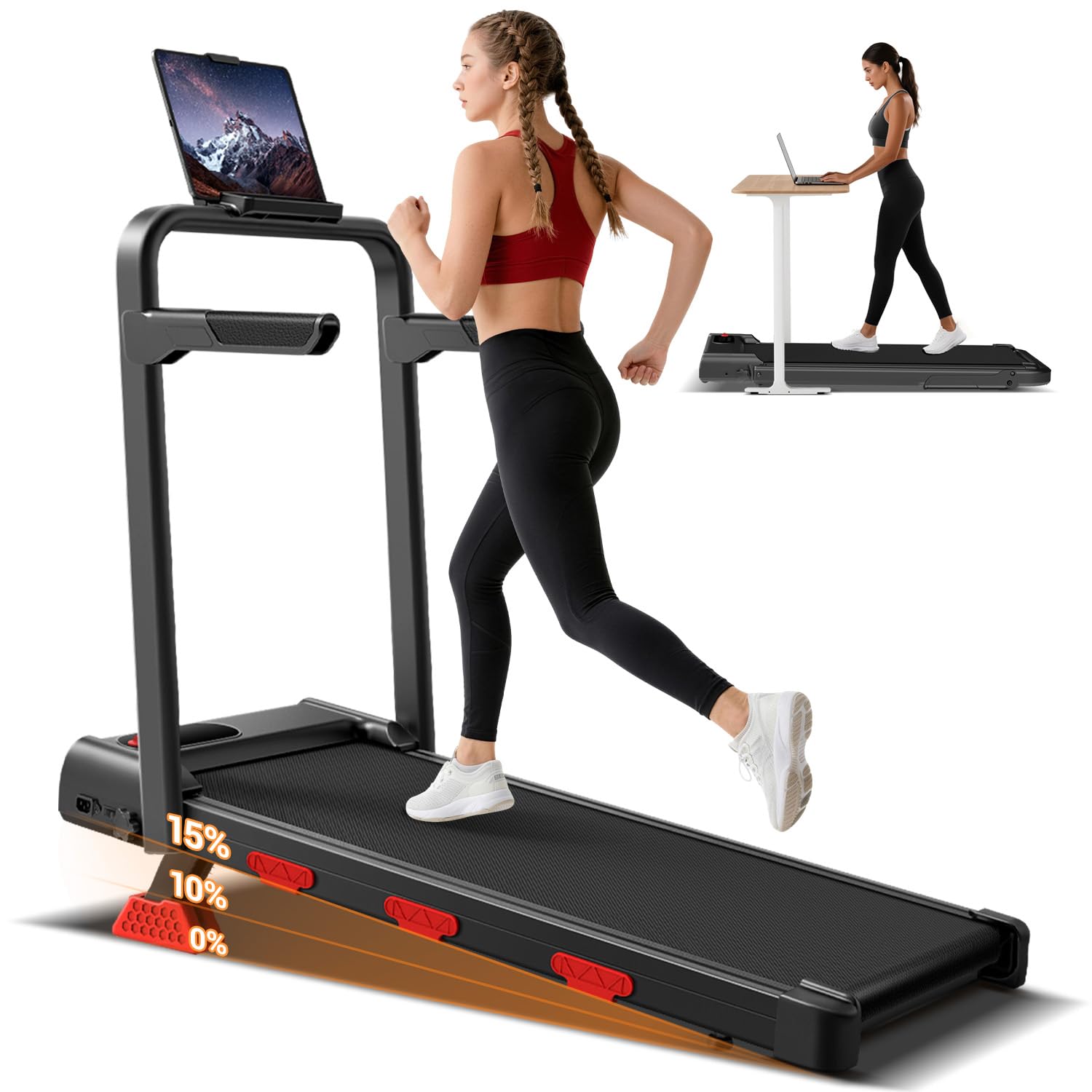
Fifteen percent is a serious grade for anything this flat. The U20F-1 stands 4.4 inches off the floor and still gives you three positions: flat, a 10% grade off the flip-out legs, and 15%. That is more hill than any other pick here offers.

The motor backs it up. A 3.0 HP brushless unit carries the belt to 6.2 mph and a 350-pound capacity, so this is a machine you can jog on rather than a desk accessory, and it stays quiet while you do it. The phone cradle lifts off, which sounds like a small thing until you have had one rattling at eye level for an hour.

The deck is where it gives ground. At 37.4 by 15 inches it is long by pad standards and still short of a running surface, so near the top of the speed range a long stride will find the front roller. If you are over six feet or you run with a long reach, this is the wrong shape for you, however good the incline looks.

Folding takes screws out rather than flipping a catch, so treat the U20F-1 as a machine that lives where it lands. Given that, it is the pick from this group for a low room where somebody wants to train rather than just add steps, and the 15% grade is what earns the place.

Bottom line: The most workout per inch here, with 6.2 mph and a 15% grade on a 4.4-inch body, as long as a short deck and a low bar suit you.

#7

Terluxra Folding Walking Pad

Terluxra Folding Walking Pad

Budget basics

Our Score 8.6/10
Check Price

Worth Noting

  • 4 mph ceiling rules out jogging
  • Stabilizing bar can feel unsettled
Motor
2 HP
Top Speed
4 mph
Dimensions
40.9 x 19.2 x 4.1 in
Read the full review

If budget is the deciding factor, this is the pad we would start with. Four miles per hour, a 2 HP motor, a folding handlebar and a body that sits 4.1 inches off the floor is the right specification for steady steps at a desk, and it takes up 40.9 by 19.2 inches of floor while it does it.

It is a simple thing to live with. The belt runs smoothly, the remote does what it says, and there is a gradual slowdown when you stop rather than a sudden halt. The fold is fussier than the word suggests: the handlebar only drops once you take the securing screws out, so this is a stow-it-once arrangement rather than something you flatten every evening.

The 4.1-inch figure needs a caveat too. That is the machine measured with the bar down; with it up you are standing inside a normal treadmill footprint and giving most of that clearance back. The flat pads in this guide are the ones that stay low while you are actually on them, which is the distinction that matters when the joists are close.

Bottom line: The budget pick, and a capable one: 4 mph, a folding handlebar and a 4.1-inch body for light desk walking and daily steps.

#8

Lacuffy 2-in-1 Walking Pad

Lacuffy 2-in-1 Walking Pad

Switchable support

Our Score 8.2/10
Check Price

Worth Noting

  • Slowest top speed here at 3.8 mph
Incline
6%
Top Speed
3.8 mph
Weight Capacity
300 lb
Height With Handlebar
39.76 in
Read the full review

Detach the side rails and you have a flat pad; fasten them back on and you have a supported treadmill. For a room where the ceiling is low over the desk and normal over the open floor, that is the most useful thing a machine can do, because you are not picking one job and living with it.

With the rails on, this is the only pick here with handrails on both sides rather than a single front bar, which matters if you are worried about balance: there is something to catch on either side of you. Speeds run 0.6 to 3.8 mph, the incline is a 6% manual setting, and a 2.5 HP motor drives it on a 300-pound frame.

Storage is where it asks for patience. It will not stand on end without unplugging it first, and with the rails fitted the footprint is 42.6 by 24.5 inches, more floor than the bare pads take. There is an app that turns a walk into a race against someone else; we mostly used the remote.

What settles it is how honestly the two-in-one idea is executed: rails sturdy enough to lean on, a detach that does not need a toolbox, and an emergency grip within reach on both sides. If your low ceiling covers half the room, this is the machine that handles both halves. Just leave yourself the floor space to set it up in either configuration.

Bottom line: Buy it if you want both: the side rails detach, so it is a supported treadmill in a normal room and a flat pad where the ceiling drops.

How We Tested Low-Ceiling Treadmills

We started by narrowing the field to treadmills whose published deck and folded heights could plausibly clear a low ceiling, then cut anything with a footprint too wide for a spare room, a cord too short for a wall outlet, or a price that didn't match the build.

I set up each of the seven treadmills solo, timing unboxing to first walk and counting how many tools it took; easy setup meant no extension cord and no hunt for a second pair of hands. I walked and jogged at slow and brisk paces while a spotter checked headroom at the top of my stride, then measured deck height, belt length, and overall length to see whether I could pass behind it. To judge noise, I ran each at a walking pace and a jog and listened from the next room, noting whether it was a hum, a whine, or a thump through the floor. For stability, I checked for rocking at speed, belt drift, and console shake, because a shaky frame feels worse under a low ceiling.

For portability and storage, I folded and unfolded each one, rolled it across carpet and over a threshold, and tried tucking it behind a door or under a bed; the easy ones moved with one hand, the annoying ones needed two people and a clear runway. I also checked cord length by plugging each into a standard wall outlet without an extension cord and watching whether the cord crossed a walking path. Value came down to what was included—tools, mat, lubrication—and whether the build felt solid at the belt seams, welds, and console buttons after eight months of regular use. The picks below stayed steady, quiet enough to live with, and compact when the workout was over.

How to Choose a Treadmill for a Low Ceiling

Measure the lowest thing overhead, not the ceiling

Ceilings are rarely uniform. A basement might be 84 inches at the joist and 78 under a duct, and it is the duct that finds your head. Measure the lowest obstruction over the exact spot the machine will sit, then subtract your own height. What is left is your budget for deck height.

That budget is tighter than most people expect. The handlebar-free pads here run 4.3 to 5.7 inches tall, and a folding treadmill with its bar up adds a good deal more. If the arithmetic leaves you under three inches of air, the machine belongs in a different part of the room, or you want a flat pad rather than an upright.

Read what the height figure actually measures

The height on a listing is usually the folded or lowest figure, taken with the handlebar down. That is useful for storage and misleading for clearance. Ask what the height is with the bar up, or choose a design with nothing to raise: a handlebar-free pad keeps its four-to-six-inch profile whether you are walking on it or not.

If you do want a bar, choose one that lowers or comes off. The Lacuffy's rails detach without tools, the Ulfario's bar comes away with two bolts. Both let you reclaim the clearance when you need it, which is more than you can say for a fixed console.

Decide whether you want something to hold

This choice shapes everything else. A bare pad gives you the most headroom and no balance support at all; at walking pace most people are fine, but if you are unsteady or you like to lean into a brisk walk, a handrail is worth several inches of ceiling.

Handrails on these machines are short by design. They are there to steady you, not to carry your weight, so a taller walker often ends up reaching down for one. Where you can, take the removable option so you are not stuck with a bar that fits neither you nor the room.

Match the deck to your stride

Deck length matters more as speed rises. The walking pads here run roughly 35 to 37 inches long and 15 inches wide, which is plenty at a slow walk and tight at 6 mph, where a long stride will catch the front roller. Width is the other half: 15 inches is normal for the class, and the 16-inch belt on the WELLFIT is the roomiest here.

If you are over six feet or you want to jog, buy the longest deck you can get in a low body and accept the extra length on the floor. If you are walking at desk speeds with an average stride, deck length is not where your money should go.

Plan for noise, cable and where it lives

A low room is often a basement, and basements are where the practical details bite. These motors are quiet enough for an apartment at walking pace, but they are all corded, and a short cord decides where the machine can go. Find the outlet before you find the spot.

Most of these units have rollers at the front end, so a 35-to-43-pound pad can be tipped and wheeled aside between sessions. Anything much heavier becomes a two-person job, which is exactly the kind of thing that stops you using it.

Frequently Asked Questions

Final Verdict

Start with the Vhorilix if the ceiling is the constraint. It is the lowest thing here with nothing standing up from the deck, it arrives assembled, and at 36.4 pounds you can move it out of the one spot where your head clears.

If you want something to hold, the Ulfario's bar unbolts and the Lacuffy's rails detach, so neither costs you clearance permanently. And if walking is not enough, the WELLFIT's 6.2 mph and 10% incline are worth the extra inches.