Cardio Machines

Best Compact Folding Treadmills of 2026

A folding treadmill solves one problem and quietly creates another. You get your floor back — but the hinge that lets the deck stand up is also where wobble lives, and a machine that shakes underfoot at a jog is one you'll abandon by February. I've run on enough of these to know the difference shows up fast: some decks feel planted at five miles an hour, others feel like a suggestion. What a good one actually fixes is narrower than the ads claim — it gives you a real walk or run at home without handing a whole room over to it.

Over six months, my team and I put eight of them through daily folding and unfolding. The ones that held up did it on unglamorous things: a setup one person can finish before the coffee goes cold, a belt wide enough to jog on, a motor quiet enough for a 7 a.m. meeting, and a cord that actually reaches the outlet behind the couch. Folded depth gets all the attention, but noise and stability are what you live with. The picks below earned the floor space they take.

#1

HADMAX H100

Top Pick
HADMAX H100

Taller walkers

Our Score 9.6/10
Check Price

Worth Noting

  • Tops out at 3.8 mph, so walking only
Incline
10% manual
Top Speed
3.8 mph
Folded Size
47.2 x 22.4 x 5.5 inches
Handrail Height
Two positions, 33.5 and 37.4 inches (85 and 95 cm)
Read the full review

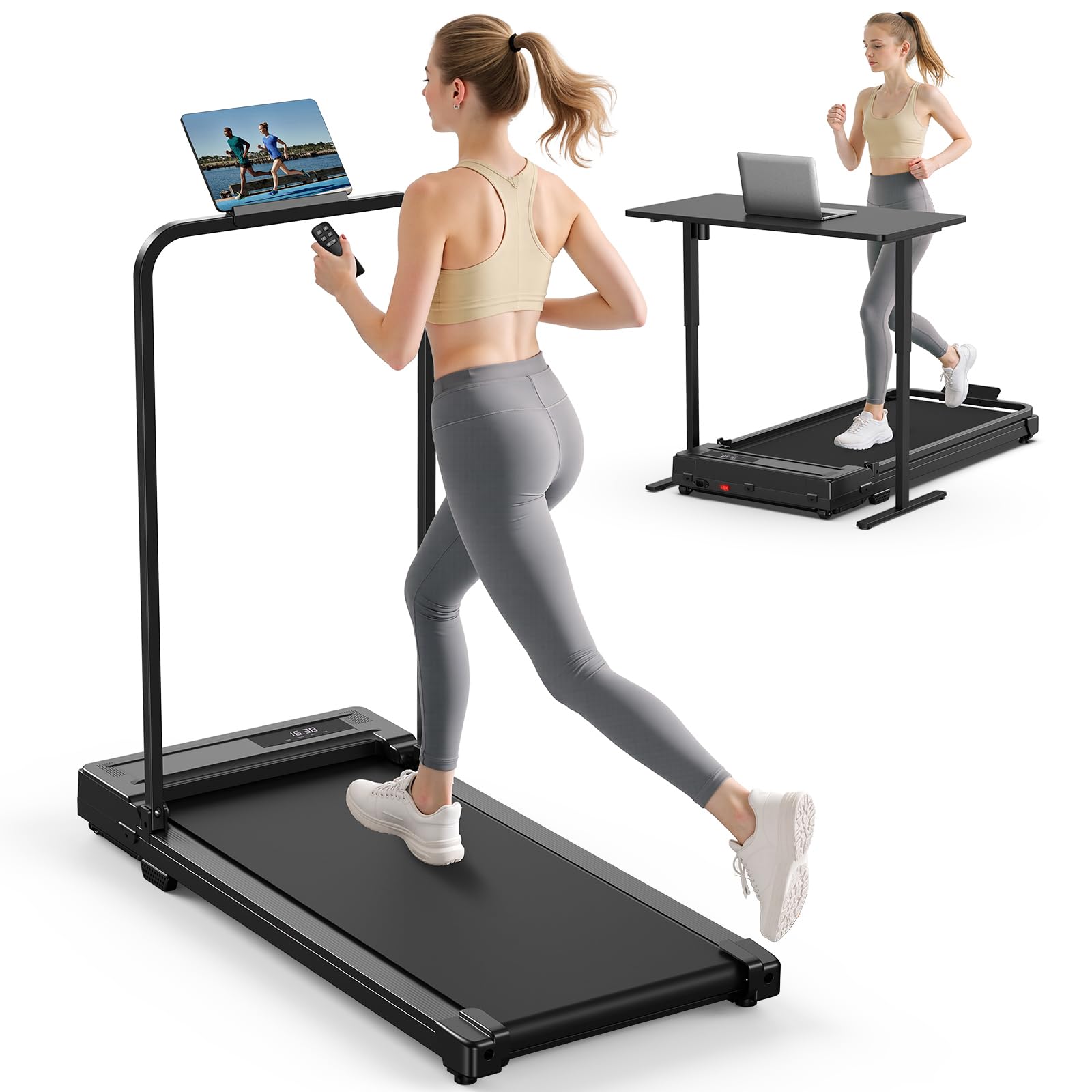
Handrails on this kind of machine have a habit of stopping at hip height, which is why two positions — 33.5 and 37.4 inches (85 and 95 cm) — is more than a spec-sheet nicety. The H100's upper setting is the tallest bar in this guide, and it folds down when you want the deck clear for under-desk use.

We rate it as the walking-only pick, and that qualifier is doing real work: this is a machine for daily steps, not for training. What you get instead is a carefully finished pad — a 3.0 hp brushless motor rated at 45 dB or less, a seven-layer belt over six silicone shock absorbers, 12 programs and a 300-pound capacity. It goes together with four hand-tightened bolts and no tools, and the two-year warranty is one of the longer ones here.

At 24 kg (about 53 pounds) it's heavier than the flat pads, which is the price of a frame that doesn't wander underfoot, and the front wheels make the daily move to the wall manageable. The magnetic remote parks on the bar instead of disappearing into the sofa. Buy it if walking is the whole plan and you want the bar at your height.

Bottom line: If the handrail is the reason you want one of these, this is the pick: it adjusts to two heights, stays quiet, and is honest about being a walking machine.

#2

WELLFIT TM037PRO

WELLFIT TM037PRO

Running and jogging

Our Score 9.6/10
Check Price

Worth Noting

  • 57 pounds, the heaviest here to move
  • Longest folded length in this set
Incline
0 to 12% automatic
Deck Size
40 x 16 inches
Top Speed
7.6 mph
Weight Capacity
375 lb
Read the full review

Same maker as our top pick, different brief. Where the WFTM037 is a walking pad that can jog, the TM037PRO is a treadmill that happens to fold: 7.6 mph, a 3.5 hp brushless motor, and a 12% incline you change from the controls instead of walking to the back to move a stand.

The extra money buys three things that matter to a runner — the automatic incline, a 40 by 16 inch belt with room for a stride to land, and dual handrails long enough to hold at speed — plus a 375-pound capacity, the highest here. If you're walking at 3 mph with a podcast on, none of that is worth paying for, and the cheaper WELLFIT or the HADMAX does the same job.

A ten-inch display, a tablet tray and a three-year warranty soften the bill, and the 40-inch deck is what earns the bulk. In a genuinely tight corner, one of the flat pads stores more easily; for everything else, this is the one that runs.

Bottom line: The running pick: 7.6 mph, automatic incline and long dual handrails in a machine that still folds to 5.5 inches and rolls away.

#3

Ulfario LF-X2DF

Ulfario LF-X2DF

Removable handrail

Our Score 9.6/10
Check Price

Worth Noting

  • 120 kg (264-pound) weight limit
  • 4 mph top speed means walking only
Deck Size
90 x 38 cm
Top Speed
4 mph
Folded Size
104 x 47 x 10.5 cm
Weight Capacity
264.6 lb
Read the full review

Loosen a few bolts and the Ulfario's handrail comes off or drops down, turning a walking pad into a flat deck for standing-desk use and back again. That flexibility is unusual at this price, and it's the reason this one is here.

The rest is budget-pad work done tidily: a 440 W motor, 1 to 6 km/h, a five-layer 90 by 38 cm belt, an LED readout for speed, time, distance and calories, and a remote. Folded, it measures 104 by 47 by 10.5 cm, and at 38.5 pounds it's easy to stand on end in a closet. Setup is a handful of bolts rather than an hour with an Allen key.

Where we hesitate is headroom: the weight limit is the tightest in this guide and the speed ceiling keeps it in walking territory, so this is a one-person, one-flat, step-goal machine. That's exactly the buyer it's built for, and the price reflects the simplicity. If you're near the limit or you want to jog, don't stretch to make it work.

Bottom line: A light, cheap pad whose handrail unbolts when you want a flat deck under a standing desk — just mind the 120 kg limit.

#4

CHAOKE Folding Treadmill

CHAOKE Folding Treadmill

Budget jogging

Our Score 9.4/10
Check Price

Worth Noting

  • Long-term motor and belt life unproven
Incline
10%
Top Speed
7.5 mph
Weight Capacity
350 lb
Read the full review

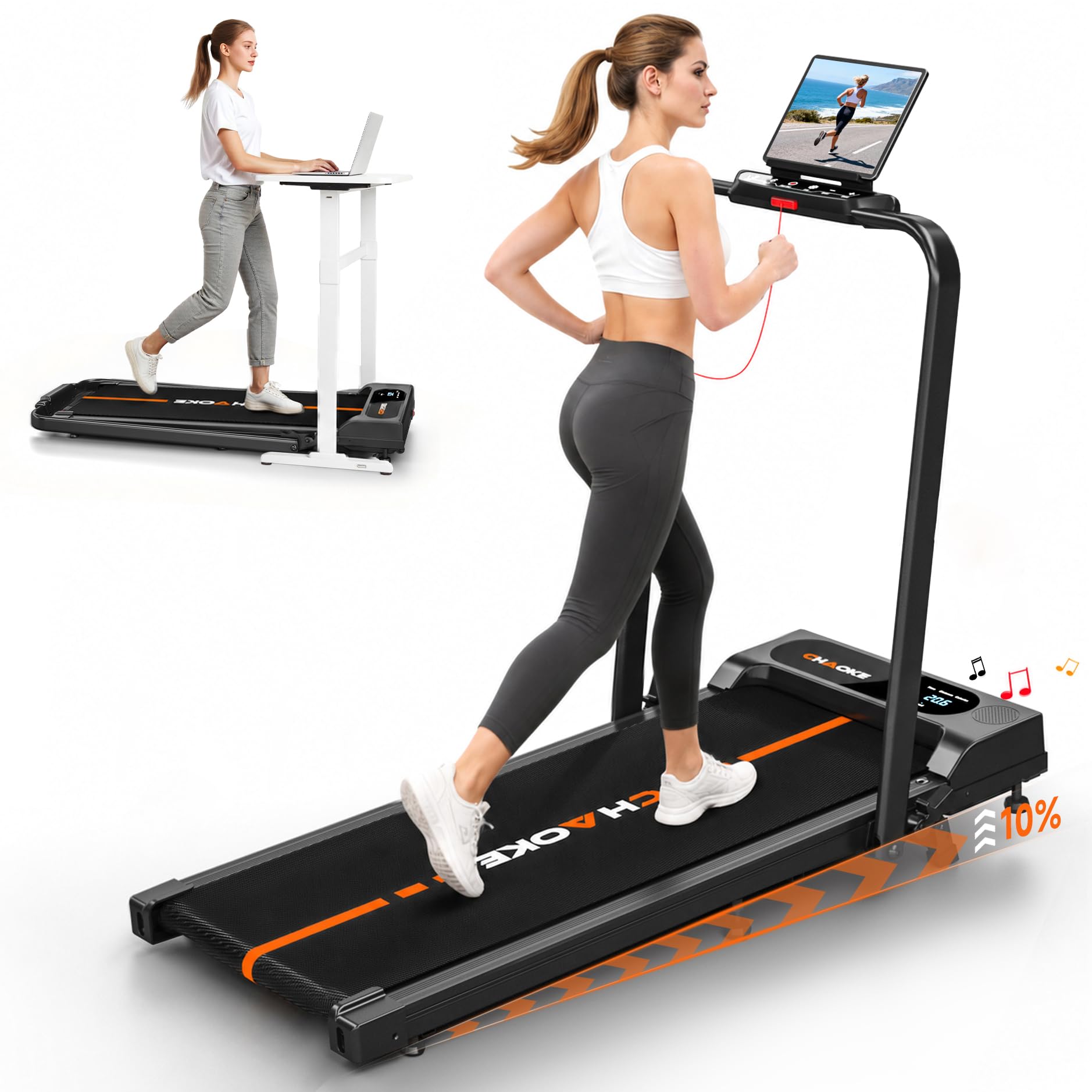
Put the CHAOKE's spec sheet beside our top pick and it looks like an ambush: 7.5 mph against 6.2, the same 10% incline, the same 350-pound capacity, and less money asked for it. It also throws in built-in speakers, 12 HIIT programs, three countdown modes and app control, which is more than most pads this size bother with.

The parts you can't line up in a table are where the difference lives. Length and width are 49.2 and 22 inches, so check the folded height against your under-bed gap before you order — that number decides whether it lives under the bed or against a wall. The fancier bits are the ones you'll use least: the speakers are a novelty and the HIIT intervals are the same ones you'd count in your head.

What we can vouch for is the shape of the thing: a 3.0 hp motor, a 0.6 mph starting speed for slow walking, a phone holder and a safety key in the box, and controls that run through a remote and an app. As a walking machine with incline headroom for a light jog, it makes sense.

Our reservation is the long haul. A motor is what decides whether a treadmill lasts three years or one, and that's the part no spec sheet settles. Buy it for what it does now and read the warranty carefully; buy the WFTM037 if you want the safer bet.

Bottom line: It beats our top pick on paper — 7.5 mph, a 10% incline, 350 pounds — for less money, and that's the case for it if the extras appeal.

#5

WELLFIT WFTM037

WELLFIT WFTM037

All-round home use

Our Score 9.0/10
Check Price

Worth Noting

  • Handrail sits low for shorter walkers
Incline
10% manual
Top Speed
6.2 mph
Folded Size
49.21 x 21.25 x 6.1-inch
Weight Capacity
350 lb
Read the full review

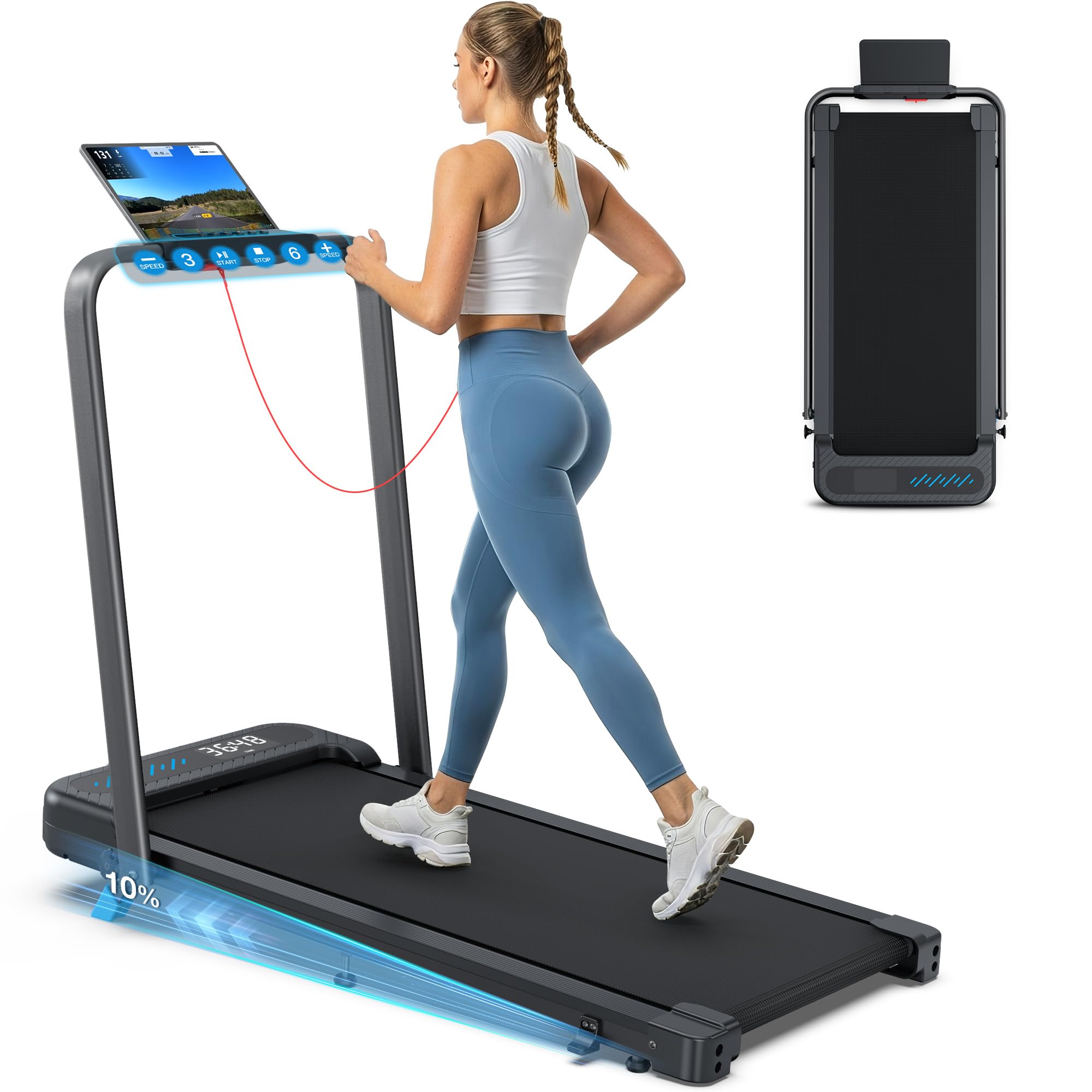
The speed controls sit on the handrail rather than down on the deck, and that single decision is most of why this is the treadmill we point people to first. Start, stop, 3 mph, 6 mph and a speed nudge are all a thumb away, so you change pace without breaking stride or bending over mid-walk. There are four ways in, too: the handrail buttons, a remote with a mute for the beeps, app control through WELLFIT, KINOMAP or Apple Health, and voice control in the app.

The capability behind those buttons is what separates it from the flat pads here. A 3.0 hp motor takes it to 6.2 mph — a jog rather than a sprint — and the 10% incline is a stand you set before you start rather than something you change mid-session. The deck measures 36 by 16 inches and is rated to 350 pounds, which is enough for a walking stride and a measured jog, though not the place for a long-strided run. The belt is built to keep itself centered, so you're not chasing drift with a hex key every few weeks.

Folded, it's 6.1 inches thick and 43.5 pounds, and the front wheels take the load when you push it under a couch or stand it behind a door. Under six inches isn't flat enough to vanish, but it clears most bed frames, and the whole package is still a treadmill rather than a mat you forget about. The five-layer belt is the other thing you feel on a hard floor: forgiving underfoot without turning the walk mushy.

One practical note before you order: the power cord is short enough that outlet placement decides where this lives, so measure the run to the wall or plan on a heavier-gauge extension cord. Otherwise it asks very little of you — fold it, roll it, plug it in.

Bottom line: Our pick for most people: the controls sit on the handrail, so you change pace mid-stride, and 6.2 mph with a 10% incline still folds to 6.1 inches.

#6

Vhorilix XM-A1

Vhorilix XM-A1

Under-desk walking

Our Score 9.0/10
Check Price

Worth Noting

  • No handrail for balance support
  • 4 mph ceiling rules out jogging
Top Speed
4 mph
Folded Size
41.3 x 19.3 x 4.1 inches
Unit Weight
36.4 lb
Weight Capacity
264 lb
Read the full review

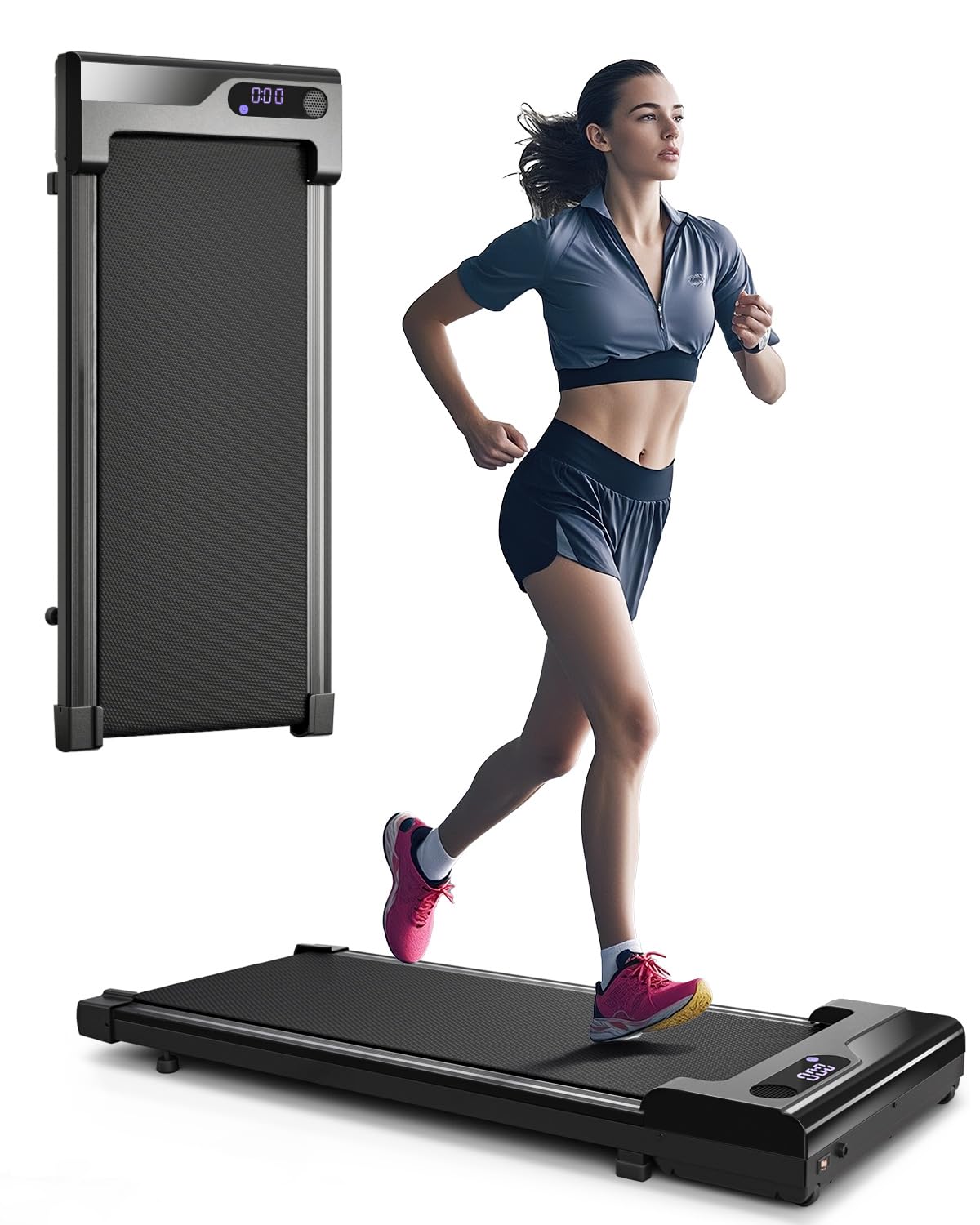
A 4.1-inch folded height and 36.4 pounds is the entire pitch: this is the pad you slide under the bed and forget about until tomorrow. The front wheels take the weight, the deck is walkable the moment it's out of the box, and a bottle of belt lubricant is in the package so the first maintenance job doesn't need a shopping trip.

It's a flat walking pad rather than a treadmill, and the honesty of that is part of the appeal. The 2.5 hp motor is quiet enough for a shared flat or a day of calls, the machine is 19.7 inches across so it sits between a desk's feet, and the diamond-textured five-layer belt gives you something to push against at a brisk pace. The LED readout is small but legible, and the remote handles speed without any menu-diving.

Our call: this is the one to buy first if you've never owned a walking pad, because there's nothing to learn, nothing to adjust and nothing to store carefully. Balance is your job without a bar to hold, and there's no incline to break up a long walk. For daily steps in a small flat, that's a fair swap.

Bottom line: The value pick here: quiet, 4.1 inches thin, and ready to walk in minutes — as long as you only ever want to walk.

#7

Yagud Walking Pad

Yagud Walking Pad

Budget desk walking

Our Score 8.4/10
Check Price

Worth Noting

  • Remote can need several presses
  • Capped at 3.8 mph
Top Speed
3.8 mph
Folded Size
47.2 x 19.6 x 4.6 inches
Unit Weight
36.5 lb
Read the full review

The remote is the weak link, and it's the one thing standing between this pad and a straightforward recommendation. It's how you change speed all day, it works fine most of the time, and then it needs two or three firm presses or a fresh pair of AAAs. Keep spares in a drawer and the remote in one place and the annoyance stays small.

Everything else about it is the value play of the handlebar pads. It arrives assembled, the five-layer belt is kind to knees on a hard floor, and the handrail folds down with the deck so the whole thing stows at 4.6 inches and 36.5 pounds. The 2.5 hp motor runs 0.6 to 3.8 mph, the display covers speed, time, distance and calories, and the wheels on the front end let you shift it with one hand.

Two things to weigh. It's louder than the quietest machines here, which matters if the pad shares a room with a work call. And this is a walker, not a trainer — the pace is for steps and standing desks, not for sweating. If a bar to hold and a low price are the priorities, this is the one.

Bottom line: The cheapest way to get a handrail on a walking pad, and a solid daily-stepper — just expect to press the remote twice now and then.

#8

Viamotion Walking Pad

Viamotion Walking Pad

Upright storage

Our Score 8.2/10
Check Price

Worth Noting

  • Handrail sits low for taller walkers
Incline
4%
Top Speed
3.8 mph
Folded Size
45.53 x 21.17 x 40.47 inches
Weight Capacity
265 lb
Read the full review

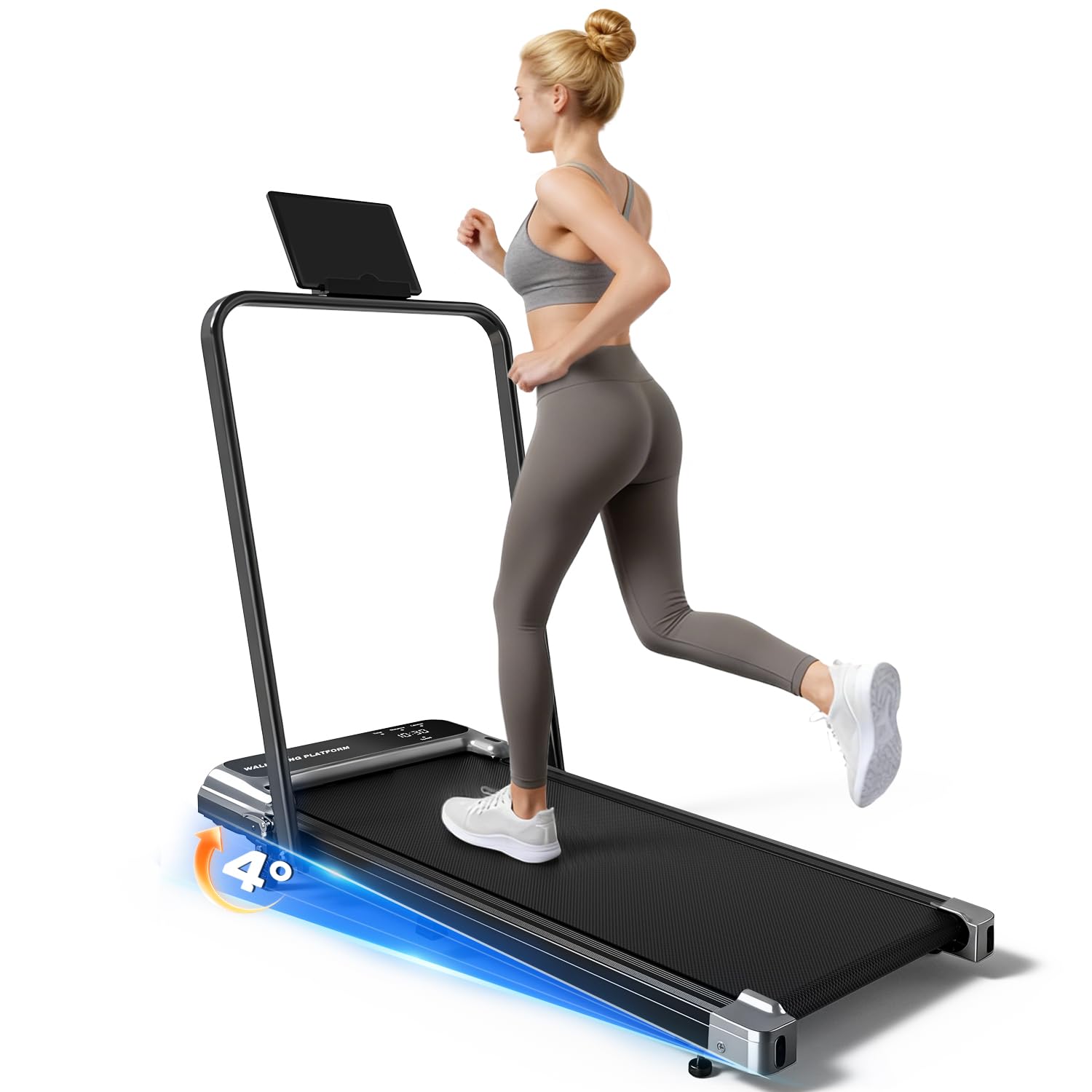
Not every small space has a bed frame to slide under. The Viamotion folds into a 40.47-inch standing shape and leans against a wall, which is the storage answer for a studio or a spare-room corner where the only free space points up.

The 4% incline is the other thing that sets it apart: small enough that you forget it on flat days, steep enough to make half an hour feel like effort. There's a handrail to steady yourself at the front, the deck is a comfortable width for walking, and at about 18 kg the machine moves between rooms without a second person.

Two realistic notes. The rear end caps are the cheapest-feeling part of the build, and the belt can slip and need re-centering now and then — a few minutes with the tool kit rather than a fault. Neither is unusual for a walking machine at this price.

Our verdict: it's the right pad for a specific space — a flat with no under-bed gap, a walker who wants a bar to steady themselves and an incline that makes a daily walk count. At 3.8 mph it isn't a running machine. If you do have six inches under a bed frame, the flat pads here are easier to live with.

Bottom line: Stores upright against a wall rather than under a bed, and adds a 4% incline and a handrail to a walking-only deck.

What Six Months of Folding and Unfolding Taught Us

We started with the numbers a manufacturer can't fudge: folded footprint, belt width, motor rating, user-weight limit, and warranty length. Anything that needed two people to assemble, or that couldn't run off a standard wall outlet, got cut before we plugged it in. That left eight machines, and I kept each one for six months — folded against a wall between sessions, unfolded for morning walks and evening runs.

Setup came first, stopwatch in hand: how long from box to first step, and whether the fold mechanism needed a pin, a latch, or a hydraulic assist to bring down. Then the size question, which is really two questions — I measured folded depth against the closet I wanted it to disappear into, and taped the unfolded length onto the floor to see what it did to a normal bedroom. Belt width got judged at a jog, not a stroll, because a narrow deck feels fine at 2 mph and precarious at 5.

Stability was checked at a 6 mph run with my hands off the rails for thirty seconds, then again at full incline. For noise, I took readings at ear height during a 3 mph walk and a 6 mph run, and ran a phone call and a TV in the next room to hear whether either bled through. Cord length got measured from the plug to the nearest outlet in three different rooms — a short cord on something you reposition constantly is a genuine daily irritation.

Functionality meant whether the console's presets made sense without the manual, whether the app paired on the first try, and whether the speed and incline controls sat within reach mid-stride. Quality got judged at the end rather than the start: belt wear, deck flex, and how much play had worked into the hinge after six months of twice-daily folding. Value came last — what each machine asked of you against what it actually delivered.

How to Choose Compact Folding Treadmills

Walking pad or folding treadmill?

A walking pad tops out around 4 mph and usually gives you no bar to hold; a folding treadmill such as the WELLFIT WFTM037 or the CHAOKE reaches 6 to 7.5 mph and comes with handrails. The trap is the word folding itself. On most pads it means the handrail drops and the deck goes flat, not that the machine becomes dramatically smaller. Decide your top speed before you shop: if every session is a desk walk, a flat pad saves money and floor space, and if you want to jog you're paying for deck length and motor.

Measure the gap before the machine

Folded thickness decides where a treadmill lives, and it's the number to check twice. The flat pads here run 4.1 to 4.6 inches; the machines with handrails run 5.5 to 6.1. Under-bed clearance is set by the frame rail, so measure from the floor to the rail, not to the mattress. Check what folded means on the model you're considering, too — the Viamotion's 40-inch folded height is the machine standing with its bar up, which is wall storage rather than under-bed storage. Leave room to step off at the back.

Handrail height beats handrail presence

A bar you can't reach is worse than no bar, because it invites you to lean on something that won't take your weight. On several machines here the handrail sits at hip height; the HADMAX adjusts between 33.5 and 37.4 inches, which is why it's our pick for taller walkers. Treat any bar on a compact machine as a balance aid for starting and stopping rather than a support rail, and if you know you'll want to lean while you walk, a full-size treadmill is the honest purchase.

Floor, belt tracking and noise

Put it on a hard, level floor. Carpet lets the deck settle unevenly, which can show up as belt drift and a wobble at speed, and a thin dense mat under a hard floor takes some of the thump out of the room below. Belt tracking is the other thing to watch, which is why the WELLFIT's self-centering belt earns its keep. On noise, the brushless motors here are rated around 45 dB, but your footfalls on a hard floor will usually be louder than the motor.

Incline: automatic, or a stand you set

An incline turns a flat walk into effort without asking for more speed, which is worth having on a machine this small. Most of the inclines here are manual — a stand you pull down before you start, including the top pick's 10% setting — so you choose a gradient for the session rather than change it mid-walk. Automatic incline, as on the WELLFIT TM037PRO's 0 to 12%, costs more and earns it if you want intervals without stepping off.

Frequently Asked Questions

Final Verdict

Our default is the WELLFIT WFTM037. It's the only machine here that covers a desk walk and a genuine jog without giving up under-bed storage, and the handrail controls are a convenience you notice every session.

If you only ever walk and want the bar at your own height, the HADMAX is the better fit. If the budget is tight, the Vhorilix gets the steps in for the least. Runners should go straight to the TM037PRO.