Accessories

Best Speed Parachutes of 2026

A speed parachute is one of those training tools that either earns a permanent spot in your bag or ends up a tangled knot at the bottom of it. The difference is rarely how hard it pulls — overdo the resistance and your stride shortens, your hips drop, and you spend the session rehearsing bad mechanics. Sized right, it solves a specific problem: how to add real drag to a sprint when there's nobody around to hold a band or throw a towel.

I've run with drag chutes for years, mostly on empty tracks at odd hours, and my team has now put 16 of them through four months of sprint work. The pattern we keep seeing is that cheap ones fail at the hardware, not the fabric: a swivel that seizes, a strap that slips, a chute that won't open by the third rep. And fit matters more than the box suggests — a chute that hangs well off a 200-pound linebacker can drag a 120-pound sprinter sideways. The picks below are the ones that held up.

#1

SKLZ Speed Chute

Top Pick
SKLZ Speed Chute

Adult sprint training

Our Score 8.8/10
Check Price

Worth Noting

  • Fixed 15-pound resistance is modest
  • Can tear at canopy attachment
Canopy Size
54 in
Belt Rotation
360°
Rated Tension
15 lb
Quick-release Buckle
Yes
Read the full review

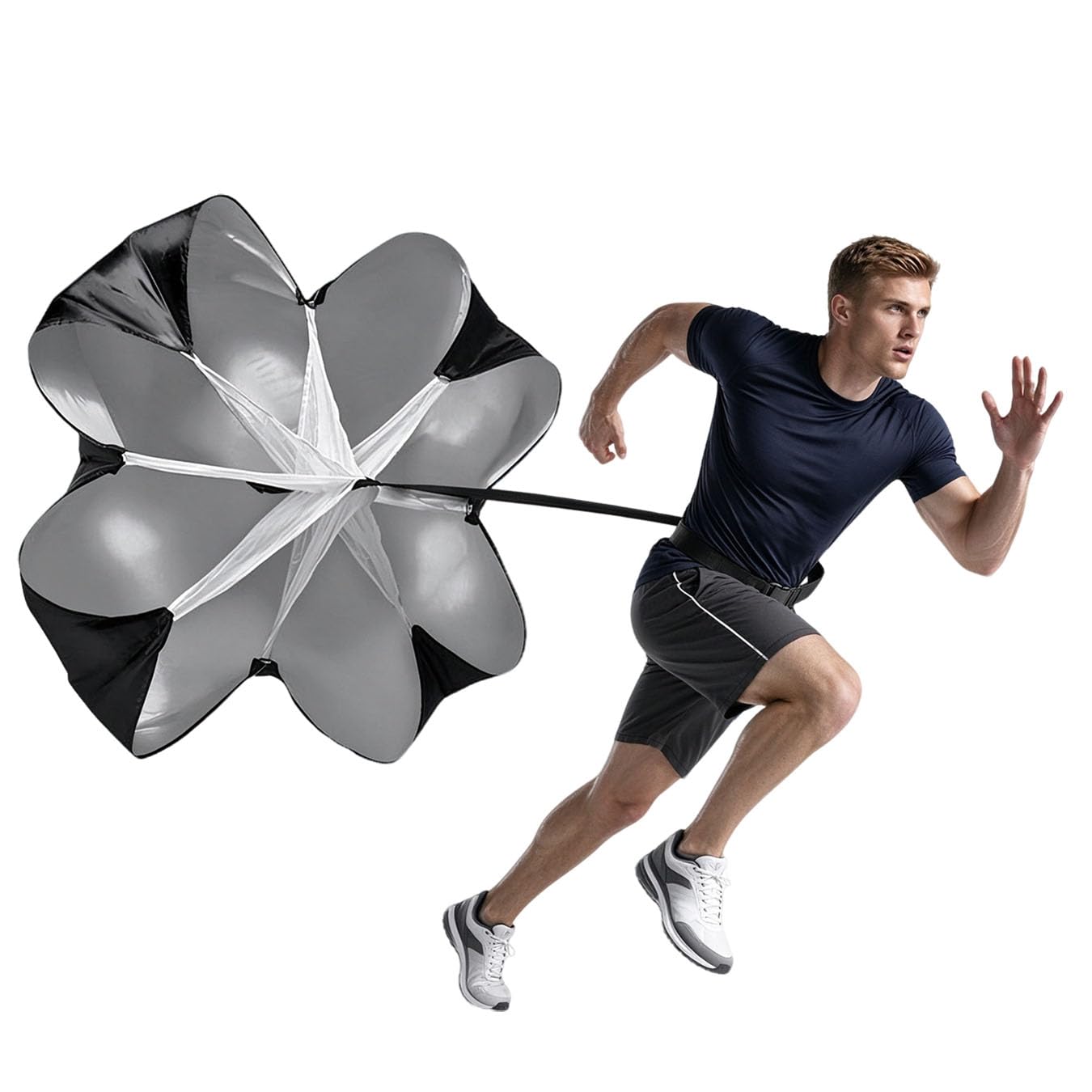
The SKLZ chute is defined by its belt, not its canopy. The 360-degree ring lets the chute swing around your hips as you cut, and the quick-release buckle lets you end a resisted burst and run free without fumbling. That combination is why it is our default for adult sprint and acceleration work: the chute stays behind you, and your stride stays natural.

The canopy is 54 inches across with a 15-pound tension rating, which puts it at the lighter end of this group. We like that for technique work and for athletes who are new to resisted running, because the pull builds gradually instead of jerking. In a strong headwind, expect more drag than the rating suggests, and there is no way to tune the chute itself.

The premium price is the trade-off. You are paying for the swivel hardware and the release, and for a build that feels more considered than the cheapest options. For adults and teens who train regularly, it is the one we reach for first; if you need a harder pull, the KUYOU is the obvious step up.

Bottom line: For adult sprint work, this is the chute we recommend: the 360-degree belt and quick release make it a controlled training tool rather than a tug-of-war.
#2

Bfsmile Speed Parachute

Bfsmile Speed Parachute

Budget team sets

Our Score 8.6/10
Check Price

Worth Noting

  • Can tear at attachment points
Carry Bag
Included
Canopy Size
56 in
Waist Range
20-42 in
Rated Resistance
12-33 lb
Read the full review

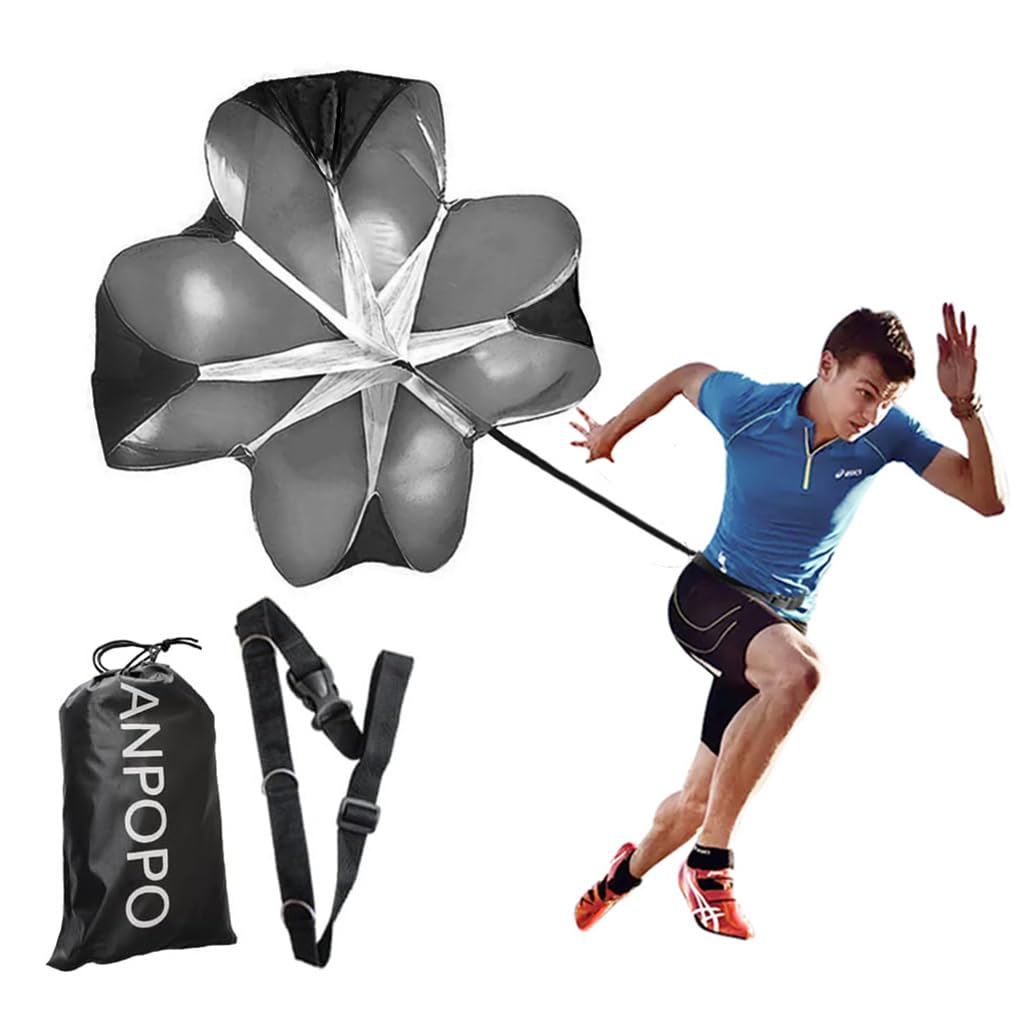
The Bfsmile is the chute we hand to a group when the goal is to get everyone moving without spending much. The 56-inch canopy gives it a useful size for youth and adult beginners, and the waist belt adjusts from 20 to 42 inches, so it covers a wider range of bodies than the kid-specific chutes. The metal D-ring swivels a full 360 degrees, which is a small detail that makes turns feel less like a tug-of-war.

Our judgement is that it is a strong budget buy for teams, families, and young athletes, not a serious tool for a powerful adult sprinter. The listed resistance range of 12 to 33 pounds depends on speed and wind, and at slower youth paces it can feel light. The upside is that lighter pull is easier to manage for beginners and smaller runners.

The carry bag is genuinely useful because the chute folds down small and stays untangled between sessions. The hardware is simple enough that setup takes seconds, which matters when you are running a rotation of young athletes. We treat it as a budget tool rather than an heirloom, and that expectation keeps it in perspective.

Bottom line: We point budget-minded coaches and parents here: the wide waist range and simple swivel belt make it easy to equip a group without spending much.

#3

KUYOU Speed Chute

KUYOU Speed Chute

Hard resisted sprints

Our Score 8.6/10
Check Price

Worth Noting

  • Belt can slip during sharp cuts
  • Can tear at canopy attachment
Belt Width
2 in
Canopy Size
56 in
Belt Rotation
360°
Rated Tension
25-35 lb
Read the full review

The KUYOU pulls harder than the SKLZ on paper, and that is the reason to consider it. Its 56-inch canopy is rated for 25 to 35 pounds of tension, and the two-inch nylon belt is wider than the straps on most budget chutes, so the load spreads across the waist instead of digging in. The belt rotates 360 degrees and the buckle releases quickly, which keeps direction-change drills practical.

The extra drag is useful for stronger teen and adult athletes who have outgrown a light beginner chute. It also makes the KUYOU less forgiving: the pull can feel inconsistent as wind and pace change, and the belt can slip through the buckle during sharp cuts. Check the fit before every set, especially if you are using it for shuttle or cone work.

We rate it as a specialist rather than the default. The wide belt and stronger tension suit athletes who want a more physical resisted run. If you already have a light chute and want a second, harder-pulling option, this one earns its place.

Bottom line: We choose the KUYOU when we want a harder pull than the SKLZ offers and can check the belt before every set.

#4

BULLETSHAKER Kids Parachute

BULLETSHAKER Kids Parachute

Young athletes

Our Score 8.6/10
Check Price

Worth Noting

  • Can tear with rough use
Canopy Size
48 in
Belt Rotation
360°
Recommended Age
0-12 years
Max Weight Recommendation
20 lb
Read the full review

The 20-pound maximum weight recommendation is the first thing to understand about the BULLETSHAKER. This is a 48-inch chute built for children, and that limit tells you more about its place than any marketing claim. For an eight- or ten-year-old, the smaller canopy is easier to manage and less likely to drag them off balance; for a teenager or adult, it is simply the wrong tool.

The 360-degree belt is the feature we appreciate most. It lets a kid turn and change direction without the chute fighting the waistband, and the included carry bag makes it easy to bring to practice. The adjustable strap has enough range for small waists, though it can run long on very slight children and the canopy can drift to one side in swirly wind.

We recommend it as a youth-first chute with a clear ceiling. It will not give a varsity sprinter meaningful resistance, which is the point: this is a teaching tool, not a varsity tool. If you are buying for a young athlete who is just learning what resisted running feels like, it is a friendly place to start; for anyone older, choose a 56-inch model.

Bottom line: We recommend it for young athletes: the 48-inch canopy and 20-pound weight limit make it a manageable first chute.

#5

EastyGold Speed Chute

EastyGold Speed Chute

Casual runners

Our Score 8.4/10
Check Price

Worth Noting

  • Can tear after a hard snag
Material
Polyester
Carry Bag
Included
Canopy Size
56 in
Package Weight
6 oz
Read the full review

The EastyGold is the lightest-feeling 56-inch chute in this group, and that is both its appeal and its limit. It folds into a small carry bag, the polyester canopy dries quickly, and the simple belt gets you running in seconds. For a casual runner or a young athlete who just wants to feel some drag, that is enough.

We see it as a spare or a first chute, not the primary pick for serious sprint work. The drag is light for a strong adult, so it suits acceleration drills and warm-ups more than heavy resisted sprints. Buy it to try parachute training or to keep a second chute in the car; look to the KUYOU or SKLZ for a main training tool.

Bottom line: We see this as a spare or a first chute for a casual runner, not the primary pick for serious sprint work.

#6

Nusogon Speed Parachute

Nusogon Speed Parachute

Packable beginner chute

Our Score 8.4/10
Check Price

Worth Noting

  • Can tear at strap connection
Weight
5.64 oz
Canopy Size
56 in
Waist Range
20-42 in
Rated Resistance
15-30 lb
Read the full review

The Nusogon is the chute that disappears into a gym bag. At 160 grams, it packs down into its included pouch and takes up about as much room as a water bottle, which makes it the easiest of these to carry to a park or an indoor session. The 56-inch canopy claims 15 to 30 pounds of drag, and the Velcro belt adjusts from 20 to 42 inches, so it can fit a range of younger and lighter athletes.

We like it as a beginner or travel chute, but not as a long-term workhorse. The Velcro closure can loosen during hard movement, so check the fit before each run. The drag is modest for a strong adult, which makes it better for form work and acceleration drills than heavy resisted sprints. If you need a chute that lives in a backpack, it is a sensible choice; if you train hard several times a week, spend more on the SKLZ or KUYOU.

Bottom line: We like it as a packable beginner chute for younger or lighter athletes who want a low-commitment way to try resisted running.

How We Tested the Speed Parachutes

We started by pulling every speed chute we could find from track suppliers and team-sports retailers, then cut the list by reading spec sheets and owner reviews for the things that actually break: mesh weight, swivel type, harness webbing, and how resistance is rated. Anything that listed a chute size without a matching athlete weight range got dropped — that number tells you nothing about suitability on its own. That left 16 chutes, from youth-sized models to large competition canopies, all bought at retail so nothing arrived pre-selected by a brand.

Testing ran four months on a high school track, a turf field, and a stretch of park grass, with athletes from 5'2" to 6'4" and 120 to 240 pounds. Every chute went through the same sequence: ten 10-yard accelerations, ten 20-yard sprints, and a set of backpedal and lateral-start drills, with each athlete strapping in unassisted to see how quickly they could get set. We timed 10- and 20-yard splits with and without the chute to check whether the resistance was genuinely loading the run or just dragging, and we watched for hip drop, shortened stride, and the canopy collapsing or swinging off-center mid-rep.

Between sessions we paid attention to the unglamorous stuff. After every 40 reps we checked seams, webbing, and swivels for fraying or seized bearings, and packed each chute back into its bag to see whether the lines came out twisted. Ease of use came down to whether one person could clip in, launch, and release without a hand from a coach. Value came down to the whole package — a cheap chute with a flimsy harness costs more across a season than one that lasts. We're still running a few of these weekly and will update as they wear.

How to Choose Speed Parachutes

Match the canopy to the athlete, not the sport

A 56-inch canopy is the common adult size, but the number on its own tells you less than the listed tension range. A chute rated around 15 pounds is a manageable starting point for teens and newer runners; one rated 25 to 35 pounds gives a stronger athlete more to push against. Youth-specific 48-inch chutes are shorter and lighter for a reason: they suit smaller bodies and lower forces. We prefer to size down for a child rather than hand them an adult chute and hope they grow into it.

Speed and wind change the actual pull, so treat the rating as a guide rather than a setting. If the chute barely opens at full sprint, it is too light; if you are straining to keep your chest tall, it is too much.

The belt and release matter as much as the canopy

A 360-degree swivel ring keeps the chute from twisting your hips when you change direction, and a quick-release buckle lets you finish the resisted part of a rep and run free without stopping to unclip. Those features matter more in a session than an extra inch of fabric. Check the waist range against the athlete's actual measurement, and look at belt width: a two-inch nylon belt spreads the load better than a thin strap. The cheapest belts can slip or loosen during hard cuts, so test the closure before you run.

Plan for wear at the attachment point

The canopy is not usually what fails first; the stitching and line where the chute meets the belt take the load. Look for reinforced stitching, a mesh panel that lets air spill, and hardware that does not twist. Even then, inspect the attachment before every session and keep the chute off abrasive surfaces. We treat these as consumable training tools rather than buy-it-for-life gear, which is why a cheap chute can still be a sensible first purchase.

Use wind and surface as part of the resistance

A parachute is a wind-dependent tool. Running into a light breeze adds drag; running downwind reduces it and can make the chute collapse. That variability is normal, so choose a clear field or track rather than a street, and start with short bursts before adding volume. The ground matters too: rough or wet grass is harder on the fabric than a dry track. If you train mostly indoors, a chute that packs small and opens reliably matters more than maximum drag.

Frequently Asked Questions

Final Verdict

The SKLZ Speed Chute is the one we recommend first for adults and teens. Its 360-degree belt and quick-release buckle make resisted sprinting feel controlled rather than clumsy, and that matters more than raw canopy size when you are trying to hold form.

If you want a harder pull and a wider belt, the KUYOU is the better buy. For a child, skip both and choose a 48-inch youth chute; a full-size canopy is more drag than a young athlete can use well.