Accessories

Best Boxing Headgear of 2026

Boxing headgear is a trade you make with your own eyesight. Every extra inch of padding buys you protection and costs you a slice of the ring, and the wrong shell turns a jab you should have seen into a flash of leather out of nowhere. The right piece does the opposite: it takes the sting out of hard sparring, sits still when you're sweaty, and leaves you enough peripheral vision to actually defend yourself.

I've spent the past six months rotating 12 pieces of headgear through sparring nights and drilling sessions, and the differences showed up fast. Open-face models breathe better and let you see hooks coming; cheek protection eats more impact but can crowd your sightline. Laces hold a fit better than hook-and-loop, but they're useless to adjust alone with gloves on. We also threw removable face bars into the mix, which is its own bargain between protection and airflow.

The picks below were chosen for people who spar a few times a week and want gear that holds up rather than people chasing a specific competition stamp. Fit, padding, and whether you can see the punch coming mattered more to us than anything else.

#1

RDX Boxing Headgear HGR-F6MB-M

Top Pick
RDX Boxing Headgear HGR-F6MB-M

Everyday sparring

Our Score 9.4/10
Check Price

Worth Noting

  • Medium is the only size in this listing
  • Nothing over the nose
Size
Medium
Shell
Maya Hide leather
Weight
12.7 oz
Padding
Three-layer foam
Read the full review

The pull-over entry is the detail that decided it for us. This guard goes on over the head and cinches with a buckle under the chin plus hook-and-loop straps at the crown and the back, so there are no laces to redo when you cycle between drills. In a busy gym that is the difference between a guard you keep wearing and one that spends the second half of class in your bag.

Coverage is where the RDX pulls ahead of the cheaper guards here. Three foam layers — a polygonal fusion foam over soft EVA and an EVA-Lution sheet — build a shell that stands proud of the ears and temples instead of pressing flat against them, and that standoff is the thing we care about most in a sparring guard. At 12.69 ounces it is not the lightest on this page, but it is light enough that we stopped thinking about it a round in.

The top and sides are cut away for airflow, which we appreciated most in the last few rounds of a session. You give up crown coverage for it, and if your partners work the head with overhand shots, a closed shell like the Ringside is the safer shape. The straps are what make it forgiving: the chin buckle plus two hook-and-loop closures move from snug to loose and back again, which the one-size shells here cannot do.

What keeps it at the top is how little it asks of you once it is set. No re-tightening between rounds, no hot spot behind the ear, no shifting when you roll under a hook. That invisibility is worth more in a training guard than another half inch of foam.

Bottom line: Our default for adult sparring: closed coverage over the ears and temples, three layers of foam, and a pull-over fit that adjusts in seconds.

#2

Ringside Competition Headgear with Cheeks

Ringside Competition Headgear with Cheeks

Amateur competition

Our Score 9.4/10
Check Price

Worth Noting

  • Lace top takes two hands and a mirror
Size
Large
Shell
Leather with suede lining
Approval
USA Boxing approved
Cheek Guards
Extended
Read the full review

Approval is the reason this one is on the list at all. Ringside builds it to the standard amateur boxing requires, and if you are entering a sanctioned bout, that line decides your purchase before anything about the fit does. Nothing else here states it.

For the money it is the most serious piece of equipment in this group. Leather inside and out with a suede lining, extended cheek guards that reach forward over the cheekbone, and three ways to lock the fit: a lace top, a hook-and-loop rear closure, and a buckle chin strap. We came away thinking of it as event gear rather than gym gear, and the cheek coverage is the part you feel in a hard round.

The lace top is the trade-off. It holds a fit better than hook-and-loop alone, but it wants two hands and usually a mirror to put on, and the chin buckle is the last thing you want to be fumbling with when the round is called. Give yourself an extra minute before your first sparring round in it.

Sizing deserves attention here, because unlike most guards on this page it comes in a real size run. The cheek guards have to sit level on the cheekbone to do their job, so measure your head above the ears rather than guessing from a hat size, and check the fit in a mirror before you take it into the ring.

Bottom line: The competition pick: USA Boxing approval, extended cheek guards, and a leather-and-suede build that feels like event equipment.

#3

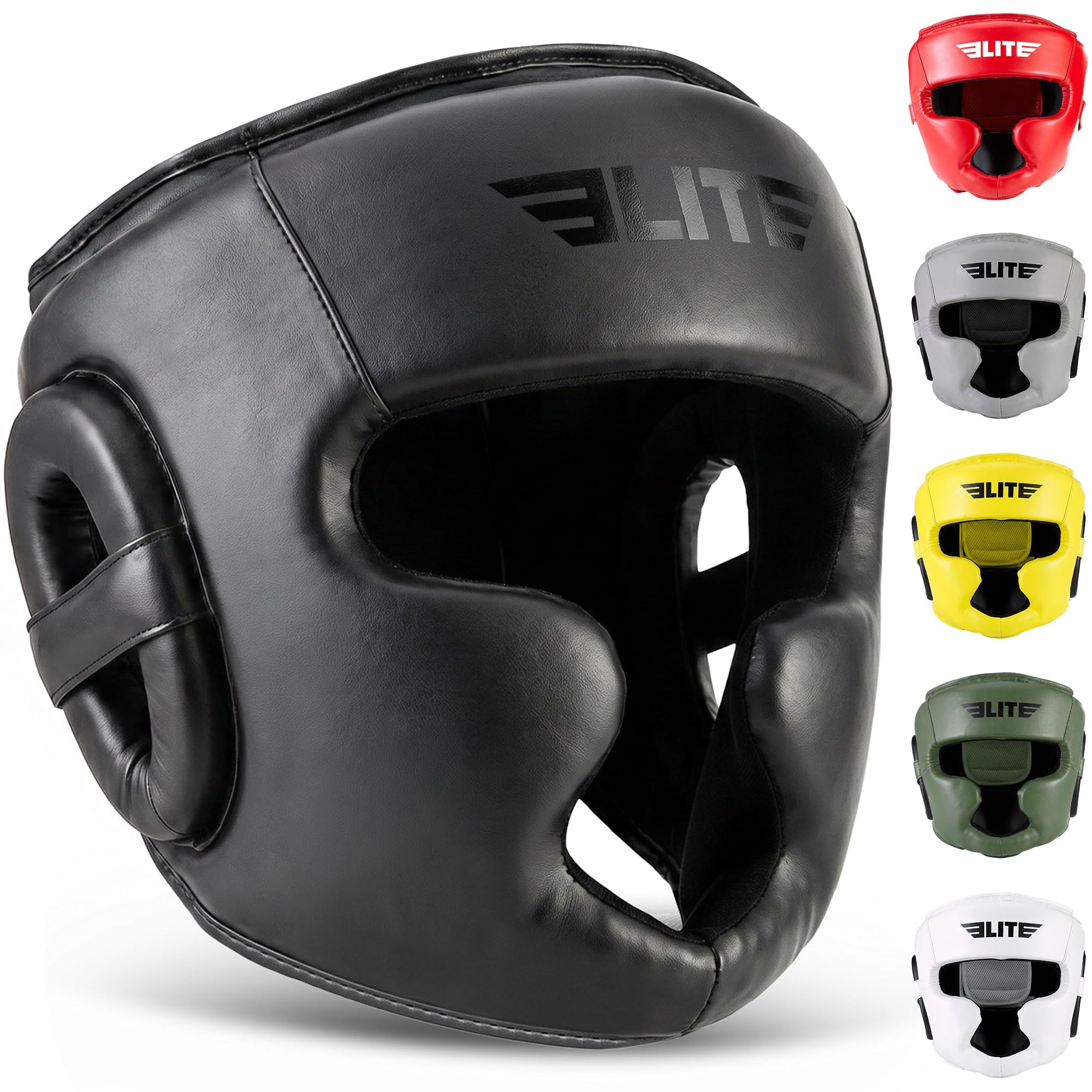
Elite Sports Boxing Head Guard

Elite Sports Boxing Head Guard

Beginner sparring

Our Score 9.2/10
Check Price

Worth Noting

  • One-size shell runs out at the extremes
  • Synthetic shell feels cheaper than leather
Size
One size
Shell
Polyurethane (PU)
Weight
8 oz
Field Of View
180 degrees
Read the full review

A first headgear has a different job from a competition one. It has to fit without a fitting, stay put while you are still learning to move your head, and be light enough that you do not spend the round thinking about it. Elite's guard does all three. The pre-curved shell comes in one size and adjusts at the chin strap, the head cap, and the head height, so it settles in a round or two, and the opening is cut wide enough that you see a hook coming from the side.

At eight ounces it is one of the lightest guards here, and the difference shows up late in a round, when a heavier shell starts pulling your chin down. Once the straps were set, it stayed where we put it through hooks and did not spin, which matters more in a guard with no cheek wrap than in one that laces tight around the jaw.

Two things to know going in. The PU shell is synthetic and feels it next to the leather guards on this list, and the fit range, wide as it is, does have ends — this is the guard that fits most people, not everyone. For a first year of classes or a class headguard you sweat in three times a week, neither is a dealbreaker, and the light shell is what you will notice every session.

Bottom line: The first-guard pick: one shell that adjusts three ways, a wide opening for new sparring partners, and eight ounces you forget about mid-round.

#4

Venum Challenger 2.0 Headgear

Venum Challenger 2.0 Headgear

Vision-first sparring

Our Score 9.2/10
Check Price

Worth Noting

  • One size only, snug on larger heads
  • Thin padding over the crown
Size
One size
Weight
9.88 oz
Closure
Two-way hook-and-loop
Padding
Triple-density foam
Read the full review

The cheek line is the first thing you notice. The Challenger sits low on the jaw and pulls back at the eye, so you get jaw and ear coverage without a wall of foam in the corner of your vision. Working angles in a round, that difference is obvious within a minute.

Triple-density contoured foam under a leather outer, 0.28 kg on the scale, and a flexible two-way hook-and-loop closure that takes one pull to set. Light, but not insubstantial: the foam is shaped rather than flat, so it wraps the jaw instead of sitting on top of it, and the shell did not slide when we caught a clean shot.

Where it lands for us is as the sparring guard for someone who hates wearing headgear. It is the least obstructive full-wrap shell in this group and it holds a fit without a lace-up. Two caveats come with that: it is one size only and runs snug on bigger heads, and the padding over the crown is thin enough that we do not count on it against a downward shot.

Bottom line: The best sightlines of the full-wrap guards: jaw and ear coverage that stops below the eye line and a fit that does not slide.

#5

Contender Competition Headgear without Cheeks

Contender Competition Headgear without Cheeks

Open-face competition

Our Score 9.2/10
Check Price

Worth Noting

  • No cheek or nose coverage
  • Runs tight; consider sizing up
Size
Medium
Design
Open face, no cheeks
Weight
9.44 oz
Approval
USA Boxing approved
Read the full review

Leaving the cheeks off is the entire argument for this guard, and it holds up. The opening runs from temple to temple with nothing in front of your eyes, so you track the whole ring instead of the middle of it. If you have ever felt boxed in by a full-wrap shell, this is the alternative we point to.

It is USA Boxing approved, built on a leather outer with a synthetic lining, and it comes in at 9.44 ounces — the light end for a competition-legal guard. Lace closures at the top and back plus a buckle chin strap let you lock it down, and the cheekless profile keeps the shell off your jaw so you can breathe through a round.

The trade is plain and you accept it going in: no cheek or nose coverage, so a stray shot finds bone. The shell also runs tight, and going up a size is the safer call if you sit between two. We treat it as a competition and hard-sparring guard rather than the thing you hand a beginner.

Bottom line: The open-face choice for competition: full peripheral vision and USA Boxing approval in a guard that leaves your cheeks bare.

#6

Hayabusa T3 Adjustable MMA Headgear

Hayabusa T3 Adjustable MMA Headgear

Compact premium training

Our Score 9.2/10
Check Price

Worth Noting

  • Runs snug across the jaw
  • Trims the far corners of your vision
Size
Medium
Shell
Vylar engineered leather
Weight
6.88 oz
Closure
T-Cross closure
Read the full review

Compact is the pitch, and the numbers back it up: 6.88 ounces, the lightest guard in this group, with mesh over the ears and an open top to dump heat. Put it on next to the leather guards here and it feels like a different category of equipment entirely.

What you pay for is the shell shape and the T-Cross closure, which pulls the guard down and back rather than straight around the skull. That is the part that matters, because a light headgear that spins is worse than a heavy one that does not. This one stayed where we set it.

The premium buys shell and closure rather than more foam. Vylar engineered leather over a polyester lining, cheek protection that reaches the jaw without a hard edge, and mesh ear covers that let heat out. It is the one guard in the group we put on and stopped noticing inside a minute.

So the T3 is for the fighter whose sparring volume makes bulk the deciding factor. If you are in the gym twice a week, the Ringside hands you more protection for less money. If you are in there four times, the lack of bulk is worth paying for, provided your head is not at the top of the Medium.

Bottom line: The least shell on your head: 6.88 ounces, full cheek coverage, and a closure that refuses to shift through a round.

#7

RDX Headgear with Removable Face Grill

RDX Headgear with Removable Face Grill

Grappling and BJJ

Our Score 9.2/10
Check Price

Worth Noting

  • Face bar narrows your peripheral view
Weight
1.1 lb
Padding
Three-layer foam
Face Bar
Removable PVC grill
Warranty
1 year
Read the full review

The removable bar is the reason to look at this one, and also the reason to think twice. Snap it on and a PVC grill sits across the front of your face; take it off and you have a conventional open-face shell with the same shell and padding underneath.

It is built like the rest of the RDX line under the bar: three attenuating foam slabs, the Quick EZ hook-and-loop strap, and 0.5 kg on the scale, the heaviest guard here. The bar itself is a buffer, not a cage. It takes the sting out of a straight line and keeps a forehead or a knuckle out of your eye; it will not save you from a shot you walk onto.

For grappling and BJJ the bar does real work, which is where this guard earns its place. For boxing sparring it is a mixed trade: your peripheral view narrows noticeably, and you are giving up sightlines to protect against contact your own gloves should be preventing. That trade is worth making in a clinch-heavy round and not worth making in a boxing round.

The practical case is one piece of gear for an MMA or clinch class — stand-up and mat work without changing helmets. Warranty runs a year and it comes in Medium. Keep the bar in your bag when you are only boxing; it is a few seconds to swap and the difference in vision is not subtle.

Bottom line: The face-bar guard: a removable PVC grill for grappling and close drills, with a real cost in peripheral vision.

#8

Farabi Sports Grill Headgear

Farabi Sports Grill Headgear

Budget face protection

Our Score 9.2/10
Check Price

Worth Noting

  • Sold in a single Large
  • Synthetic shell rather than leather
Size
Large
Shell
Synthetic leather
Weight
14.1 oz
Face Bar
Removable front bar
Read the full review

Two guards here carry a front bar, and this is the cheaper of them. Where the RDX brings a heavier shell and a year of warranty, Farabi strips the build back to synthetic leather and puts the money into the bar and the padding behind it.

Three layers of padding sit under that synthetic outer, and the quick-release chin strap with hook-and-loop closure is easy to set one-handed. At 400 g it lands in the middle of this group — a good deal lighter than the bar guard from RDX and heavier than the open-face shells.

The bar comes off, which changes the guard's job from round to round: on for clinch and grappling drills, off for straight boxing. Ventilation is better with it off, and that swap is the practical argument for a removable bar rather than a fixed one.

Where we land is that it is the value face-bar guard rather than the best one. If you want a bar for the occasional grappling round and do not want to pay for a leather shell, this is the sensible buy. If the bar will be on for most of your training, the RDX is the better long-term piece.

Bottom line: A cheaper route into face-bar protection, with a synthetic shell and a single size to work with.

#9

MaxxMMA Headgear L/XL

MaxxMMA Headgear L/XL

Budget backup gear

Our Score 9.0/10
Check Price

Worth Noting

  • Chin strap will not tighten for smaller heads
  • Unpadded gaps between panels
Size
L/XL
Shell
PVC
Weight
14.1 oz
Read the full review

This is the cheapest guard in the group, and it looks it — a plain PVC shell over foam with no branding to speak of. What you get for that money is more than the price suggests: a padded crown, chin coverage, and a shell that keeps showing up to class.

At 0.4 kg it is light enough to live in a bag, and the padding covers the crown, the temples, and the chin. In a light round it does what headgear is supposed to do, and for a beginner or a partner drill it is enough.

The fit is the catch. The L/XL shell takes a big head happily, but the chin strap only tightens so far, so a smaller head gets a guard that shifts. A loose fit plus a sweaty forehead can let the shell roll forward over your eyes, which is worth testing in a controlled round before you spar hard in it.

Padding is adequate rather than generous. It softens a jab and it does the job in playful rounds, but there are gaps between the padded panels, and a clean shot that finds one of them lands harder than you expect.

We keep it on the list because a second guard in the gym bag is genuinely useful, and this is the one you can leave in the car without wincing. For hard sparring, spend more: the loose fit and the padding gaps find you in the rounds that matter.

Bottom line: The budget spare: enough padding and chin coverage for light rounds, provided the shell happens to fit your head.

How We Tested Boxing Headgear

We started by narrowing a long list of headgear down by price, available size ranges, and whether replacement parts or different closure styles existed, then cut anything with a history of sizing complaints or shells that only came in one size. That left 12 pieces, tested over six months.

Most of the work happened on Tuesday and Thursday sparring nights, plus Muay Thai clinch sessions and grappling drills where headgear gets dragged across shoulders and mats. We put each one on with bare hands first, then with 16-ounce gloves on, and noted whether the laces or straps landed somewhere we could reach mid-round. Three training partners with different head shapes wore every model, and we counted how many times we had to re-tighten between rounds.

For field of view, a partner threw jabs and hooks while we kept our chin down, and we logged whether we saw each shot or only felt it. Padding got judged in live rounds — where the cheek pads landed on hooks, whether the brow foam pressed on the forehead, and what our faces looked like the next morning. Comfort meant keeping each one on for a full 45-minute session, including the rest between rounds, and watching for heat buildup, ear pinch, and linings that stayed damp. Value came down to stitching, lining wear, and whether closures still held tension after months of use.

How to Choose Boxing Headgear

Coverage and Field of View

Every extra inch of coverage takes something out of your sightlines, and that trade is the real decision. Extended cheek guards like the Ringside's reach forward over the cheekbone and cost you the low corners of your vision. A front bar costs more still. Open-face guards such as the Contender show you the whole ring and leave your cheeks bare.

The trap is assuming more coverage is automatically safer. A bar or a tall cheek pad that hides a hook coming from the side has its own cost, so pick the exposure that matches your training instead of the maximum available. A sanctioned bout and a Tuesday sparring round are different questions.

Fit, Sizing, and Closures

Hook-and-loop straps and a buckle let you adjust a guard yourself in seconds, which is why most gym headgear uses them. Laces hold a fit more securely but want two hands and a mirror. One-size shells adjust a long way and still run out at the extremes, so measure your head above the ears and compare that number to the size chart before ordering.

We put fit ahead of padding thickness, because a loose shell slides. The chin strap is where a good fit quietly fails: set it snug enough that you cannot roll the shell back off your forehead, then check it again after the first round, since sweat loosens hook-and-loop.

Padding, Shell, and Ventilation

Layered foam — three densities in the RDX guards, the Venum shells, and the Farabi — spreads a shot across a wider area than a single slab, and it is the front of the head and the temples where you notice the difference. Leather outsides outlast synthetic ones; PVC and PU shells cost less and feel it.

Weight in this group runs widely. The lightest guard here is under seven ounces and the heaviest is more than double that, and the heavy ones are heavy because of foam or a face bar. An open top and mesh ears dump heat on a crowded gym floor, at the cost of some crown coverage.

Competition Approval and Gym Reality

USA Boxing approval matters when you are entering a sanctioned amateur bout, and both the Ringside and the Contender carry it. For gym sparring, approval buys you nothing — coverage, fit, and staying put are what keep you in the round.

The trap is buying competition gear for a first year of training. Those guards are built light and legal rather than forgiving, and you feel the missing cheek pads the first time someone wings a hook. Check with your coach or the event's equipment rules before a bout, since approval is granted per sanctioning body.

Frequently Asked Questions

Final Verdict

For most adults sparring a few times a week, the RDX pull-over earns the recommendation: closed coverage over the ears and temples, three layers of foam, and a strap system you fit once and then forget about.

Change the requirement and the answer changes. Competing in an amateur bout makes the Ringside's USA Boxing approval the deciding line. Buying a first guard makes the Elite Sports the friendlier fit and the friendlier price. And if you grapple, RDX's grill model does a job none of the open-face guards here can.