Accessories

Best Agility Ladder of 2026

An agility ladder looks like the simplest gear in the world—until you're on a windy field trying to coil it back into its bag while everyone waits. The good ones disappear into a backpack, stay flat underfoot, and turn a driveway or patch of grass into a quick footwork session. The bad ones tangle, slide, and make you regret bothering. A decent ladder removes the friction between wanting to train and actually doing it: kids get a game, athletes get a warmup, and everyone else gets a portable way to sharpen coordination.

I've used ladders for youth soccer warmups and basement workouts, and my team has put 14 of them through five months of driveway sprints, park sessions, gym floors, and backyard drills with kids who mostly wanted to race. The ones that stayed put and folded without a fight got used constantly; the rest got stuffed in a closet. Portability and stability matter as much as rung quality—a ladder only works as a training tool if it's easy to bother with. The picks below earned a spot by the door.

#1

SKLZ Quick Ladder

Top Pick
SKLZ Quick Ladder

Small spaces

Our Score 9.6/10
Check Price

Worth Noting

  • No ground anchors included
  • Rungs drift out of position on slick floors
Rungs
11
Length
15 ft
Weight
9.88 oz
Rung Width
17 in
Read the full review

Fifteen feet and eleven rungs is the whole argument for this one. If your drill space is a spare room, a narrow driveway or half a garage, a 20-foot ladder is a nuisance, and you spend the first five minutes folding the ends or angling it across the lawn. The Quick Ladder fits, and at 0.28 kg it is light enough to hang on a hook between sessions and forget about.

The 17-inch rungs are wide enough for adult feet, and the carry bag packs the whole thing down to roughly the size of a rolled mat. One thing to check when it arrives: run a finger along each strap where it passes through a rung, because a strap sewn with a twist pulls the ladder into a gentle curve you feel in every drill. Straighten the straps before the first session and it lies flat.

The shorter length costs more in variety than in quality. Eleven rungs means fewer steps per pass, so you turn around sooner and get less continuous work at speed, and that is the trade for a ladder you will actually leave out in a small space. As a first ladder in an apartment, or for a kid practising in the hallway, we rate it above anything else here that demands 20 feet of clear floor.

Bottom line: The ladder for a spare room or short driveway: 15 feet, 11 wide rungs and a bag, light enough that setting it up stops being a decision.

#2

MANTRA SPORTS Agility Ladder Set

MANTRA SPORTS Agility Ladder Set

All-round home drills

Our Score 9.4/10
Check Price

Worth Noting

  • Cones bend and sit unevenly on rough ground
Rungs
12
Included
Cones and carry bag
Ladder Width
16.81 in
Ladder Length
19.6 ft
Read the full review

Twelve rungs spread across 19.6 feet, every one of them sliding on the straps, is the short version of why this is our top pick. Widening the spacing for a beginner learning the pattern and tightening it for cadence work takes a minute, and the 16.81-inch width leaves room to land a foot without clipping a rail. Add a set of cones, a carry bag and a lifetime warranty and you have a kit that runs a whole session without a second order.

In use, what struck us is how little ceremony there is: unroll, even out the rungs, go. The adjustable rungs need straightening the first time out of the bag and a glance after every pack-down, but the spacing holds where you tension it. At 1.17 kg packed it goes under a stroller or across a back seat without a second thought, and 19.6 feet is long enough to set three different patterns without moving the ladder.

Where it gives ground is the extras. The cones are the flimsiest thing in the box, thin enough to bend and reluctant to lie flat on rough grass, so treat them as markers rather than obstacles to hurdle. The ladder, straps and bag are what you are paying for, and on that count this is the safest recommendation here for a household that wants one piece of kit for warm-ups, footwork and conditioning.

Bottom line: Our default recommendation: adjustable rungs across a full 19.6 feet with cones and a bag in the box, so a complete footwork session starts the day it arrives.

#3

POWER GUIDANCE Agility Ladder

POWER GUIDANCE Agility Ladder

Grass and wind

Our Score 9.4/10
Check Price

Worth Noting

  • Pegs only bite in soft ground
Rungs
12 adjustable
Length
20 ft
Included
4 pegs, 10 cones, carry bag
Packed Weight
2.07 lb
Read the full review

Four metal pegs go through D-rings at each end, and the ladder stops moving. That is the pitch, and it is why this 20-footer is the one we set up on grass. Twelve adjustable rungs, ten cones and a carry bag cover a standard speed session, and the rungs are heavy enough that they do not skate underfoot between reps.

Adjustment works the way it should: loosen the strap, slide the rung, re-tension, and the spacing holds through a session. The ten cones are enough to mark a change-of-direction gate at the end of the ladder without borrowing kit from anyone, and at 0.94 kg packed it lives in the car between practices without complaint.

Outdoors, on grass soft enough to take a peg, this is the most planted ladder in this group. We stopped resetting the ends after the first pass, which is not something the strap ladders managed on the same ground. It is also the closest thing here to a full-size drill ladder you can carry under one arm.

Bottom line: The outdoor pick: 20 feet, 12 adjustable rungs, ten cones and four pegs that keep the ends exactly where you put them on grass.

#4

ALPHAWORX Agility Ladder

ALPHAWORX Agility Ladder

Fast setup

Our Score 9.2/10
Check Price

Worth Noting

  • Only eight rungs
  • Fold takes practice and rough handling bends it
Frame
Spring steel and polypropylene
Rungs
8
Weight
13.4 oz
Packed Size
14.8 x 13.35 x 2.64 inches
Read the full review

There are no straps to sort out and no rungs to even up: this ladder is a semi-rigid frame of spring steel and polypropylene that unfolds when you flick it and lands square. Packed, it is a 14.8 x 13.35 x 2.64 inches bundle weighing 0.38 kg, smaller than most of the carry bags here.

We came to it expecting a gimmick and left wanting a second one for the car. The moment that matters is at the end of a session, in the rain, in a hurry: you fold it away, and it is away. Eight rungs is fewer than the 12-rung ladders here, so you get fewer steps per pass, but the frame also lets you lift individual sections into low hurdles, which turns one piece of equipment into two or three drills.

The hook-and-loop joins are the thing to watch: the ladder is only as straight as your last join, so check each tab before a timed set. Otherwise this is the ladder for a home athlete who sets up and packs away every single session, because a setup that takes seconds is the difference between drilling and skipping it.

Bottom line: For anyone who drills alone and packs up every time, the shake-out setup is worth more than four extra rungs, so long as you expect to practise the fold.

#5

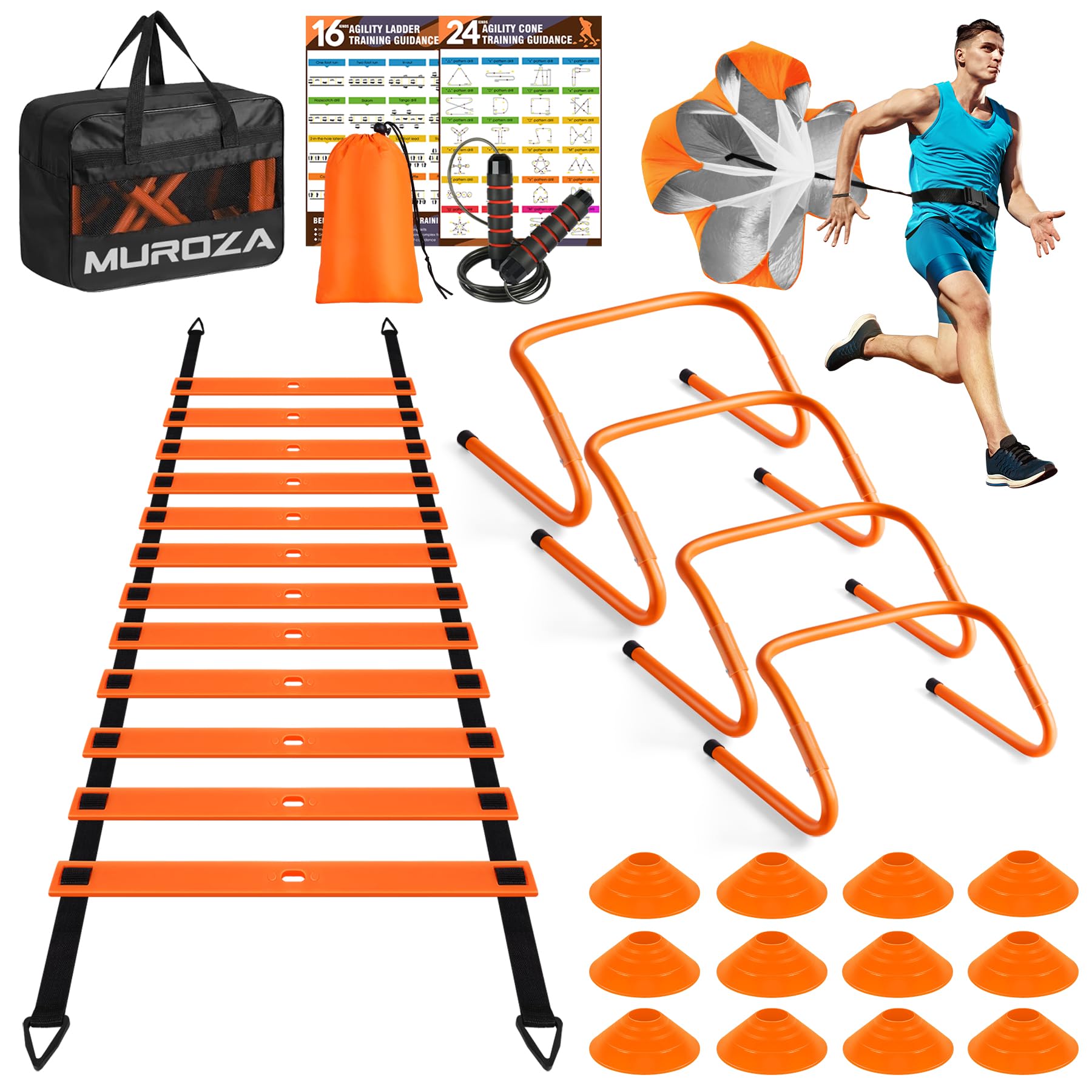
MUROZA Agility Training Set

MUROZA Agility Training Set

Coaches and families

Our Score 9.2/10
Check Price

Worth Noting

  • Parachute is the flimsiest piece in the bag
  • Six pounds to carry to the field
Ladder
20 ft long, 16.7 in wide
Weight
6 lb
Hurdles
4 adjustable, 8.5–12 in
Included
12 disc cones, parachute, jump rope
Read the full review

The box holds a 20-foot ladder with four stakes, four adjustable hurdles that set between 8.5 and 12 inches, 12 disc cones, a running parachute, an 8.5-foot jump rope, a carry bag and training guides. That is a circuit rather than a ladder, and it is the reason one purchase replaces three.

The ladder is the fixed-rung kind: the rungs hold their position on the straps instead of sliding, which is the right call for a set like this. Nothing drifts out of line mid-session and nothing needs evening up when you unpack. You give up widening the spacing for a beginner, but when you are setting a course for a group, identical spacing every time is worth more than flexibility.

For a coach, a PE teacher or a parent running a session for a group of kids, this is the pick that saves two extra purchases, because the hurdles and the cones do work the ladder cannot do alone and the guide gives you patterns to run on day one. It turns a five-minute warm-up into a full session, and that is what the premium buys you.

Bottom line: Buy this when the ladder is only part of what you need: a 20-footer plus hurdles, cones, parachute and rope, all in one bag.

#6

GHB Pro Agility Ladder

GHB Pro Agility Ladder

Budget buyers

Our Score 9.0/10
Check Price

Worth Noting

  • Tangles easily when packed away
Rungs
12
Length
20 ft
Weight
4.8 oz
Rung Spacing
Adjustable to 15 in
Read the full review

This is the least expensive full-size ladder here, and it is a proper 20-footer: 12 rungs, each 16.5 inches wide, spacing you can stretch to 15 inches, a carry bag, a drill guide and a lifetime manufacturer warranty.

The build is what the price suggests, with plastic rungs on flat nylon straps and 4.8 ounces in the hand, but it does what the others do: rungs on the ground at intervals you choose, and a bag to put them back in. If you are equipping four kids or a small club, four of these cost less than two of almost anything else on this page.

Adjustment is where patience is needed. The rungs slide along the straps with nothing to click them into place, so after a hard plant, straighten and re-tension before the next set. On the plus side, the spacing goes out to 15 inches, wider than most here, which is genuinely useful for teaching the pattern before you narrow it.

As a first ladder, a school club's budget buy or a fifth ladder for a group, it earns its place, and the lifetime warranty takes some of the risk out of the low outlay. The trade is refinement rather than function: the straps are basic and the bag is thin.

Bottom line: The cheapest way into a full-size ladder: 20 feet, 12 rungs and a bag, with basic straps and more untangling than the picks above.

#7

Teenitor Agility Ladder

Teenitor Agility Ladder

Long drill runs

Our Score 0.0/10
Check Price

Worth Noting

  • Tangles when packed away
  • Rungs lift if a foot clips one
Rungs
13
Length
23 ft
Carry Bag
Included
Packed Weight
15.5 oz
Read the full review

Twenty-three feet is a long ladder. Thirteen rungs stretched across that span makes this the only one here that lets you run a full pattern without turning around halfway, and packed it is 0.44 kg in a bag that fits behind a car seat.

We used it for continuous footwork, the in-in-out and lateral repeats where the point is rhythm rather than a single sharp rep, and the extra three feet over a 20-foot ladder is what makes those sets feel like conditioning instead of a drill you reset every 20 seconds. For a coach running a station, or two kids taking turns, that length earns its keep. For a backyard with 15 feet of clear grass, it is simply too much ladder.

The trade is space: 23 feet needs a clear run most suburban yards cannot offer, and if your longest stretch is a driveway, the 20-foot MANTRA is the better buy. What the length gives back is variety at speed, with enough room for a long straight pattern and a wide lateral one in the same set without moving the bag.

Bottom line: The coach's length: 23 feet and 13 rungs for long continuous patterns, provided you have the clear run to use it.

How We Tested the Best Agility Ladders

We started with a shortlist of ladders sold in sporting goods stores and online, filtering for adjustable rung spacing, flat straps, carry bags, and prices that made sense for a piece of gear you'd throw in a trunk. We eliminated anything with plastic rungs that flexed underfoot or straps that felt slick, then ordered 14 models to test for five months.

Testing happened where ladders actually get used: a driveway, a park field, a gym floor, and a backyard. We ran straight-ahead and lateral drills, timed solo setup and teardown, and checked whether rungs stayed put when we pushed sideways mid-stride. After each session, we folded and stuffed each ladder into its bag, then shook it out the next day to see if it tangled. We also left a few in a hot car and dragged them over grass and concrete to watch for stretched straps, cracked rungs, and bent anchors.

To judge portability, we carried each one in a backpack and a car trunk, noting whether it fit without snagging. We used the ladders with adults, teenagers, and kids, running the same basic footwork patterns and a few made-up relay races to see which ones people actually wanted to keep using. Quality and value came down to the details: rung thickness, strap stitching, anchor weight, and whether the bag survived repeated packing. The ladders that scored best were the ones that set up fast, stayed flat, and folded without a fight—the kind you'd grab for a quick session rather than leave in the garage.

How to Choose the Right Agility Ladder

Match the length to your clear run

For most people the ladder's length is decided by the space, not the drills. Measure your longest clear stretch and subtract a stride at each end, because you step in before the first rung and out past the last. Fifteen feet is the sensible choice for a spare room, a garage or a short driveway, which is where the SKLZ earns its place. Twenty feet is the backyard standard and covers most of this group. Twenty-three feet, like the Teenitor, is coach territory: in a small yard the extra length just means folding the ends.

Adjustable rungs versus fixed ones

An adjustable ladder lets you widen the spacing to teach a beginner the pattern and tighten it for cadence work later, and most of the ladders here work that way. The cost is that the rungs ride on the straps: they need evening out after unpacking and a glance after a hard plant. Fixed-rung designs such as the MUROZA give up the spacing changes and, in return, never drift mid-session. We lean adjustable for one household and fixed for a group, where identical spacing for every athlete matters more than flexibility.

The surface decides your stability plan

On grass, four pegs through D-rings are the difference between a ladder that stays and one you chase, which is why the POWER GUIDANCE is our outdoor pick. The trap is buying pegs for an indoor setup: on a gym floor or carpet they are dead weight, and rung weight and strap tension are all that hold the ladder in place. If you drill on both, buy for the surface you use most and accept the other as a compromise.

Tangling is the daily cost

Every strap ladder here tangles; the question is how much of your session you spend fixing it. Coil the ladder loosely and strap it before it goes in the bag rather than stuffing it, and unroll from one end so the rungs feed out in order. If you know that minute of untangling will stop you training, the semi-rigid ALPHAWORX sidesteps the problem entirely: it unfolds from a flat bundle and never has a strap to sort out.

What is in the box, and what it weighs

Cones, hurdles, a parachute and a jump rope turn one ladder into a full circuit, and for a coach or a parent running a group session that is worth real money — the MUROZA covers all of it in one bag. The trade is weight and bulk, since a six-pound kit is a different proposition from the 4.8-ounce GHB. Buy the bundle when the other tools will actually be used; if you only need footwork, a bare ladder plus a few markers is lighter and easier to keep with you.

Frequently Asked Questions

Final Verdict

The MANTRA SPORTS set is the ladder we point most people to: adjustable rungs across a full 19.6 feet, cones and a bag in the box, and a lifetime warranty behind it. If you drill on grass, the POWER GUIDANCE's four pegs are worth the step up in outlay; if you pack up in the rain and hate untangling, the ALPHAWORX is the one to take instead.